


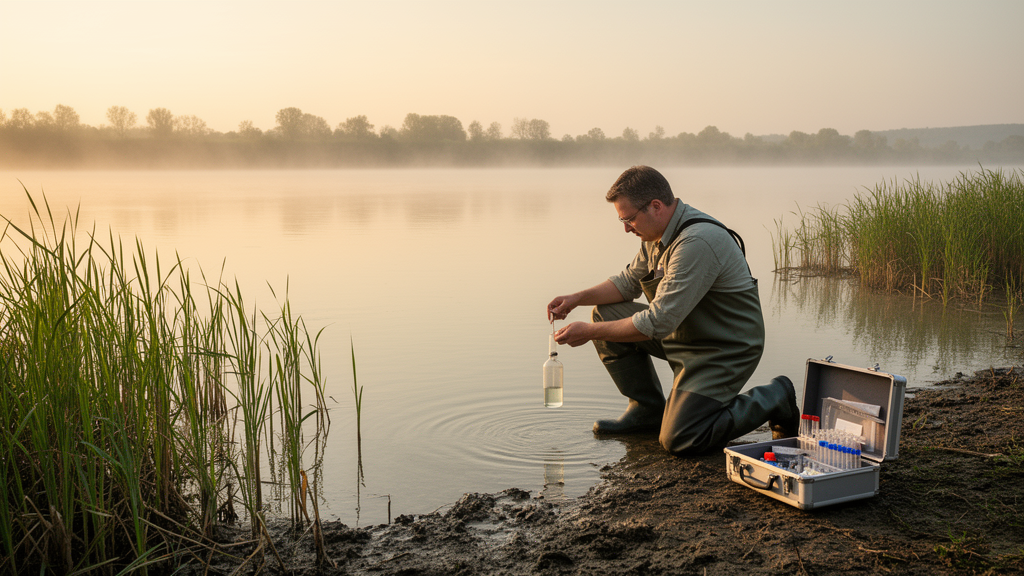
The Danube River, Europe’s second-longest waterway after the Volga, drains an extraordinary 801,463 square kilometers across nineteen countries and touches more than 80 million people. A new review published in the Scientific Annals of the Danube Delta Institute has synthesized nearly three decades of scientific evidence—spanning 1995 to 2023—to assess how pesticide residues have evolved in the surface waters of this vast basin. The findings paint a sobering picture of persistent chemical contamination that continues to threaten water quality, biodiversity, and human health across one of the world’s most international river systems.
The study, led by researchers examining the long-term dynamics of pesticide pollution, systematically searched major academic databases including Google Scholar, ScienceDirect, and MDPI. From an initial pool of 1,590,393 scientific articles, the team selected 54 key publications for detailed analysis, most published between 2001 and 2024. The researchers also compared pesticide sales data from countries within the Danube River Basin against agricultural production figures for the period 2014–2022, drawing on Eurostat and European Commission datasets to understand the relationship between chemical use and farming intensity.
Pesticides encompass a diverse array of chemical compounds—algicides, antimicrobials, disinfectants, herbicides, insecticides, molluscicides, pheromones, rodenticides, and biopesticides—each designed to control specific pests that threaten crop production and storage. Their evolution over the past century has been remarkable: copper and iron sulphates dominated the early 1900s, followed by organomercuric compounds, organochlorine insecticides, and organophosphorus insecticides in the 1940s–1950s. By 1980–1990, most of the chemical compounds still in use today had already been synthesised, reflecting an industry that continuously develops increasingly complex molecules with enhanced phytosanitary efficacy.
The environmental pathways through which pesticides reach aquatic systems are varied and well-documented. Contamination can result from spraying, volatilisation, surface runoff, and subsurface loss through leaching. Persistence in the environment depends on susceptibility to microbial and enzymatic degradation, soil temperature, and water content. Soil organic matter, colloidal particles, and clay minerals play crucial roles in sorption, while high temperatures can cause soil desiccation and erosion, mobilising adsorbed particles and transferring them into aquatic systems. Alarmingly, over 90% of pesticides applied never reach their target species, meaning the vast majority of these chemicals end up contaminating food and water instead.
The review identified five key compounds for detailed long-term analysis based on their frequency of detection in Danube surface waters: atrazine, 2,4-D (2,4-dichlorophenoxyacetic acid), diuron, and metolachlor—all herbicides—along with dimethoate, a commonly used insecticide. Ten benchmark studies targeting these compounds in surface water revealed concentration ranges of 0.6 to 55.6 ng/L for atrazine, 0.2 to 25.6 ng/L for 2,4-D, 0.1 to 20.8 ng/L for diuron, 1 to 6 ng/L for dimethoate, and 0.5 to 163 ng/L for metolachlor. Metolachlor stood out with a high average concentration of up to 50 ng/L, suggesting more frequent agricultural use, higher water solubility, or a slower degradation process compared to dimethoate, which averaged below 10 ng/L.
Beyond these five benchmark compounds, the broader literature revealed a much wider chemical footprint. Among the compounds identified across the Danube River Basin were acetochlor (28–40 ng/L), atrazine (<3–392 ng/L), bentazone (9.1–65 ng/L), carbendazim (3–755 ng/L), carbaryl (<55.8–1353 ng/L), diuron (<10.9–1197 ng/L), dimethenamid (<0.84–1189 ng/L), imidacloprid (14.6–107 ng/L), simazine (70–2010 ng/L), and terbuthylazine (41.4–200 ng/L), among many others. Metolachlor was the most consistently detected compound, with a maximum concentration of 4,612 ng/L recorded at sampling points in Ukraine and the Republic of Moldova. The concentration of atrazine determined in Serbia in 2015—392 ng/L—was nearly 40 times higher than levels reported in Moldova during 2011–2012 (5.1–9.5 ng/L), highlighting stark spatial disparities in contamination across the basin.
The analysis of pesticide sales data revealed that Italy, Germany, and Poland recorded the highest quantities of pesticide use during 2014–2022. Germany’s amounts correlated with its intensive, mechanised agricultural sector, which accounted for 28% of total agricultural production among the countries considered. Interestingly, although Italy registered the largest quantities of pesticides sold, it had the lowest agricultural production among the countries examined, suggesting less efficient chemical-to-output ratios. The ratio between pesticide use and agricultural production is directly influenced by crop types, the number of treatments required, and the technologies deployed in each country.
Human exposure to pesticide residues occurs through ingestion of contaminated food or water, inhalation, and dermal absorption. The type and severity of adverse health effects depend on the chemical category, dose, duration of exposure, and route of entry. Even when applied at recommended doses, pesticides may still adversely affect the neurological, respiratory, reproductive, nervous, and hormonal systems. Compounding the problem, prolonged and intensive use drives pest resistance, requiring higher doses or alternative chemicals that further amplify environmental and human health impacts. Adjuvants in pesticide formulations can also alter the persistence or degradation rate of active substances, adding another layer of complexity to risk assessment.
At the European regulatory level, the EU Water Framework Directive, Groundwater Directive, and Drinking Water Directive establish maximum concentrations of 100 ng/L for individual pesticides and their metabolites, and 500 ng/L for total pesticides in water samples. Several compounds detected in the Danube Basin—including simazine at up to 2,010 ng/L, metolachlor at up to 4,612 ng/L, and diuron at up to 1,197 ng/L—exceed these thresholds by significant margins at certain sampling points. The FOOTPRINT PPDB database, developed by the University of Hertfordshire, covers approximately 2,300 active pesticide ingredients and over 700 metabolites, providing essential physicochemical, toxicological, and ecotoxicological data for regulatory decision-making.
The review underscores that continuous monitoring of pesticide residues remains essential for determining the quality of Danube water and protecting regional biodiversity. Sustainable agricultural practices—including annual crop rotation, biological control measures, and precise chemical application—are increasingly being adopted across the basin to reduce pesticide consumption. Organic farming covered 9.9% of the EU’s utilised agricultural area in 2021, and the number of approved non-chemical and low-risk active substances has grown from fewer than 60 in 2009 to almost 120 in 2019. Yet the persistence of legacy compounds and the ongoing detection of concentrations well above regulatory limits demonstrate that the Danube River Basin remains highly vulnerable to pesticide pollution, demanding sustained vigilance, improved training for farmers, and continued investment in evidence-based water protection policies across all nineteen countries that share this remarkable river.
Subject of Research: Long-term trends of pesticide residues in the Danube River Basin surface waters (1995–2023)
Article Title: Review: long-term trends of pesticide residues in the Danube River Basin
Article References: Matei, N., Seceleanu-Odor, D., Burada, A., Gheorghe, P.-B., Tiganus, M., Suliman, I., Ibram, O., & Despina, C. (2025). Review: long-term trends of pesticide residues in the Danube River Basin. Scientific Annals of the Danube Delta Institute, 30, 1-16. https://doi.org/10.3897/saddi.30.160456
Image Credits: AI Generated
Keywords: Danube River, pesticide residues, water pollution, herbicides, metolachlor, atrazine, agriculture, biodiversity, EU Water Framework Directive, environmental monitoring, river basin, human health
Cite Scienmag News
Violet Maxwell. (October 16, 2026). Pesticide Residues in the Danube River Basin: Three Decades of Data Reveal Persistent Contamination. Scienmag. https://scienmag.com/pesticide-residues-in-the-danube-river-basin-three-decades-of-data-reveal-persistent-contamination/
Violet Maxwell. "Pesticide Residues in the Danube River Basin: Three Decades of Data Reveal Persistent Contamination." Scienmag, 16 October 2026, https://scienmag.com/pesticide-residues-in-the-danube-river-basin-three-decades-of-data-reveal-persistent-contamination/. Accessed 16 October 2026.
Violet Maxwell. "Pesticide Residues in the Danube River Basin: Three Decades of Data Reveal Persistent Contamination." Scienmag. October 16, 2026. https://scienmag.com/pesticide-residues-in-the-danube-river-basin-three-decades-of-data-reveal-persistent-contamination/


