


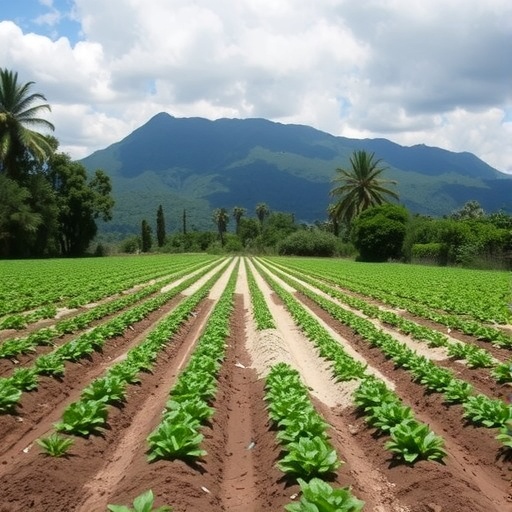
In the tropical farmlands of northwestern Mexico, the soil is revealing a chemical history that refuses to stay buried. A new survey around Santiago Ixcuintla, one of the country’s most productive agricultural regions, has detected residues from 26 pesticide active ingredients across a roughly 30,000-hectare landscape bordering coastal wetlands. The findings, published in Archives of Environmental Contamination and Toxicology, show that agricultural soils can act not merely as passive recipients of farm chemicals but as long-term contaminant reservoirs capable of releasing residues into water, dust, crops and wildlife habitats. Concentrations varied dramatically from one location to another, ranging from 10.3 to 1,491 nanograms per gram of soil. At three sampling sites, the combined pesticide burden exceeded the European Union’s reference soil limit of 0.1 milligrams per kilogram, equivalent to 100 nanograms per gram. The study provides one of the clearest snapshots yet of how intensive agriculture, persistent chemicals and vulnerable tropical wetlands can intersect in a single landscape.
The research team, led by Francisco Alberto Verdín-Betancourt and colleagues at Mexican environmental and agricultural institutions, focused on an area in the municipality of Santiago Ixcuintla in the state of Nayarit. The region supports intensive cultivation while also lying near a network of coastal wetlands, waterways and low-lying areas that can receive runoff during seasonal rains. Forty-eight composite soil samples were collected throughout a preselected polygon. Rather than choosing sites randomly, the researchers used remote sensing and geographic information systems to identify agricultural zones and landscape features likely to influence contamination. Satellite-derived information and geographic mapping can reveal field boundaries, vegetation patterns, drainage routes and areas of active cultivation, allowing environmental sampling to target the places where pesticide movement is most plausible. This approach is particularly important in tropical agricultural regions, where heavy rainfall, irrigation and rapid changes in land use can redistribute chemicals over short distances.
To identify the residues, the scientists used a modified version of the QuEChERS extraction method. QuEChERS—short for “quick, easy, cheap, effective, rugged and safe”—is widely used to isolate pesticide compounds from complex materials such as food and soil. In a typical extraction, chemicals are pulled from a soil matrix using an organic solvent, while salts and cleanup materials help separate the compounds of interest from water, minerals and organic matter. The extracts were then analyzed with two complementary forms of mass spectrometry: ultra-performance liquid chromatography coupled to tandem mass spectrometry, or UPLC-MS/MS, and gas chromatography paired with triple-quadrupole or ion-trap mass spectrometry. Liquid chromatography is suited to many compounds that are polar, thermally unstable or difficult to vaporize, whereas gas chromatography is powerful for volatile and semi-volatile chemicals. Tandem mass spectrometry identifies molecules by their characteristic fragmentation patterns and can quantify them at extremely low concentrations. Together, the methods allowed the team to validate a panel of 73 pesticides and related active ingredients.
The screen detected 26 compounds, representing 31.5 percent of the validated pesticide panel. Nineteen were insecticides, six were fungicides and one was a herbicide. The most widespread residue was p,p′-DDE, detected in 97.9 percent of samples. DDE is a persistent breakdown product of DDT, the once ubiquitous insecticide whose environmental legacy has endured decades after restrictions and bans in many countries. Its near-ubiquitous presence indicates that historical applications can remain chemically visible in soil long after the original compound has degraded. Chlorpyrifos, an organophosphate insecticide, was found in 87.0 percent of samples. Unlike DDE, chlorpyrifos is associated primarily with more recent agricultural use, although its persistence depends strongly on soil chemistry, climate, microbial activity and how tightly it binds to soil particles. The coexistence of an old DDT derivative and a widely used modern insecticide illustrates how agricultural soils can contain overlapping chemical layers from different eras of pest control.
The total concentration of pesticides, expressed as ΣPesticides, showed a highly uneven pattern. Some sites contained only modest quantities, while others accumulated much larger mixtures. The highest burdens occurred at sampling locations 27, 36 and 43, where total concentrations surpassed the European Union’s cited soil limit. These values should not be interpreted as a direct measurement of human poisoning or an immediate prediction of ecological damage: soil standards vary by jurisdiction and are designed for specific regulatory purposes, while toxicity depends on individual compounds, exposure routes and the sensitivity of organisms present. But the elevated measurements identify locations that merit closer investigation. A combined concentration of 1,491 nanograms per gram is numerically small compared with many industrial pollutants, yet pesticide potency can occur at low doses, and mixtures may affect organisms through different biological pathways. The researchers’ central concern is therefore not simply the amount of chemical present, but its persistence, mobility and repeated delivery into connected ecosystems.
The spatial pattern is especially significant because contamination was not distributed uniformly across the agricultural polygon. Elevated concentrations were associated with actively cultivated areas and with pathways leading toward coastal wetlands. During rainfall or irrigation, water can detach fine soil particles and transport chemicals adsorbed to them across field margins, drainage channels and flood-prone ground. Pesticides may also dissolve in the water itself, depending on properties such as solubility and the compound’s tendency to partition between soil organic matter and water. A chemical’s octanol–water partition coefficient, commonly written as Kₒw, provides one indication of whether it preferentially associates with organic phases and sediments rather than remaining in water. Soil texture, organic-carbon content, pH, temperature and microbial communities further influence adsorption, desorption and degradation. Once deposited in a wetland, residues can be redistributed by flooding, sediment movement and changing water levels, potentially exposing aquatic plants, invertebrates, fish and birds.
The study’s emphasis on chlorinated and aromatic compounds raises particular concern about environmental persistence and bioaccumulation. Molecules containing chlorine atoms often resist biological and chemical breakdown, while hydrophobic compounds can accumulate in organic-rich sediments and in the tissues of organisms that ingest contaminated particles or prey. As chemicals move through food webs, concentrations may increase in predators, although the extent of biomagnification depends on the compound’s structure, metabolism and ecological pathway. DDE, for example, is notorious for its longevity and ability to persist in fatty tissues. Chlorpyrifos behaves differently, but it can bind to soil and sediment and may affect organisms beyond the pest species it is intended to control. Soil microbes are also part of the risk picture. Bacteria and fungi regulate nutrient cycling, decompose organic matter and help maintain soil fertility; pesticide residues can alter microbial communities, potentially changing the biological processes on which productive agriculture depends.
The findings do not establish that the detected residues have already damaged human health, reduced crop safety or caused measurable losses of wetland biodiversity. The researchers did not report exposure studies in residents, pesticide concentrations in food, or toxic effects in field organisms as part of this soil survey. Nor can a one-time collection fully describe seasonal variation. Tropical soils may show different contaminant patterns during dry periods and after intense rainfall, and residue levels can change as compounds degrade, bind to deeper layers or arrive in new applications. The study nevertheless adds to a growing body of evidence that pesticide monitoring cannot stop at farm products or surface water. Soil is a dynamic environmental compartment: it can store chemicals between applications and later release them through wind-driven dust, erosion, runoff or contact with groundwater. Because the sampling sites were distributed across a large and heterogeneous area, the results also show why averages alone can conceal localized hotspots.
The authors argue that improved knowledge of pesticide degradation and transport is essential for managing tropical agricultural soils, particularly where cropland meets wetlands. Future monitoring could combine repeated seasonal sampling with measurements of soil organic carbon, moisture, texture, pH and microbial activity to determine why some sites retain more residues than others. Testing sediments, drainage water, wetland organisms and locally grown crops would help establish whether the chemicals are moving beyond soil and entering biological food webs. The results also point toward practical risk-reduction strategies, including more precise application, vegetated buffer zones, erosion control and integrated pest management that reduces reliance on persistent compounds. For Santiago Ixcuintla, the message is stark but actionable: the most productive fields can also become hidden chemical archives. Protecting the wetlands downstream will require treating the soil itself as part of the watershed—and as a living system whose contamination may outlast the season in which a pesticide was applied.
Cite Scienmag News
Sloane Callahan. (August 27, 2026). Pesticide Residues Found Across Tropical Agricultural Soils in Northwestern Mexico. Scienmag. https://scienmag.com/pesticide-residues-found-across-tropical-agricultural-soils-in-northwestern-mexico/
Sloane Callahan. "Pesticide Residues Found Across Tropical Agricultural Soils in Northwestern Mexico." Scienmag, 27 August 2026, https://scienmag.com/pesticide-residues-found-across-tropical-agricultural-soils-in-northwestern-mexico/. Accessed 3 September 2026.
Sloane Callahan. "Pesticide Residues Found Across Tropical Agricultural Soils in Northwestern Mexico." Scienmag. August 27, 2026. https://scienmag.com/pesticide-residues-found-across-tropical-agricultural-soils-in-northwestern-mexico/


