

Sunday, November 22, 2026
Science
No Result
View All Result
  • Login
  • HOME
  • SCIENCE NEWS
  • CONTACT US
  • HOME
  • SCIENCE NEWS
  • CONTACT US
No Result
View All Result
Scienmag
No Result
View All Result
Home Science News Technology and Engineering

Peruvian canopy traits linked to bird vulnerability, study finds

October 25, 2026
in Technology and Engineering
Margaret Porter
By Margaret Porter Scienmag Editorial Profile - Biodiversity Science
Reading Time: 2 mins read
0
Peruvian canopy traits linked to bird vulnerability, study finds

Peruvian canopy traits linked to bird vulnerability, study finds

65
SHARES
587
VIEWS
Share on FacebookShare on Twitter
ADVERTISEMENT

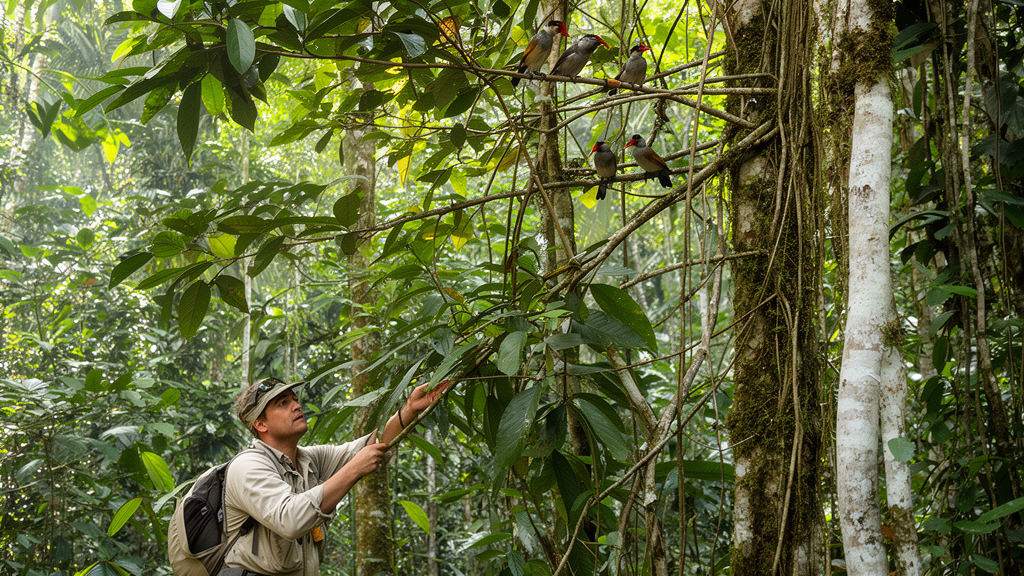
Airborne measurements of the chemical and structural differences among tropical forest canopies were associated with the traits and potential vulnerabilities of 1,331 forest-dependent bird species in Peru. The study classified forests into six broad canopy types and compared their distributions with the geographic ranges and ecological characteristics of the birds. Birds associated with different forest environments differed in body size, longevity, reproductive strategy, feeding location and relationships with human threats, showing that canopy maps may reveal conservation risks that species counts or generic tree-cover maps overlook.

Researchers used an aircraft-mounted spectrometer from Arizona State University’s Global Airborne Observatory to measure wavelengths of light reflected by foliage. The measurements characterized seven canopy features, including leaf nutrients, water content and plant compounds, and were used to sort Peru’s forests into six broad types. The team then determined how much of each bird species’ range occurred within each canopy type. Those range patterns were compared with information on body size, clutch size, where birds feed within the forest, conservation status and population trend. Published in Nature Communications, the analysis linked canopy functional composition with avian ecology rather than relying only on the quantity of forest cover present.

Distinct canopy environments were associated with different suites of bird traits. Birds in northern Amazonian swamp forests tended to be larger-bodied and longer-lived, traits associated with slower reproductive strategies and potentially lower ecological resilience. Montane Andean forests more often supported understory specialists, which can be more sensitive to habitat fragmentation and changes in temperature and humidity. Birds in lower Andean forests showed stronger links to cumulative human threats, while species associated with floodplain forests displayed traits linked to greater tolerance of urbanization. These geographic patterns were observational associations: the study did not directly test whether canopy composition caused the differences or measure how particular bird populations would respond to future forest change.

The results suggest that conservation networks could benefit from considering canopy functionality as well as species richness and total tree cover. Prioritizing areas solely by the number of species present might place greater emphasis on relatively resilient floodplain forests while leaving large-bodied birds of northern swamp forests comparatively underprotected. A tree-cover measure alone would also not distinguish the chemical, structural and functional differences among forest types. The researchers propose that combining remotely sensed canopy traits with species-level ecology could help identify conservation risk areas across forest types that had previously been poorly documented. Because the study focused on Peru and combined existing ecological information with airborne measurements, it does not establish that the same relationships hold throughout the Amazon Basin or demonstrate the effectiveness of a particular protection strategy. The approach nevertheless offers a scalable way to assess both species diversity and ecosystem function, with potential relevance to broader biodiversity monitoring as satellite-based imaging spectroscopy becomes more widely available.

Subject of Research: Airborne canopy mapping of bird traits and conservation vulnerability in tropical Peruvian forests

Article Title: High-tech canopy maps reveal how tropical birds use Amazon forests

Article References: High-tech canopy maps reveal how tropical birds use Amazon forests. Original publication (Bibliographic details unavailable.)

Image Credits: AI Generated

DOI: Not provided

Keywords: Amazon forests, airborne spectroscopy, avian ecology, biodiversity, bird traits, canopy composition, conservation planning, forest types, Peru, remote sensing, High-tech, canopy

Cite Scienmag News

Margaret Porter. (October 25, 2026). Peruvian canopy traits linked to bird vulnerability, study finds. Scienmag. https://scienmag.com/peruvian-canopy-traits-linked-to-bird-vulnerability-study-finds/

Margaret Porter. "Peruvian canopy traits linked to bird vulnerability, study finds." Scienmag, 25 October 2026, https://scienmag.com/peruvian-canopy-traits-linked-to-bird-vulnerability-study-finds/. Accessed 22 November 2026.

Margaret Porter. "Peruvian canopy traits linked to bird vulnerability, study finds." Scienmag. October 25, 2026. https://scienmag.com/peruvian-canopy-traits-linked-to-bird-vulnerability-study-finds/

Tags: airborne spectroscopyairborne spectroscopy for forest analysisAmazon forestsavian ecologybiodiversitybird habitat preferences and threatsbird traitsbird vulnerability and conservationcanopycanopy compositioncanopy functional composition and bird ecologycanopy structural and chemical differencesconservation planningforest biodiversity and ecological risk assessmentforest typesforest-dependent bird species traitsHigh-techPeruPeruvian tropical forest canopy traitsremote sensingremote sensing in forest ecologyspecies distribution based on canopy typestropical forest canopy classificationusing spectrometry for conservation planning
Share26Tweet16
Previous Post

Dust record ties ancient hominin booms in Arabia to wet spells

Next Post

Semantic Typing of Security Data Boosts AI Intrusion Detection by Up to 23 Points

Related Posts

Precast Concrete Shear Walls with UHPC Boundary Connections Improve Seismic Performance
Technology and Engineering

Precast Concrete Shear Walls with UHPC Boundary Connections Improve Seismic Performance

November 21, 2026
Portable Raman Spectroscopy Screens Microbial Carotenoids for Solar Cell Fabrication
Technology and Engineering

Portable Raman Spectroscopy Screens Microbial Carotenoids for Solar Cell Fabrication

November 21, 2026
New Unified Contraction Framework Establishes Fixed Point Results in Metric Spaces
Technology and Engineering

New Unified Contraction Framework Establishes Fixed Point Results in Metric Spaces

November 21, 2026
Simulations Show Zwitterion Pair Enhances Dialysis Membrane Blood Compatibility
Technology and Engineering

Simulations Show Zwitterion Pair Enhances Dialysis Membrane Blood Compatibility

November 21, 2026
Electrospun Polymer-Derived Carbon Fibers Deliver Effective Lightweight Electromagnetic Shielding
Technology and Engineering

Electrospun Polymer-Derived Carbon Fibers Deliver Effective Lightweight Electromagnetic Shielding

November 21, 2026
Digital Twin Framework Coordinates Vehicular Edge Computing with Opportunistic Vehicles
Technology and Engineering

Digital Twin Framework Coordinates Vehicular Edge Computing with Opportunistic Vehicles

November 21, 2026
Next Post
Semantic Typing of Security Data Boosts AI Intrusion Detection by Up to 23 Points

Semantic Typing of Security Data Boosts AI Intrusion Detection by Up to 23 Points

  • Mothers who receive childcare support from maternal grandparents show more optimized

    Mothers who receive childcare support from maternal grandparents show more parental warmth, finds NTU Singapore study

    27656 shares
    Share 11059 Tweet 6912
  • University of Seville Breaks 120-Year-Old Mystery, Revises a Key Einstein Concept

    1061 shares
    Share 424 Tweet 265
  • Bee body mass, pathogens and local climate influence heat tolerance

    682 shares
    Share 273 Tweet 171
  • Researchers record first-ever images and data of a shark experiencing a boat strike

    546 shares
    Share 218 Tweet 137
  • Groundbreaking Clinical Trial Reveals Lubiprostone Enhances Kidney Function

    531 shares
    Share 212 Tweet 133
Science

Embark on a thrilling journey of discovery with Scienmag.com—your ultimate source for cutting-edge breakthroughs. Immerse yourself in a world where curiosity knows no limits and tomorrow’s possibilities become today’s reality!

RECENT NEWS

  • Younger Pet Dogs Prefer Yellow Bowls Over Blue and Grey Options
  • Organ Donor Study Links Fatal Asthma to Widespread Mucosal Immune Dysregulation
  • Case Study Examines How Anthropocene Education Disrupts Conventional University Learning
  • Financial Inclusion and Behaviors Shape Financial Resilience in Saudi Arabia

Categories

  • Agriculture
  • Anthropology
  • Archaeology
  • Athmospheric
  • Biology
  • Biotechnology
  • Blog
  • Bussines
  • Cancer
  • Chemistry
  • Climate
  • Earth Science
  • Editorial Policy
  • Marine
  • Mathematics
  • Medicine
  • Pediatry
  • Policy
  • Psychology & Psychiatry
  • Science Education
  • Science News
  • Social Science
  • Space
  • Technology and Engineering

Subscribe to Blog via Email

Enter your email address to subscribe to this blog and receive notifications of new posts by email.

Join 5,151 other subscribers

© 2026 Scienmag - Science Magazine

Welcome Back!

Login to your account below

Forgotten Password?

Retrieve your password

Please enter your username or email address to reset your password.

Log In
No Result
View All Result
  • HOME
  • SCIENCE NEWS
  • CONTACT US

© 2026 Scienmag - Science Magazine

Discover more from Science

Subscribe now to keep reading and get access to the full archive.

Continue reading

