


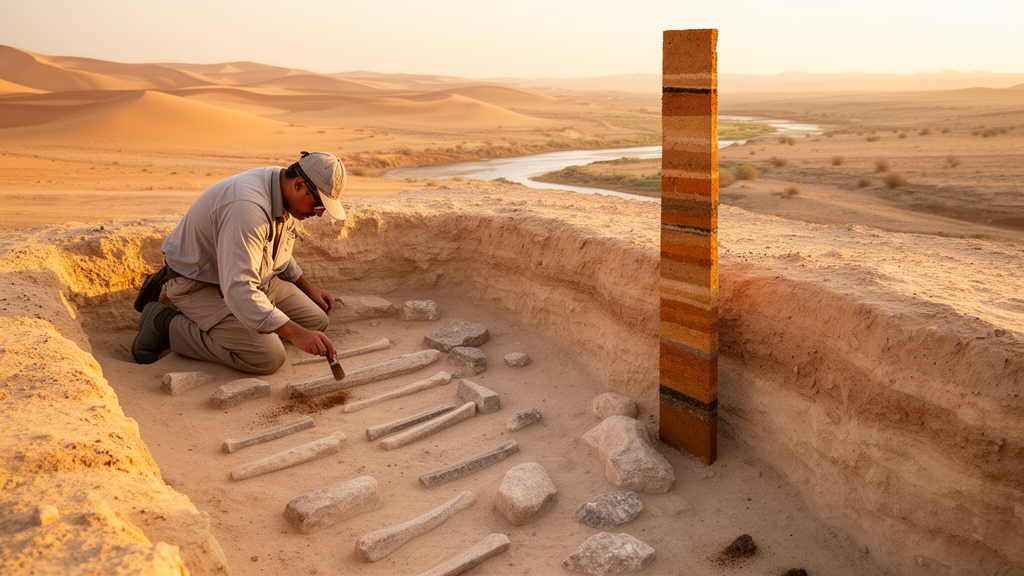
A 500,000-year dust record recovered from the western equatorial Indian Ocean shows that hominin populations in Arabia expanded not only during the prolonged humid phases known as Green Arabia periods, but also during brief episodes of high-intensity rainfall embedded within some glacial periods. The study, published in Nature Communications, uses a multi-proxy, high-resolution sediment archive to reconstruct how rainfall varied across the Arabian Peninsula on orbital timescales, and then links those hydrological swings to the region’s deep archaeological record.
The new archive addresses a long-standing gap. Although a rich Palaeolithic archaeological record has been discovered in Arabia over the last decade, the environmental context of hominin occupations and dispersals there has remained poorly understood because Pleistocene palaeoenvironmental records from the peninsula are scarce. By analysing dust preserved in ocean sediments offshore, the researchers built a continuous timeline of hydrological change spanning half a million years, allowing them to evaluate how orbital-scale variations in the hydrological cycle influenced hominin populations in Arabia.
The dust evidence reinforces the view that hominin presence in Arabia was driven by enhanced monsoon precipitation during Green Arabia periods, when wetter conditions made the landscape more hospitable. When the palaeoclimate signal is coupled with hunter-gatherer demographic data, the results point to marked hominin population expansions during these prolonged wetter intervals, suggesting that demographic growth tracked the long rhythm of monsoon strengthening rather than occurring independently of climate.
The study’s most consequential finding, however, complicates the traditional Green Arabia narrative. Hominin occupation, the researchers report, was not linked exclusively to the classic humid periods. Instead, brief phases of high-intensity rainfall within some glacial periods also favoured hominin expansions. These short wet episodes left a distinctive and initially counterintuitive signature in the record: transient spikes in dust content, which the authors interpret as reflecting enhanced terrestrial moisture availability combined with an increased supply of wind-erodible particles reaching the ocean.
That interpretation matters for how archaeologists read the Arabian record. If occupation phases can correspond to short, sharp rainfall events buried within glacial stages, rather than only to extended humid windows, then the environmental conditions under which hominins occupied the peninsula were more varied than a simple green-versus-desert model would imply. The convergence of the dust record with independent demographic data strengthens the case that water availability was a primary control on hominin presence in Arabia.
The researchers note that the dust record is an environmental archive rather than a direct census of ancient people; the demographic link emerges from combining the palaeoclimate signal with hunter-gatherer demographic data. Because this version is an accepted manuscript that is subject to further edits before the final version of record appears, detailed chronologies and proxy interpretations may still be refined. The central message, however, already stands: Arabia’s deserts have repeatedly bloomed, and hominin populations expanded when they did, whether the wet spells lasted for prolonged periods or arrived as brief, rain-soaked interludes within an ice age.
Subject of Research: Arabian hydroclimate variability and its influence on hominin population dynamics over the last 500,000 years
Article Title: Arabian hydroclimate and hominin population dynamics over the last 500,000 years
Article References: Zhou, L., Jiang, Z., Li, S., Larrasoaña, J. C., Roberts, A. P., Yang, S., Liu, Q., Chen, L., Yin, Z., Liu, W., Guan, Y., Zhang, Y., & Petraglia, M. D. (2026). Arabian hydroclimate and hominin population dynamics over the last 500,000 years. Nature Communications. https://doi.org/10.1038/s41467-026-78983-y
Image Credits: AI Generated
DOI: 10.1038/s41467-026-78983-y
Keywords: Arabian Peninsula, Green Arabia, paleoclimate, dust record, Indian Ocean sediments, monsoon precipitation, hominin dispersals, Pleistocene, hunter-gatherer demography, glacial rainfall events, Nature Communications, Arabian
Cite Scienmag News
Violet Maxwell. (October 25, 2026). Dust record ties ancient hominin booms in Arabia to wet spells. Scienmag. https://scienmag.com/dust-record-ties-ancient-hominin-booms-in-arabia-to-wet-spells/
Violet Maxwell. "Dust record ties ancient hominin booms in Arabia to wet spells." Scienmag, 25 October 2026, https://scienmag.com/dust-record-ties-ancient-hominin-booms-in-arabia-to-wet-spells/. Accessed 25 October 2026.
Violet Maxwell. "Dust record ties ancient hominin booms in Arabia to wet spells." Scienmag. October 25, 2026. https://scienmag.com/dust-record-ties-ancient-hominin-booms-in-arabia-to-wet-spells/


