


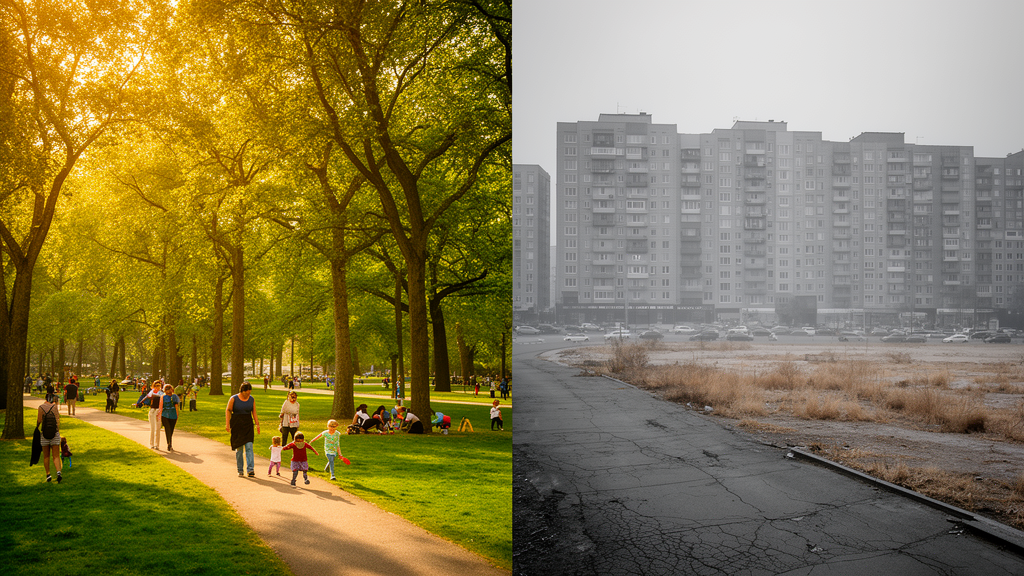
Spending time in nature is supposed to be good for everyone, but a new study from southeastern France shows that the path to those benefits is anything but level. Researchers surveyed more than 700 residents of the Grenoble metropolitan area and found that the obstacles standing between people and the natural world are not distributed evenly. Lower-income residents, women, people living in dense urban neighbourhoods, and those with limited physical mobility all reported more barriers to benefiting from nature, and those barriers rippled outward into lower satisfaction with nature’s services and, ultimately, lower reported quality of life. The findings, published in the journal Ambio, offer one of the most detailed quantitative portraits yet of who gets shut out of nature’s advantages, and how.
The research team, led by Margot Neyret of Université Grenoble Alpes together with colleagues including Sandra Lavorel, Bruno Locatelli and Berta Martín-López, framed their questions around the concept of Nature’s Contributions to People, or NCP. This framework covers far more than a pleasant stroll in a park. It spans material contributions such as crop and timber production, regulating contributions such as temperature cooling, flood protection, erosion control and the maintenance of air and water quality, and non-material contributions such as outdoor recreation, aesthetic enjoyment, cultural identity, wild food harvesting, hunting and fishing, and the simple presence of habitats for biodiversity. The researchers wanted to know which barriers most commonly limit people’s ability to benefit from these contributions, how those barriers vary across social groups, and how they interact with nature connectedness and quality of life.
To answer those questions, the team ran an online survey between March and October 2024 across the Grenoble metropolitan area and its surrounding intermunicipalities, a 4,450-square-kilometre region home to roughly 950,000 people. The area is geographically striking: three biodiverse mountain ranges, the Vercors, Chartreuse and Belledonne, frame three valleys under pressure from urban sprawl, creating a setting where conservation, tourism, agriculture and dense city living collide. Respondents first rated their overall quality of life, then selected the three NCP most important to their own well-being from a list of fifteen. For each chosen contribution, they rated their satisfaction with their ability to benefit from it and ticked any barriers from a list of sixteen, spanning physical obstacles such as transport, structural and relational ones such as social networks, rights-based constraints, and psychosocial factors such as lack of motivation or perceived insecurity. Free-text answers added further categories, including sustainability concerns such as reluctance to drive into the mountains.
The headline numbers are telling. Two-thirds of respondents, 67 percent, reported at least one barrier to accessing the contributions they valued most. Across all respondents and contributions, the three most frequent barriers were the low availability of green spaces providing the benefit in question, cited in 17.4 percent of all reported barriers, lack of time, at 14 percent, and crowding that prevents enjoyment of these spaces, at 13.7 percent. The main barriers differed across NCP categories, although the detailed breakdown is presented in the study’s supplementary material. Crowding, the authors note, reflects well-known overuse problems in the region’s green and natural areas, and respondents perceived it both as a direct limitation, for example when other users constrain hunting opportunities, and an indirect one, through degradation that erodes biodiversity, cultural identity and aesthetic value.
The distribution of those barriers followed social fault lines with remarkable consistency. High-income, physically mobile and rural residents reported fewer barriers to non-material contributions, while men and rural residents reported fewer barriers to regulating contributions. The type of barrier also shifted across groups. People with good physical mobility were much less likely to report health-related obstacles, and also reported fewer motivation-related ones. Men were less likely to cite poor health, lack of transport, and lack of knowledge. Higher-income respondents were far less likely to report cost-related barriers, and also less likely to cite poor quality of green or natural spaces, likely because they live near better-maintained green areas or can more easily travel, for instance by car. Rural residents, living closer to natural areas, were less likely to report transport, motivation, time, knowledge and availability barriers than their urban counterparts. In a region where low-income households are concentrated in the southern parts of the metropolis while average incomes rise sharply to the north-east, these patterns map directly onto existing socio-spatial inequality.
The consequences extended well beyond inconvenience. Respondents who reported more barriers for a given contribution were significantly less satisfied with their ability to access and benefit from it, a relationship that held strongly across categories. Using a structural equation model, the researchers traced how these effects cascade: socio-demographic disadvantage increases the number of barriers, which lowers satisfaction with nature’s contributions, which in turn drags down quality of life. Notably, the effect of satisfaction with NCP on quality of life was stronger than the effect of income itself, a variable usually tightly correlated with well-being. The authors caution this may partly reflect the survey’s focus on nature, which primed respondents to evaluate their lives through that lens, but the signal is striking nonetheless.
Nature connectedness, measured with the Inclusion of Nature in Self scale, emerged as a separate and powerful pathway. Rural residents, men and physically mobile respondents reported higher connectedness, and connectedness directly and positively affected quality of life, independent of barriers. This matters because nature disconnection is rising worldwide, driven by urbanisation, environmental degradation and lifestyle shifts, and has itself been linked to poorer mental health. Previous research suggests a reinforcing cycle: reduced nature contact leads to an extinction of experience, weakening connectedness, which then generates further psychosocial barriers such as fear of the unfamiliar, diminishing contact again. Interestingly, the study found no direct correlation between the number of barriers reported and connectedness scores, leading the authors to suggest that connectedness is not merely a moderator of nature contact but also an individual trait linked to greater life satisfaction in its own right. Untangling the causal direction between barriers, connectedness and well-being, they acknowledge, will require experimental designs.
The study has honest limits, and the authors are upfront about them. The sample was recruited through local administrations, environmental NGOs, associations and leaflets, and is therefore biased toward highly educated people already interested in nature. Hunters were dramatically over-represented, roughly 28 percent of respondents against a regional baseline of 1.7 percent, a skew the team corrected with statistical weighting that brought their effective contribution to about 3 percent. The survey also did not collect data on race or ethnicity for ethics reasons, meaning barriers that disproportionately affect racialised groups, such as safety concerns and lack of representativeness, are likely underestimated. Because respondents only reported barriers for their three most valued contributions, the true count of obstacles is probably higher. If anything, the authors argue, disparities in the general population are likely even more pronounced than the study shows.
The findings also resonate with the language of environmental justice. The distributional dimension appeared most clearly, through barriers tied to the costs and benefits people derive from nature, such as low availability or poor quality of providing spaces. The capabilities dimension was reflected in barriers such as lack of time, poor health or financial costs, often overlapping with distributional inequities. Procedural justice surfaced implicitly in participant comments on rights and conflicts over space use, from hikers fearing encounters with hunters or guard dogs to reactions against new access restrictions on formerly open private areas. Barriers tied to recognition, whether spaces matched personal values and cultural identity, were rarely selected, likely because the sample was already familiar with these spaces, a limitation the authors themselves highlight.
The policy implications are pointed. Current frameworks, from Sweden’s right of public access to the EU Biodiversity Strategy, the Green Infrastructure Strategy, the Nature Restoration Law and the widely cited 3-30-300 urban greening rule, focus overwhelmingly on the quantity and spatial distribution of green space. The study argues this is necessary but insufficient: a park can exist on paper while entry fees, transport gaps, poor quality, crowding, time poverty or perceived insecurity keep large groups from benefiting. Emerging initiatives point the way forward, including therapeutic gardens in Tallinn and Zagreb, a network of inclusive parks in Barranquilla, Colombia, and the United Nations Sustainable Development Goal target 11.7, which commits to universal access to safe, inclusive and accessible green and public spaces by 2030, particularly for persons with disabilities. The researchers call for integrated policies that address the multiple dimensions of access simultaneously, recognising that barriers accumulate for disadvantaged groups and reinforce broader social inequities. Dense, low-income urban neighbourhoods in the study area already face especially limited access to cooling green spaces, precisely where low income, poor health and limited mobility heighten vulnerability to heat. Shifting policy attention from the mere presence of nature to the actual ability of diverse populations to engage with and benefit from it, the authors conclude, is the key to building cities that are socially just, nature-connected and climate-resilient.
Subject of Research: Socio-demographic disparities in barriers to accessing Nature's Contributions to People and their effects on quality of life
Article Title: Unequal barriers to Nature’s Contributions to People impact quality of life
Article References: Neyret, M., Lavorel, S., Locatelli, B., & Martín-López, B. (2026). Unequal barriers to Nature’s Contributions to People impact quality of life. Ambio. https://doi.org/10.1007/s13280-026-02482-z
Image Credits: AI Generated
DOI: 10.1007/s13280-026-02482-z
Keywords: nature's contributions to people, environmental justice, green space access, quality of life, nature connectedness, Grenoble, survey study, social inequality, urban green spaces, ecosystem services, access barriers, Ambio
Cite Scienmag News
Violet Maxwell. (October 25, 2026). Unequal Barriers to Nature’s Benefits Widen Gaps in Quality of Life. Scienmag. https://scienmag.com/unequal-barriers-to-natures-benefits-widen-gaps-in-quality-of-life/
Violet Maxwell. "Unequal Barriers to Nature’s Benefits Widen Gaps in Quality of Life." Scienmag, 25 October 2026, https://scienmag.com/unequal-barriers-to-natures-benefits-widen-gaps-in-quality-of-life/. Accessed 25 October 2026.
Violet Maxwell. "Unequal Barriers to Nature’s Benefits Widen Gaps in Quality of Life." Scienmag. October 25, 2026. https://scienmag.com/unequal-barriers-to-natures-benefits-widen-gaps-in-quality-of-life/


