


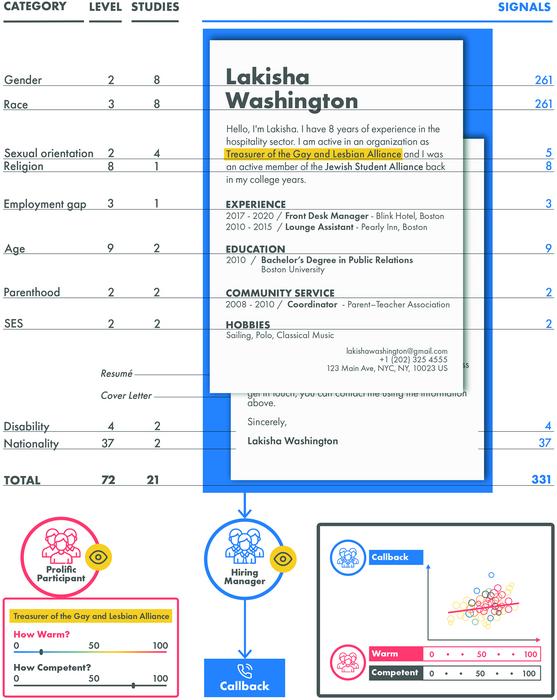
Perceived warmth and competence predict the influence of race, gender and age on callback decisions, suggesting social perceptions might underlie such hiring bias. The meta-analysis of North American correspondence studies is published July 10, 2024 in the open-access journal PLOS ONE by Carina Hausladen from the California Institute of Technology and ETH Zürich, Marcos Gallo from the California Institute of Technology, and colleagues.

Credit: Gallo et al., 2024, PLOS ONE, CC-BY 4.0 (
Perceived warmth and competence predict the influence of race, gender and age on callback decisions, suggesting social perceptions might underlie such hiring bias. The meta-analysis of North American correspondence studies is published July 10, 2024 in the open-access journal PLOS ONE by Carina Hausladen from the California Institute of Technology and ETH Zürich, Marcos Gallo from the California Institute of Technology, and colleagues.
In the labor market, applicants from marginalized groups continue to face disparate treatment. To examine hiring bias, researchers use experimental studies known as correspondence studies, in which they present employers with sets of artificial résumés, identical except for one detail that may indicate identity. Researchers can then use callback decisions to identify patterns of discrimination.
Hausladen and colleagues examined the potential link between social perceptions of candidates and callback decisions, asking if different social perceptions associated with stereotypes of particular identities might explain observed differences in callback rates. They draw upon the social perception dimensions warmth (good intentions) and competence (capability to carry out one’s intentions) to measure the major ways in which people categorize each other.
The researchers analyzed callback rates from 21 US and Canadian correspondence studies which varied either the applicants’ names or attributes to signal identity (e.g., “Sarah Davis” may be perceived as a white female, while volunteering at a church may signal religious affiliation). Participants, selected to demographically resemble North American hiring managers, rated the applicants’ characteristics on their perceived warmth and competence.
Analysis revealed that in studies where names were varied to signal race, gender, and age, warmth and competence ratings predicted callback differences between identities. The applicants’ characteristics which experienced lower callback rates tended to be rated as less warm and competent, and the reverse was also true. One explanation might be that identity signals trigger specific warmth and competence perceptions according to stereotypes, which then influence callback decisions. However, for studies varying attributes to signal other categories (e.g. sexuality and disability), the influence of social perception on callbacks was inconsistent.
Social perceptions may vary across cultures, and the sample sizes of some correspondence studies were also fairly small, making it harder to draw broad conclusions from the study. The researchers encourage future research to include intersectional studies that expand and diversify the attributes measured.
The researchers aim to harness this link between perceived warmth and competence and callback rates to further understand hiring discrimination and even to correct biases in the Large Language Models increasingly used for evaluating résumés.
#####
In your coverage please use this URL to provide access to the freely available article in PLOS ONE:
Citation: Gallo M, Hausladen CI, Hsu M, Jenkins AC, Ona V, Camerer CF (2024) Perceived warmth and competence predict callback rates in meta-analyzed North American labor market experiments. PLoS ONE 19(7): e0304723.
Author Countries: USA, Switzerland
Funding: NSF DRMS grants 1851879 (ACJ), 1851745 (CFC), 1851902 (MH), and a Tianqiao and Chrissy Chen Graduate Fellowship (MG).
Journal
PLoS ONE
Method of Research
Meta-analysis
Subject of Research
People
Article Title
Perceived warmth and competence predict callback rates in meta-analyzed North American labor market experiments
Article Publication Date
10-Jul-2024
COI Statement
The authors have declared that no competing interests exist.
Cite Scienmag News
Reid Dalton. (July 10, 2024). Perceived warmth, competence predict callback decisions in meta-analysis of hiring experiments. Scienmag. https://scienmag.com/perceived-warmth-competence-predict-callback-decisions-in-meta-analysis-of-hiring-experiments/
Reid Dalton. "Perceived warmth, competence predict callback decisions in meta-analysis of hiring experiments." Scienmag, 10 July 2024, https://scienmag.com/perceived-warmth-competence-predict-callback-decisions-in-meta-analysis-of-hiring-experiments/. Accessed 5 September 2026.
Reid Dalton. "Perceived warmth, competence predict callback decisions in meta-analysis of hiring experiments." Scienmag. July 10, 2024. https://scienmag.com/perceived-warmth-competence-predict-callback-decisions-in-meta-analysis-of-hiring-experiments/

