Friday, October 30, 2026
Science
No Result
View All Result
  • Login
  • HOME
  • SCIENCE NEWS
  • CONTACT US
  • HOME
  • SCIENCE NEWS
  • CONTACT US
No Result
View All Result
Scienmag
No Result
View All Result
Home Science News Agriculture

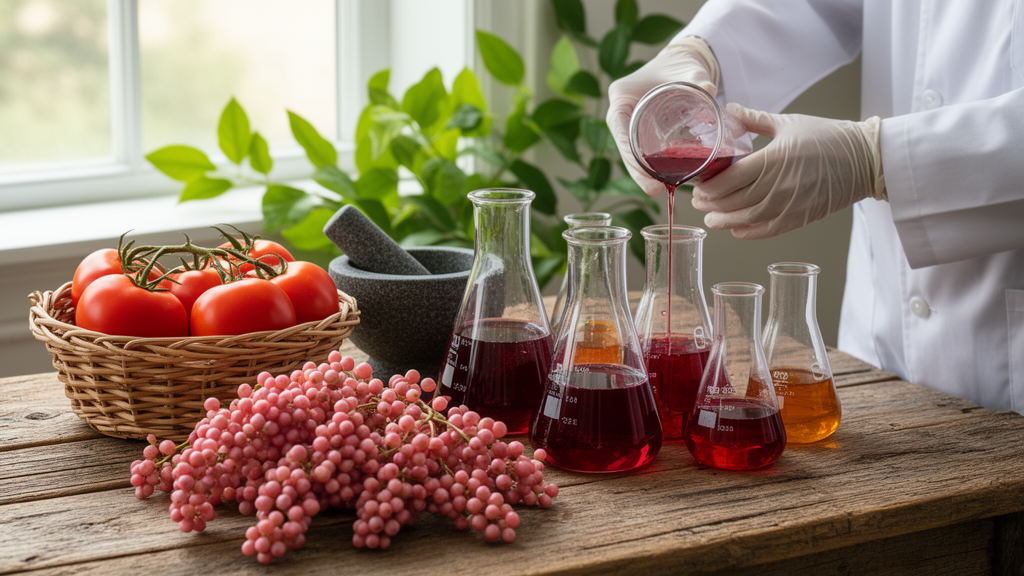
Peppertree and tomato team up for stronger antioxidant extraction

October 29, 2026
in Agriculture
Daisy Hatcher
By Daisy Hatcher Scienmag Editorial Profile - Food Safety and Toxicology
Reading Time: 2 mins read
0
Peppertree and tomato team up for stronger antioxidant extraction

Peppertree and tomato team up for stronger antioxidant extraction

65
SHARES
587
VIEWS
Share on FacebookShare on Twitter
ADVERTISEMENT

Food scientists have optimised a way to pull antioxidant phenolic compounds from a blend of two plants: the fruit of Schinus molle, the Peruvian peppertree, and the tomato. The study, published open access in Discover Food on 28 October 2026, reports that mixing the two plant materials in roughly equal parts boosted phenolic extraction by up to 14% compared with extracting either fruit on its own, an effect the authors attribute to complementary pH conditions and improved mass transfer within the mixture.

The research team, led by Eskedar Adane Fentie with colleagues including Reddy Prasad D.M. and Manjula Muthu Narayanan, set out to address a practical problem: synthetic antioxidants such as BHT and BHA face growing regulatory scrutiny over potential carcinogenic effects, creating demand for safer plant-derived alternatives. Although Schinus molle and tomato (Lycopersicon esculentum Mill.) had each been studied individually, no earlier work had examined their binary combination for synergistic phenolic extraction.

A face-centered central composite design explored three factors across 20 experimental runs: extraction temperature from 25 to 60 degrees Celsius, extraction time from 40 to 180 minutes, and the fruit-to-fruit ratio ranging from 0:100 to 100:0 by weight. The resulting model fit the data closely, with an R-squared value of 0.9896.

The model predicted a maximum yield of 50.07% at 55 degrees Celsius, an extraction time of 110 to 132 minutes, and a peppertree-to-tomato ratio of 47.6:52.4 by weight. When the team ran the experiment under those predicted optimum conditions, they measured an actual yield of 49.71% with a standard deviation of 0.10%, corresponding to a mean absolute percentage error of just 0.71%.

The optimised extract showed notable antioxidant and phytochemical content. Total phenolic content ranged from 2.4 to 154 milligrams of gallic acid equivalents per gram, and total flavonoid content ranged from 66 to 284 milligrams of quercetin equivalents per gram across the tested conditions.

The authors describe their work as a validated protocol for synergistic natural antioxidant extraction from the Schinus molle and tomato system. Because the study reports an optimised extraction procedure and in vitro antioxidant measurements rather than effects in humans or animals, the findings speak to process design and chemical characterisation, not clinical benefit. The article is being shared early as a citable, peer-reviewed accepted version carrying a permanent DOI, subject to further edits before the final Version of Record appears.

Subject of Research: Response surface optimisation of synergistic phenolic antioxidant extraction from a Schinus molle and tomato binary mixture

Article Title: Synergistic phenolic extraction from Schinus molle–tomato binary mixture with RSM optimisation and DPPH antioxidant activity

Article References: Fentie, E. A., D.M., R. P., Andualem, T. L., Yemata, T. A., & Narayanan, M. M. (2026). Synergistic phenolic extraction from Schinus molle–tomato binary mixture with RSM optimisation and DPPH antioxidant activity. Discover Food. https://doi.org/10.1007/s44187-026-01326-9

Image Credits: AI Generated

DOI: 10.1007/s44187-026-01326-9

Keywords: Schinus molle, tomato, phenolic extraction, response surface methodology, antioxidants, DPPH assay, total flavonoids, food science, natural preservatives, synergy, Synergistic, phenolic

Cite Scienmag News

Daisy Hatcher. (October 29, 2026). Peppertree and tomato team up for stronger antioxidant extraction. Scienmag. https://scienmag.com/peppertree-and-tomato-team-up-for-stronger-antioxidant-extraction/

Daisy Hatcher. "Peppertree and tomato team up for stronger antioxidant extraction." Scienmag, 29 October 2026, https://scienmag.com/peppertree-and-tomato-team-up-for-stronger-antioxidant-extraction/. Accessed 30 October 2026.

Daisy Hatcher. "Peppertree and tomato team up for stronger antioxidant extraction." Scienmag. October 29, 2026. https://scienmag.com/peppertree-and-tomato-team-up-for-stronger-antioxidant-extraction/

Tags: antioxidantsbinary plant material combination for enhanced phenolic recoveryDPPH assayextraction process parameters for plant antioxidantsfood safety and natural antioxidant sourcesfood sciencefood science open access research on antioxidant optimizationfood science research on natural antioxidantsimpact of pH on antioxidant yieldnatural preservativesoptimization of phenolic compound extraction methodsPeppertree and tomato antioxidant extractionphenolicphenolic extractionplant-based antioxidants for food preservationpractical applications of plant-based antioxidants in food industryresponse surface methodologysafe alternatives to synthetic preservativesSchinus mollesynergisticsynergistic phenolic compounds from Schinus molle and tomatosynergytomatototal flavonoids
Share26Tweet16
Previous Post

Fertile female scent enrichment boosts sexual behaviour in zoo ruffed lemurs

Next Post

Novel CNKSR2 Splice Variant Shown to Skip Exon 16 in Boy with Epileptic Encephalopathy

Related Posts

Freeze-Dried Chips Made from Discarded Prawns Win the Taste Test
Agriculture

Freeze-Dried Chips Made from Discarded Prawns Win the Taste Test

October 30, 2026
European farmers split on agroforestry as policy support proves decisive
Agriculture

European farmers split on agroforestry as policy support proves decisive

October 30, 2026
Microalgae Triple Team Beats Bean Damping-Off and Boosts Yields in Egyptian Field Trials
Agriculture

Microalgae Triple Team Beats Bean Damping-Off and Boosts Yields in Egyptian Field Trials

October 30, 2026
Robot Hand Mimics Human Fingers to Pick Chili Peppers Without Damage
Agriculture

Robot Hand Mimics Human Fingers to Pick Chili Peppers Without Damage

October 30, 2026
Food loss in smallholder farms may be a coordination failure, not a technical one
Agriculture

Food loss in smallholder farms may be a coordination failure, not a technical one

October 30, 2026
By-product feeds from cocoa, coconut and rice could cut methane in ruminant diets
Agriculture

By-product feeds from cocoa, coconut and rice could cut methane in ruminant diets

October 30, 2026
Next Post
Novel CNKSR2 Splice Variant Shown to Skip Exon 16 in Boy with Epileptic Encephalopathy

Novel CNKSR2 Splice Variant Shown to Skip Exon 16 in Boy with Epileptic Encephalopathy

  • Mothers who receive childcare support from maternal grandparents show more optimized

    Mothers who receive childcare support from maternal grandparents show more parental warmth, finds NTU Singapore study

    27656 shares
    Share 11059 Tweet 6912
  • University of Seville Breaks 120-Year-Old Mystery, Revises a Key Einstein Concept

    1061 shares
    Share 424 Tweet 265
  • Bee body mass, pathogens and local climate influence heat tolerance

    682 shares
    Share 273 Tweet 171
  • Researchers record first-ever images and data of a shark experiencing a boat strike

    546 shares
    Share 218 Tweet 137
  • Groundbreaking Clinical Trial Reveals Lubiprostone Enhances Kidney Function

    531 shares
    Share 212 Tweet 133
Science

Embark on a thrilling journey of discovery with Scienmag.com—your ultimate source for cutting-edge breakthroughs. Immerse yourself in a world where curiosity knows no limits and tomorrow’s possibilities become today’s reality!

RECENT NEWS

  • Microbial Sources and Stress Shape the Hidden Endophytes of an Invasive Plant
  • Firebreaks Leave Lasting Scars in Grasslands While Wildfire Heals Fast
  • Regularisation and voluntary return reproduce precarity for irregularised migrants in Spain and the UK
  • ZNF207 shields glutamine transporter ASCT2 from degradation to fuel liver cancer growth

Categories

  • Agriculture
  • Anthropology
  • Archaeology
  • Athmospheric
  • Biology
  • Biotechnology
  • Blog
  • Bussines
  • Cancer
  • Chemistry
  • Climate
  • Earth Science
  • Editorial Policy
  • Marine
  • Mathematics
  • Medicine
  • Pediatry
  • Policy
  • Psychology & Psychiatry
  • Science Education
  • Science News
  • Social Science
  • Space
  • Technology and Engineering

Subscribe to Blog via Email

Enter your email address to subscribe to this blog and receive notifications of new posts by email.

Join 5,151 other subscribers

© 2025 Scienmag - Science Magazine

Welcome Back!

Login to your account below

Forgotten Password?

Retrieve your password

Please enter your username or email address to reset your password.

Log In
No Result
View All Result
  • HOME
  • SCIENCE NEWS
  • CONTACT US

© 2025 Scienmag - Science Magazine

Discover more from Science

Subscribe now to keep reading and get access to the full archive.

Continue reading