


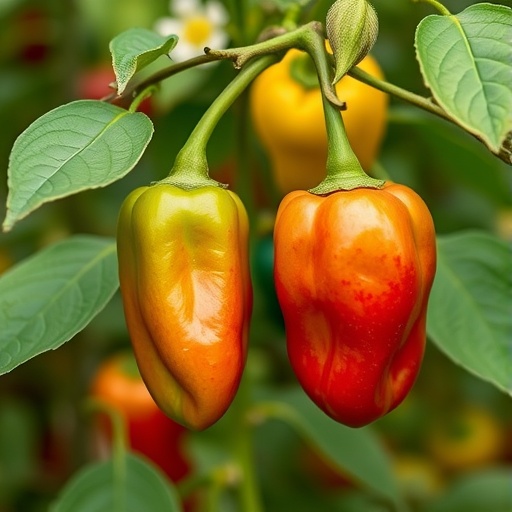
Pepper plants may be hiding some of their most consequential genetic variation in regions long treated as difficult, repetitive stretches of DNA. A study published in Nature Ecology & Evolution reports that ultra-long haplotypes surrounding pepper centromeres can extend across tens of millions of DNA bases, remain largely protected from recombination, and carry genetic combinations associated with important fruit traits. The findings suggest that centromeric and pericentromeric regions are not merely structural anchors for chromosomes, but may function as powerful reservoirs of agronomically valuable variation shaped by evolution, domestication and unusual patterns of inheritance.
Centromeres are specialized chromosome regions that assemble the machinery required for accurate chromosome movement during cell division. They are marked not only by their DNA sequence but also by epigenetic features, including the deposition of a centromere-specific histone variant called CENH3. In many eukaryotes, centromeres and the DNA surrounding them are packed with satellite repeats and transposable elements, making them extremely difficult to assemble and compare across genomes. Their low recombination rates create a second challenge: genetic variants located nearby tend to be inherited together, obscuring the individual effects of genes and making population studies harder to interpret.
Pepper, or Capsicum annuum, offers an unusual opportunity to investigate these regions. Its centromeres contain relatively few satellite repeats, which makes them more accessible to genome assembly and population-level analysis. Hu, Chen, Huang and colleagues combined nine near-complete pepper genome assemblies with CENH3 chromatin immunoprecipitation sequencing from 26 diverse accessions. They also examined resequencing and phenotypic data from approximately 400 cultivated and wild peppers, creating one of the most extensive efforts to connect centromere organization with natural diversity and domestication-related traits.
The researchers found that the functional positions of pepper centromeres are largely stable on eight of the species’ twelve chromosomes. On the other four chromosomes, however, centromere locations differed among accessions. These alternative configurations, described as centromeric epialleles, appear to have been influenced primarily by centromere repositioning and by inversions in pericentromeric DNA. A centromeric epiallele is not necessarily a conventional DNA mutation that changes the underlying sequence. Instead, it can reflect a different chromosomal location or epigenetic state at which the CENH3-marked centromere is assembled, potentially altering chromosome behavior without requiring a wholesale change in gene content.
The most striking discovery was the scale of the haplotypes spanning these regions. The team identified ultra-long centromere-spanning haplotype blocks, or “cenhaps,” ranging from 29.8 to 112.9 megabases. Together, these blocks cover nearly 24 percent of the pepper genome. Because crossing-over is strongly suppressed around centromeres and pericentromeres, DNA variants within a cenhap can remain linked over extraordinary distances. Yet despite their size, each block contained only one to four major haplotypes across the sampled diversity, indicating that these regions may have been maintained by strong evolutionary constraints, population history, selection or a combination of all three.
This architecture gives cenhaps some features of supergenes. A supergene is a cluster of genes kept together by suppressed recombination, allowing a coordinated set of traits to be inherited as a unit. The pepper study does not establish that every cenhap is a supergene in the strict genetic sense, but several appear to behave similarly. When recombination is restricted, multiple genes affecting a shared phenotype can remain locked into favorable or unfavorable combinations. Such blocks may help preserve adaptive traits in wild populations or domestication traits selected by farmers, while also making it difficult for breeders to separate desirable alleles from linked genetic material.
The strongest associations involved fruit characteristics. The researchers connected particular cenhaps with variation in traits related to pepper fruits, although the study emphasizes that the large recombination-suppressed intervals contain many genes and therefore cannot always identify a single causal variant. Among the candidate genes are members of the OFP family, which can influence plant architecture and fruit shape, and F-box genes, a broad class involved in protein degradation, development and signaling. The presence of fruit-related genes inside these extended haplotypes offers a plausible biological explanation for the associations, but it also highlights a central challenge: when dozens or hundreds of genes travel together, conventional association analyses may detect the block without revealing which gene drives the phenotype.
The study also uncovered evidence that alternative cenhaps do more than influence measurable traits; they may affect their own transmission to the next generation. In controlled F2 segregation experiments, chromosomes carrying different cenhaps were not always inherited in the proportions expected under simple Mendelian genetics. This transmission distortion can arise when chromosomes differ in their ability to form functional centromeres, move accurately during meiosis, survive gamete production or establish viable offspring. Such biases could help certain centromere configurations spread through populations even when they do not provide an obvious advantage in adult plants. They may also complicate breeding experiments, because the predicted frequency of a useful allele may not match the frequency actually recovered among progeny.
The findings broaden the way scientists view repetitive and recombination-poor portions of plant genomes. Instead of treating centromeric regions as inaccessible genetic deserts, researchers may need to consider them as dynamic compartments containing large, structured haplotypes with consequences for evolution, domestication and crop improvement. For pepper breeders, cenhaps could become useful markers for tracking fruit-associated variation, predicting inheritance and identifying combinations of genes that are difficult to reconstruct through crossing. At the same time, their size and linkage can create obstacles: introducing one favorable gene may bring along many neighboring variants, and transmission distortion may reduce the efficiency of breeding schemes. By combining chromosome biology, epigenomics, long-read genome assembly and population genetics, the study reveals that some of the most important variation in a crop may be concealed not in isolated genes, but in vast chromosomal neighborhoods inherited as integrated units.
Cite Scienmag News
Juliet Wilcox. (August 25, 2026). Pepper Study Links Ultra-Long Centromere Haplotypes to Evolution and Domestication Traits. Scienmag. https://scienmag.com/pepper-study-links-ultra-long-centromere-haplotypes-to-evolution-and-domestication-traits/
Juliet Wilcox. "Pepper Study Links Ultra-Long Centromere Haplotypes to Evolution and Domestication Traits." Scienmag, 25 August 2026, https://scienmag.com/pepper-study-links-ultra-long-centromere-haplotypes-to-evolution-and-domestication-traits/. Accessed 4 September 2026.
Juliet Wilcox. "Pepper Study Links Ultra-Long Centromere Haplotypes to Evolution and Domestication Traits." Scienmag. August 25, 2026. https://scienmag.com/pepper-study-links-ultra-long-centromere-haplotypes-to-evolution-and-domestication-traits/


