


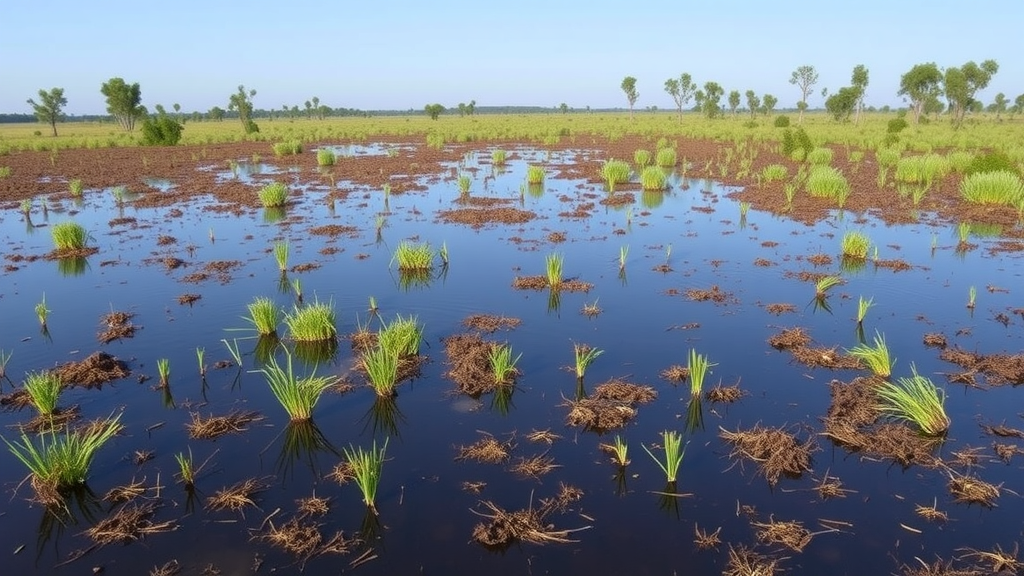
Restoring drained peatlands has become one of the most celebrated tools in the fight against climate change, prized for its ability to lock away carbon, revive rare biodiversity and cool the landscape. But any large-scale change to wet ecosystems inevitably reshuffles the species that live there, and some of those species bite. New research from a fen peatland landscape in North-East Germany now offers one of the most detailed pictures yet of how two widespread European Anopheles mosquitoes respond when the water returns, revealing that each species follows its own ecological script shaped by an intricate interplay between landscape structure and weather. The findings, published in the open-access journal Parasites & Vectors, carry direct implications for how wetland restoration and mosquito-borne disease surveillance should be planned together rather than treated as separate policy problems.
The study, led by Patrick Gutjahr, Amelie Weber, Susanne Fischer and Mandy Schäfer of the Friedrich-Loeffler-Institut, together with ecologists from the Greifswald Mire Centre and the University of Greifswald, focused on two mosquito species with very different public profiles. Anopheles algeriensis, first described by Theobald in 1903, is a comparatively rare and poorly studied member of the European mosquito fauna, while Anopheles claviger sensu stricto, originally described by Meigen in 1804, is far more common and broadly distributed across European wetlands. Both species are considered to have vector potential, meaning they are capable of transmitting pathogens under certain conditions, yet their precise ecological niches, the particular combination of habitat features and climatic conditions under which each thrives, had remained poorly resolved. That gap in knowledge matters, because peatland rewetting is being scaled up across Europe as a cost-effective climate mitigation strategy, and decision-makers need to know which mosquitoes rewetted landscapes will favor.
To answer that question, the research team carried out an intensive field campaign across a fen peatland landscape in North-East Germany. Adult mosquitoes were sampled biweekly, once every two weeks, over two consecutive flight seasons at 15 sites. The sites were then classified into three habitat types based on key peatland characteristics: wet peatlands, where the water table had been restored or naturally remained high; drained peatlands, where ditches and land use had lowered the water table; and settlements, the human-inhabited areas embedded within the landscape. Trapped anophelines that did not belong to the notoriously difficult Anopheles maculipennis complex were identified morphologically and, where necessary, confirmed with molecular methods targeting standard genetic barcodes, including the mitochondrial cytochrome c oxidase subunit 1 gene and the nuclear internal transcribed spacer 2 region. This combination of classical taxonomy and DNA-based verification ensured that the two focal species were distinguished with confidence.
The numbers alone tell a striking story of niche segregation, the process by which closely related or ecologically similar species partition the environment to avoid direct competition. Over the course of the study, the team collected 278 individuals of Anopheles algeriensis and a much larger haul of 950 specimens of Anopheles claviger sensu stricto. The rare species and the common species, as the paper’s title frames them, were not distributed at random. Anopheles algeriensis showed significantly higher abundances in wet peatlands than in any other habitat type, marking it as a specialist of the very environments that rewetting projects are working to recreate. Anopheles claviger sensu stricto, by contrast, reached its highest abundances in settlements, suggesting that the human-dominated edges of these landscapes provide conditions the species finds particularly favorable.
Habitat type, however, was only half of the equation. The researchers then deployed generalised linear mixed models, a statistical framework well suited to count data with repeated measures and hierarchical structure, to test how weather variables modulated abundance in each habitat type. The models estimated incidence rate ratios, allowing the team to quantify how a change in temperature, humidity or precipitation shifts expected mosquito counts. Weather data came from the German Weather Service, the Deutscher Wetterdienst, which provided reliable meteorological measurements for the study region. The result was a set of species-specific responses in which the effect of each weather variable depended, sometimes dramatically, on the surrounding landscape.
For Anopheles algeriensis, mean temperature emerged as a consistent ally. Abundance rose with warmer conditions regardless of habitat type, meaning the temperature effect was independent of the landscape context. Mean relative humidity was also positively correlated with abundance, but here the strength of the relationship was modulated by habitat type, indicating that humid air benefits the species most in certain settings. Perhaps most intriguingly, cumulative precipitation showed a negative correlation with abundance, and the strength of that negative relationship varied across habitat types. A rain-loving intuition might suggest the opposite for a wetland mosquito, but the pattern makes ecological sense: adult female mosquitoes, which are what the traps captured, tend to be less active in heavy or persistent rain, and the larvae of this species are presumably already assured of standing water in peatland habitats, so rainfall adds little larval benefit while suppressing adult flight and trap catches.
Anopheles claviger sensu stricto painted an almost mirror-image picture, underscoring how distinct the two species’ environmental niches truly are. In settlements, mean relative humidity was positively correlated with abundance, echoing the humid-air benefit seen in its rarer relative. In the peatland habitats, however, the humidity effect flipped and became negative, a reversal that points to genuinely different physiological or behavioral tolerances between the species, or to different microhabitat preferences that make the same weather variable matter in opposite ways depending on where the mosquitoes live. Temperature effects were equally context-dependent: minimum temperature during trap nights was positively associated with abundance both in settlements and in wet peatlands, yet negatively associated in drained peatlands. A cooler night, in other words, can boost catches in one part of the landscape while depressing them in another.
These interaction effects, where landscape and weather jointly determine abundance, are the analytical heart of the study and the reason its findings go beyond a simple habitat checklist. In disease ecology, knowing that a vector species responds positively to warmth is useful, but knowing that the same warm spell multiplies its numbers in villages while doing the opposite in restored bogs is far more actionable. It means that surveillance efforts can be targeted spatially and temporally: trap networks and public health warnings can be concentrated in settlement habitats during warm, humid periods when Anopheles claviger sensu stricto is expected to peak, while wet peatland sites can be monitored for Anopheles algeriensis, whose populations climb with temperature across the board. The modeling approach, based on generalised linear mixed models with habitat type and weather interactions, provides a template that can be transferred to other rewetting landscapes across temperate Europe.
The broader context of this work is the CuliMoor project, funded by the German Federal Ministry of Research, Technology and Space, which examines the consequences of peatland rewetting within a One Health framework, the recognition that human, animal and ecosystem health are inseparably linked. Peatlands that remain drained continue to oxidize and release greenhouse gases, and rewetting them is among the most cost-effective climate actions available. Yet rewetting also changes the water table, vegetation structure and standing-water dynamics that mosquito larvae depend on. The new results demonstrate that such changes do not simply produce more mosquitoes or fewer mosquitoes; they shift the balance between species, potentially favoring different vectors in different parts of a restored landscape. As Gutjahr and colleagues put it in their conclusions, the species-specific responses to peatland habitat types highlight the need to integrate vector surveillance into rewetting and management strategies.
For now, the message from the North German fens is one of complexity and cautious optimism. Rewetted peatlands strongly favor Anopheles algeriensis, a species whose vector competence under natural conditions remains incompletely characterized, while the better-known Anopheles claviger sensu stricto concentrates in human settlements, where humidity and warm nights drive its numbers up. Neither pattern is inherently alarming, but both demand attention. The study’s authors emphasize that their findings were made possible by the many local volunteers who granted access to their plots and gardens and assisted with data collection, a reminder that large-scale ecological surveillance is as much a community endeavor as a technical one. As Europe accelerates its peatland restoration agenda, this work makes a compelling case that mosquito monitoring should ride along with the diggers and the hydrologists, ensuring that the climate benefits of returning water to the bogs are not achieved blind to their consequences for the tiny, buzzing inhabitants of the new wetlands.
Subject of Research: Habitat suitability and niche segregation of two Anopheles mosquito species in North German peatlands
Article Title: The rare and the common: habitat suitability and niche segregation of Anopheles algeriensis (Theobald, 1903) and Anopheles claviger s.s. (Meigen, 1804) in North-German peatlands is shaped by distinct landscape–weather interactions
Article References: The rare and the common: habitat suitability and niche segregation of Anopheles algeriensis (Theobald, 1903) and Anopheles claviger s.s. (Meigen, 1804) in North-German peatlands is shaped by distinct landscape–weather interactions. (n.d.). https://doi.org/10.1186/s13071-026-07612-w
Image Credits: AI Generated
DOI: 10.1186/s13071-026-07612-w
Keywords: Anopheles algeriensis, Anopheles claviger, peatland rewetting, mosquito ecology, niche segregation, vector surveillance, North-East Germany, One Health, GLMM, landscape ecology, weather interactions, Parasites & Vectors
Cite Scienmag News
Margaret Porter. (September 23, 2026). Peatland Rewetting Reshapes Mosquito Communities in Unexpected Ways, Study Finds. Scienmag. https://scienmag.com/peatland-rewetting-reshapes-mosquito-communities-in-unexpected-ways-study-finds/
Margaret Porter. "Peatland Rewetting Reshapes Mosquito Communities in Unexpected Ways, Study Finds." Scienmag, 23 September 2026, https://scienmag.com/peatland-rewetting-reshapes-mosquito-communities-in-unexpected-ways-study-finds/. Accessed 5 October 2026.
Margaret Porter. "Peatland Rewetting Reshapes Mosquito Communities in Unexpected Ways, Study Finds." Scienmag. September 23, 2026. https://scienmag.com/peatland-rewetting-reshapes-mosquito-communities-in-unexpected-ways-study-finds/


