


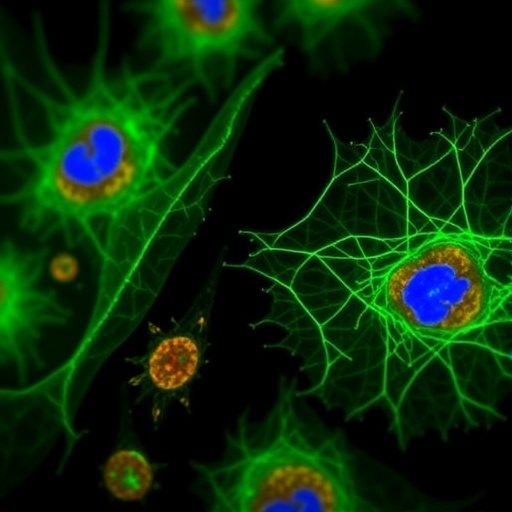
Immunotherapy has rewritten the prognosis for lung cancer, yet one of its most persistent costs is written on the skin. Rashes, itching and inflammation are among the most frequently reported side effects of checkpoint-blocking cancer drugs, and they are serious enough in some patients to force oncologists to interrupt, or abandon entirely, otherwise lifesaving treatment. A study published on 29 August 2026 in the open-access journal BMC Pharmacology and Toxicology now offers an unusually granular mechanistic account of how this damage might begin inside the skin’s own cells. A team of pharmacist-researchers in Fujian Province, China, led by Xuekun Nie of Ningde Municipal Hospital and co-first-authored by Jiangyuan Zhang and Yaodan Zhang, combined network toxicology, molecular dynamics simulations and laboratory experiments to trace how the small-molecule PD-L1 inhibitor BMS-1 injures keratinocytes, the epithelial cells that make up roughly ninety percent of the epidermis. Their evidence converges on a distinctive molecular signature in which a single compound simultaneously suppresses albumin, amplifies two skin-remodeling proteins and ignites inflammatory cytokines.
The biological backdrop is one of modern medicine’s most consequential molecular handshakes. Programmed cell death protein 1, or PD-1, sits on the surface of T cells; its ligand, PD-L1, appears on tumors and healthy tissue alike. When the two proteins bind, the immune system’s attack on those cells is restrained. Tumors exploit the pathway ruthlessly, displaying PD-L1 like an invisibility cloak, and the blocking antibodies that sever this interaction have become standard of care for non-small cell and small cell lung cancers, among other malignancies. But dermatologic toxicity remains one of the commonest immune-related adverse events of the class, and it compromises therapeutic compliance in ways oncologists cannot ignore. The skin is an obvious suspect for collateral damage: it is an immunologically active barrier in constant turnover, and keratinocytes are not passive scaffolding but signaling cells that release inflammatory mediators when stressed. Most mechanistic work has nonetheless concentrated on immune cells. “Current studies mostly focus on immune cells, while the direct role of keratinocytes remains unclear,” the authors write, framing the knowledge gap their study set out to close.
To interrogate that gap, the team used BMS-1, a synthetic small molecule that disrupts the PD-1/PD-L1 interaction but is not an approved medicine; they treated it strictly as a tool compound, a chemically tractable probe whose behavior can be modeled atom by atom on a computer in ways that antibodies cannot. Their first move was network toxicology, a data-mining discipline that treats drug action and adverse effects as properties of whole biological networks rather than of single targets. Where classical pharmacology asks what a molecule does to one protein, network toxicology asks what it perturbs across the entire web of human proteins, then searches for the nodes where that web intersects a toxicity of interest. The researchers harvested known and predicted targets of BMS-1 from public pharmacological databases, compiled genes linked to cutaneous toxicity, and computed the overlap. The intersection yielded 246 potential targets through which a PD-L1 inhibitor might plausibly damage skin cells — a list far too long to interrogate one protein at a time, and precisely the kind of problem computational screening exists to solve.
To narrow the field, the investigators used the DAVID database to run Gene Ontology and KEGG pathway enrichment analyses, asking what shared functions unite the 246 candidates. The answer read like a clinical description of irritated, damaged skin: the targets clustered in pathways governing inflammation, cell proliferation and apoptosis, the cell’s orderly program of self-destruction. The team then wired the candidates into a protein-protein interaction network, in which centrality metrics act like importance rankings — proteins that touch many partners, or bridge otherwise separate modules, are statistically likelier to matter. Applying multiple such algorithms, and cross-validating the resulting shortlist against differentially expressed genes mined from public datasets in the Gene Expression Omnibus, or GEO, three molecules survived the gauntlet: ALB, the gene encoding albumin; EGFR, the epidermal growth factor receptor; and MMP9, matrix metalloproteinase 9.
Each of the three survivors carries a story that maps intuitively onto distressed skin. EGFR sits at the commanding heights of epidermal biology, driving keratinocyte growth and renewal, and drugs deliberately designed to inhibit it in cancer therapy are themselves notorious for triggering inflammatory eruptions — an indirect hint that perturbing this receptor in either direction destabilizes skin homeostasis. MMP9 is a secreted gelatinase that dismantles extracellular matrix during wound repair, and it is prominently implicated in inflammatory dermatoses and tumor invasion. ALB is the enigma. Albumin is best known as the liver’s multipurpose cargo protein, and its functions inside keratinocytes are far less charted; its consistent downregulation in this study suggests that losing a homeostatic or protective role, rather than merely activating a single villainous pathway, may be part of how the injury unfolds.
The first line of physical evidence came from molecular docking, a computational technique that fits a flexible ligand into the binding pocket of a protein structure and scores how energetically favorable the resulting pose is. Docked into all three candidate proteins, BMS-1 produced scores below minus five kilocalories per mole in every case — a conventional benchmark beneath which binding is generally considered meaningful rather than accidental. That a single compact molecule can nestle credibly into three structurally unrelated proteins is a classic fingerprint of polypharmacology, the phenomenon in which one compound acts on several molecular targets at once, for better or worse.
Docking, however, is only a snapshot. To test whether the complexes would hold together amid the thermal jostling of a real cellular environment, the team ran 100-nanosecond all-atom molecular dynamics simulations on each drug-protein pair, tracking root mean square deviation, a measure of how far the structure drifts from its starting geometry; root mean square fluctuation, which reports the flexibility of individual residues; radius of gyration, a gauge of overall compactness; and solvent-accessible surface area. All three complexes settled into stable conformations, with no sign of the ligand tearing free. The researchers then estimated binding strength with the Molecular Mechanics/Poisson-Boltzmann Surface Area method, MM/PBSA, which decomposes binding free energy into gas-phase molecular mechanics terms, a polar solvation term solved with the Poisson-Boltzmann model, and surface-area-dependent nonpolar contributions. The analysis produced an affinity ranking of MMP9 over ALB over EGFR, identified van der Waals interactions as the dominant driving force, and showed that polar solvation energy consistently imposed a desolvation penalty — the energetic cost of stripping water molecules from the binding interface before hydrophobic contact can pay it back.
Interaction fingerprint analysis added texture to those numbers. Van der Waals packing and pi-interactions between the drug and the hydrophobic and aromatic residues lining each pocket emerged as the central forces stabilizing all three complexes, with MMP9 standing out for its dense hydrophobic network and, correspondingly, the most favorable binding potential. In plainer terms, BMS-1’s grip on MMP9 owes less to elegant directional bonds than to sheer hydrophobic alchemy: a snug, greasy fit that water cannot easily pry apart. The structural detail matters because MMP9’s matrix-degrading activity sits squarely at the intersection of wound healing, chronic inflammation and tumor invasion, placing it on every shortlist of suspects in damaged skin.
Computational predictions, however coherent, still have to survive contact with living cells. The team therefore exposed HaCaT cells — an immortalized line of human keratinocytes that serves as a workhorse model of the epidermis — to BMS-1 and measured the consequences. Cell proliferation dropped, consistent with the apoptosis and proliferation programs flagged by the enrichment analyses. Gene-expression readouts confirmed the inflammatory arm of the hypothesis: messenger RNA levels of interleukin-1 beta and tumor necrosis factor alpha, two cytokines that amplify cutaneous inflammation and summon immune cells, rose significantly. And the three core targets behaved exactly as the network had forecast. ALB expression fell, while EGFR and MMP9 expression climbed. Convergence of this kind — independent computational screens and direct cellular measurements pointing at the same three proteins — gives the findings considerably more weight than either line of evidence could command alone.
The authors are careful about what the model can and cannot claim. BMS-1 is a laboratory tool, not a marketed medicine, and the checkpoint inhibitors that dominate oncology clinics are monoclonal antibodies whose pharmacokinetics, tissue distribution and immunomodulatory behavior differ substantially from those of any small molecule. “Caution should be exercised when extrapolating to clinically approved PD-L1 antibodies, as their pharmacokinetic and immunomodulatory profiles differ substantially,” the paper states, adding that further studies are warranted to validate the relevance of the three targets in real clinical cutaneous adverse reactions. Even with those caveats, the work arrives at an opportune moment. Immune checkpoint inhibitors continue to expand into earlier lines of therapy and broader tumor types, which means more patients exposed for longer periods and more clinic hours devoted to managing dermatologic toxicity. A largely computational pipeline that flags candidate toxicity targets before drugs reach patients — or before a rash escalates into a dose interruption — could reshape how adverse events are anticipated, monitored and discussed. The research was supported by the Natural Science Foundation of Fujian Province and the Joint Project of Ningde Natural Science Foundation. Perhaps its deepest contribution is methodological: a demonstration that network toxicology fused with molecular simulation and simple cellular assays can generate a coherent, physically grounded hypothesis about why the body’s largest organ so often pays the price for cancer’s most celebrated therapy.
Cite Scienmag News
Nathaniel Bowman. (August 29, 2026). PD-L1 inhibitor BMS-1 injures keratinocytes: network toxicology reveals mechanisms. Scienmag. https://scienmag.com/pd-l1-inhibitor-bms-1-injures-keratinocytes-network-toxicology-reveals-mechanisms/
Nathaniel Bowman. "PD-L1 inhibitor BMS-1 injures keratinocytes: network toxicology reveals mechanisms." Scienmag, 29 August 2026, https://scienmag.com/pd-l1-inhibitor-bms-1-injures-keratinocytes-network-toxicology-reveals-mechanisms/. Accessed 3 September 2026.
Nathaniel Bowman. "PD-L1 inhibitor BMS-1 injures keratinocytes: network toxicology reveals mechanisms." Scienmag. August 29, 2026. https://scienmag.com/pd-l1-inhibitor-bms-1-injures-keratinocytes-network-toxicology-reveals-mechanisms/


