


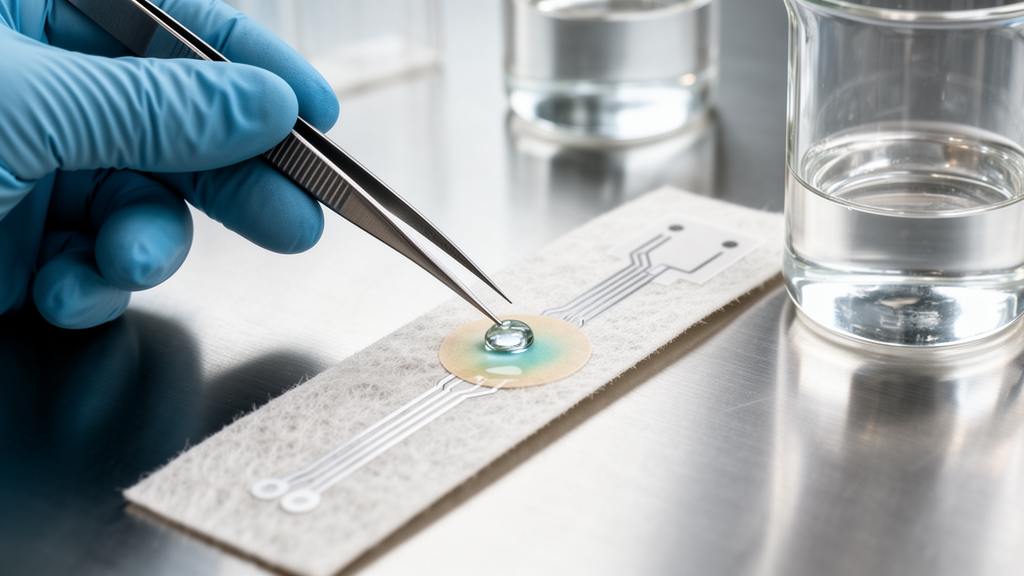
Researchers have developed a flexible, paper-based electrochemical biosensor capable of detecting trace levels of phenolic pollutants in water. The device, described in a study published in the journal Ionics, utilizes a nanohybrid material composed of molybdenum disulfide and reduced graphene oxide, modified with ionic liquids, to achieve high sensitivity. The primary targets of this detection method are the phenolic pollutants 17β-Estradiol and hydroquinone.
The core of the sensor is a conducting paper electrode modified with a nanohybrid structure. The research team combined molybdenum disulfide and reduced graphene oxide, then introduced two specific ionic liquids: 1-Butyl-3-methylimidazolium chloride and 1-Allyl-3-methylimidazolium chloride. Structural and morphological analyses confirmed that the nanohybrid was successfully fabricated and deposited uniformly onto the paper electrode.
To enable the selective detection of the target pollutants, the team immobilized the enzyme Laccase onto the modified electrode. By integrating this biological component with the conductive nanohybrid, the sensor can specifically identify and measure the presence of 17β-Estradiol and hydroquinone.
The performance of the developed biosensor was evaluated through conductivity measurements and detection range analyses. Conductivity tests conducted in methanol revealed that the MoS2/rGO@ILs/CPE configuration achieved a conductivity of 5.12 × 10⁻³ S/cm, which was higher than when tested in other solvents. For detection capabilities, the sensor demonstrated a wide linear range for 17β-Estradiol, from 0.01 to 70.0 µM, and for hydroquinone, from 0.1 to 90.0 µM. The limits of detection were determined to be 0.01 µM for 17β-Estradiol and 0.10 µM for hydroquinone, indicating the sensor’s ability to detect these compounds at very low concentrations.
Validation of the sensor’s practical utility was performed using spiked water samples. The research team successfully detected the phenolic pollutants in these samples with high recovery rates, suggesting that the device can function effectively in real-world matrices. The study characterizes the platform as low-cost, flexible, disposable, and environmentally friendly.
The findings support the potential of ionic liquid-modified nanohybrids in enhancing the performance of paper-based electrochemical devices.
Subject of Research: Development of a paper-based electrochemical biosensor for detecting phenolic pollutants
Article Title: Ionic liquid mediated graphene oxide@MoS₂ nanohybrid-based conducting paper for trace-level electrochemical detection of phenolic pollutants
Article References: Raza, M. J., Riyazuddeen, & Pandey, C. M. (2026). Ionic liquid mediated graphene oxide@MoS₂ nanohybrid-based conducting paper for trace-level electrochemical detection of phenolic pollutants. Ionics. https://doi.org/10.1007/s11581-026-07630-9
Image Credits: AI Generated
DOI: 10.1007/s11581-026-07630-9
Keywords: electrochemical biosensor, phenolic pollutants, molybdenum disulfide, graphene oxide, ionic liquids, water quality, conducting paper, Laccase, 17β-Estradiol, hydroquinone, Ionic, liquid
Cite Scienmag News
Denise Maddox. (November 10, 2026). Paper-based sensor detects trace phenolic pollutants. Scienmag. https://scienmag.com/paper-based-sensor-detects-trace-phenolic-pollutants/
Denise Maddox. "Paper-based sensor detects trace phenolic pollutants." Scienmag, 10 November 2026, https://scienmag.com/paper-based-sensor-detects-trace-phenolic-pollutants/. Accessed 10 November 2026.
Denise Maddox. "Paper-based sensor detects trace phenolic pollutants." Scienmag. November 10, 2026. https://scienmag.com/paper-based-sensor-detects-trace-phenolic-pollutants/




