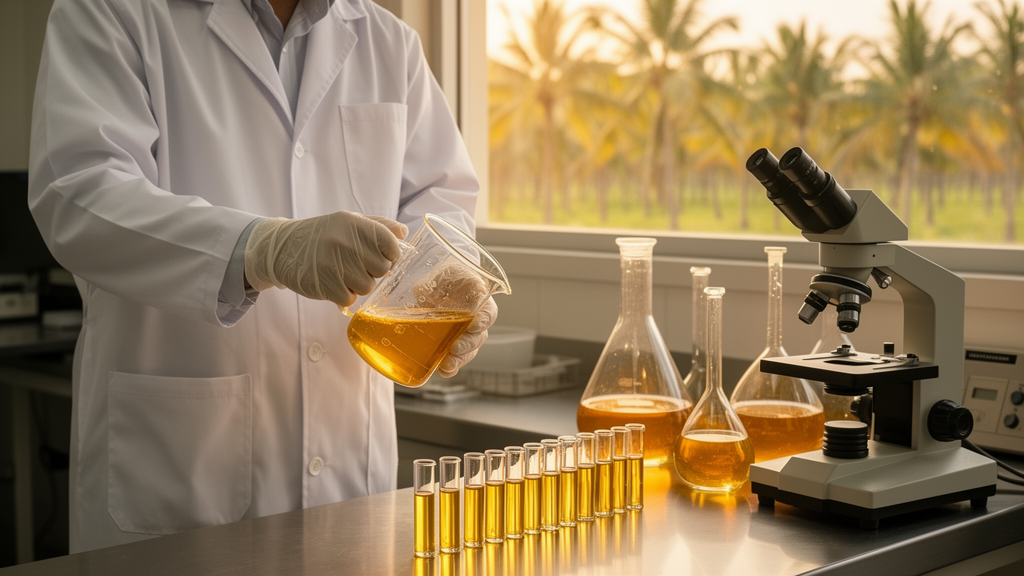
A sweeping bibliometric analysis of palmyra palm sap research has found a small but fast-evolving scientific literature in which Indonesia, Thailand and India dominate, and in which the sweet, perishable liquid harvested from Borassus flabellifer inflorescences is being reimagined as everything from a bioethanol feedstock to a source of carbon films for experimental solar cells. The study, published in Biotechnology for Food Future, searched the Web of Science and Scopus databases for publications from 2015 to 2025 and identified just 32 documents in WoS and 41 in Scopus that matched a carefully constructed Boolean query combining the terms palmyra, Borassus flabellifer and Borassus with sap, neera, toddy, palm wine, padhaneer, palm nectar, palm juice and inflorescence sap. After deduplication, the merged dataset was small enough that the authors describe the internationally indexed literature on this specific topic as genuinely scarce, with much palmyra sap work buried inside broader studies of palm species, fermented beverages and non-centrifugal sugars.
The geographic picture differs sharply between databases. In Scopus, Indonesia led with 11 of 29 country-attributable documents, followed by Thailand with 8 and India with 4. In Web of Science, India topped the count with 8 documents, Thailand followed with 6, and Australia and Indonesia contributed 2 each. Institutional productivity was similarly concentrated: Indonesia’s Institut Teknologi Sepuluh Nopember produced 5 papers and Politeknik Pertanian Negeri Payakumbuh 4 in Scopus, while Thailand’s Kasetsart University appeared prominently in both databases with 3 documents. Wiley published the most WoS-indexed articles at 5, ahead of MDPI with 4 and Elsevier with 3. The most-cited document in both databases, by Darminto and colleagues, had accumulated 19 citations in Scopus and 16 in WoS, and citation activity peaked in 2020. The authors note that the field sits predominantly within agricultural sciences.
A central technical thread of the review concerns the extreme instability of fresh sap. Sap with a pH below 5.0 tends to contain higher levels of reducing sugars, titratable acidity and lactic acid bacteria, all of which drive fermentation and hinder sugar crystallization, whereas sap at pH 6.9 to 7.5 or above is richer in proteins and amino acids that favor crystallization and participate in Maillard reactions during heating. Storage temperature is equally decisive. In one study, palmyra sap held at ambient temperature of 30 plus or minus 2 degrees Celsius degraded its sucrose, glucose and fructose progressively, with sucrose loss following a first-order kinetic model and ethanol climbing to 6.24 percent within just 10 hours. Refrigeration at 7 plus or minus 1 degree Celsius curtailed these transformations and prevented alcohol formation, and the work was the first to apply zero-, first- and second-order kinetic models to palmyra sap fermentation.
Thermal processing brings its own trade-offs. Analysis of palmyra jaggery candy showed that as heating temperatures rose from 28 to 108.4 degrees Celsius, total soluble solids climbed from 28.8 to 84 degrees Brix while thermal conductivity fell from 0.44 to 0.14 watts per meter-kelvin, thermal diffusivity dropped from 0.31 to 0.05 times ten to the minus six square meters per second, and volumetric specific heat declined from 1.35 to 0.64 times ten to the third kilojoules per cubic meter-kelvin, with candy hardness peaking at 6419 grams. For syrup, slow heating produced a darker product with elevated 5-hydroxymethylfurfural, a potential carcinogen capped at 80 milligrams per kilogram by Codex Alimentarius, reaching 56.34 milligrams per kilogram but still within limits, alongside higher antioxidant capacity and phenolic content. Rapid heating yielded a lighter syrup with significantly lower HMF at 17.54 milligrams per kilogram while preserving acceptable sensory and nutritional qualities, leading the review to recommend rapid heating as the standard protocol.
The safety picture is complicated by acrylamide. In a study of 32 commercial non-centrifugal sugar products including coconut, sugarcane and palmyra syrups, acrylamide ranged from below 15 to 4011 micrograms per kilogram, with the highest levels in sugarcane products. Palmyra palm syrups averaged 1564 micrograms per kilogram, which the researchers attributed to the sap’s high concentrations of the amino acids ornithine and asparagine, key precursors in acrylamide formation, and to Maillard chemistry accelerated by prolonged heating at mildly acidic pH values of 5.14 to 5.66. The review argues that optimized production protocols and stringent monitoring, particularly in artisanal and small-scale manufacturing, are prerequisites before palmyra syrups can be positioned as health-promoting natural sweeteners.
Microbiology emerges as both a challenge and an opportunity. A survey of fresh saps from coconut, palmyra and nipa palms identified 204 yeast isolates spanning 15 Ascomycota species and one Basidiomycota species, with Saccharomyces cerevisiae dominant in 100 percent of nipa samples, 86.7 percent of palmyra sap and 76.7 percent of coconut sap. Among 199 isolates tested for fermentative capacity, Lachancea fermentati YSP383 from nipa sap produced the highest ethanol concentration at 76.74 grams per liter, and 26 isolates across species reached between 69.57 and 76.74 grams per liter. In Burkina Faso, 60 yeast strains and 30 lactic acid bacteria were isolated from fresh and naturally fermented Borassus aethiopum sap, with Leuconostoc mesenteroides the most prevalent LAB at 67 percent and the first identification of Enterococcus gilvus in palm wine. Fresh B. aethiopum sap over four days of tapping showed an average pH of 4.84, total sugars of 11.36 percent, vitamin C at 8.93 percent and potassium as the most abundant mineral at 13.26 grams per liter, alongside substantial microbial loads.
Spontaneous toddy fermentation studied in India’s West Bengal and Jharkhand states over 48 hours revealed key organisms including Enterococcus faecalis, Lactiplantibacillus plantarum, Lacticaseibacillus paracasei and Saccharomyces cerevisiae, with pH and sugars declining as titratable acidity, alcohol, esters and proteins rose, and phenolics and flavonoids increasing antioxidant activity over the fermentation period. On the preservation side, calcium hydroxide addition proved the most effective hurdle treatment, retaining alcohol at just 0.9 percent under ambient conditions and 0.1 percent under refrigeration over 28 days, while a separate bioconversion approach used Acetobacter xylinum to convert palmyra sap into nata de legen, a cellulose-based fermented food with 1.05 to 1.55 centimeter thickness and a mass of 500 to 700 grams after 7 to 9 days of fermentation. A canonical discriminant analysis model also achieved 100 percent correct classification of 14 palm sap samples as adulterated or authentic using six physicochemical variables.
Industrial applications show promise but also hard limits. Bioethanol optimization using response surface methodology and central composite design achieved a maximum yield of 0.2368 grams per gram with Saccharomyces cerevisiae at pH 4.77, an inoculum of 12.74 million cells per milliliter and 110 grams per liter sugar, while a 1.8-liter bioreactor study reached 85.68 grams per liter ethanol with S. cerevisiae and 58.97 grams per liter with Zymomonas mobilis at a yield of 0.3039 grams per gram. The review stresses that all reported bioethanol work remains at laboratory or small bioreactor scale, with the largest working volume just 1 liter, and that no techno-economic comparison against sugarcane or corn has been conducted. In contrast, fermenting rice bran with 10 percent palmyra sap lowered pH, raised lactic acid, cut crude fiber, NDF and lignin, and increased crude protein, an application the authors consider more immediately feasible for rural farming communities. Photovoltaic films made from palmyra-derived amorphous carbon achieved a maximum efficiency of just 0.0013 percent under AM 1.5 conditions, orders of magnitude below commercial solar technologies.
Biomedical findings remain preliminary and largely in vitro. Palmyra haustorium showed stronger antioxidant activity and alpha-amylase and alpha-glucosidase inhibition than coconut haustorium, but the review cautions that the effective concentrations may not be achievable through diet. A Trikatu syrup combining palmyra neera, black pepper, long pepper and ginger enhanced cell-mediated immunity in Wistar albino rats, an animal result not yet translated to humans, and metabolomic analysis of palm jaggery identified antimicrobial compounds including carnosol with in vitro activity against Gram-positive and Gram-negative bacteria. Even genetics holds surprises: despite screening 1204 primer pairs, over 10,000 subtraction clones and 32 million transcriptome reads, researchers could not identify a conclusive sex-linked marker in the dioecious palmyra palm, though transcripts tied to sucrose metabolism align with its high-sucrose sap. The review concludes that the field’s priorities are processing optimization, quality standards, toxicity evaluation, controlled fermentation with selected native starters and integration of biotechnology with traditional knowledge, alongside policy frameworks to carry the tree of life from regional subsistence crop toward globally significant resource.
Subject of Research: Bibliometric analysis of global research trends on palmyra palm sap and its applications
Article Title: Palm sap beyond sweeteners: mapping research trends and future sustainable directions
Article References: Das, R., Kumar, M. S., & Kumar, P. S. (2026). Palm sap beyond sweeteners: mapping research trends and future sustainable directions. Biotechnology for Food Future, 1(1), Article 4. https://doi.org/10.1186/s44496-026-00007-5
Image Credits: AI Generated
DOI: 10.1186/s44496-026-00007-5
Keywords: palmyra palm, palm sap, bibliometric analysis, Borassus flabellifer, fermentation, bioethanol, acrylamide, HMF, food safety, preservation, photovoltaic carbon films, functional foods
Cite Scienmag News
Gregory Coleman. (October 27, 2026). Palm sap research maps a future beyond sweeteners, from bioethanol to solar films. Scienmag. https://scienmag.com/palm-sap-research-maps-a-future-beyond-sweeteners-from-bioethanol-to-solar-films/
Gregory Coleman. "Palm sap research maps a future beyond sweeteners, from bioethanol to solar films." Scienmag, 27 October 2026, https://scienmag.com/palm-sap-research-maps-a-future-beyond-sweeteners-from-bioethanol-to-solar-films/. Accessed 28 October 2026.
Gregory Coleman. "Palm sap research maps a future beyond sweeteners, from bioethanol to solar films." Scienmag. October 27, 2026. https://scienmag.com/palm-sap-research-maps-a-future-beyond-sweeteners-from-bioethanol-to-solar-films/