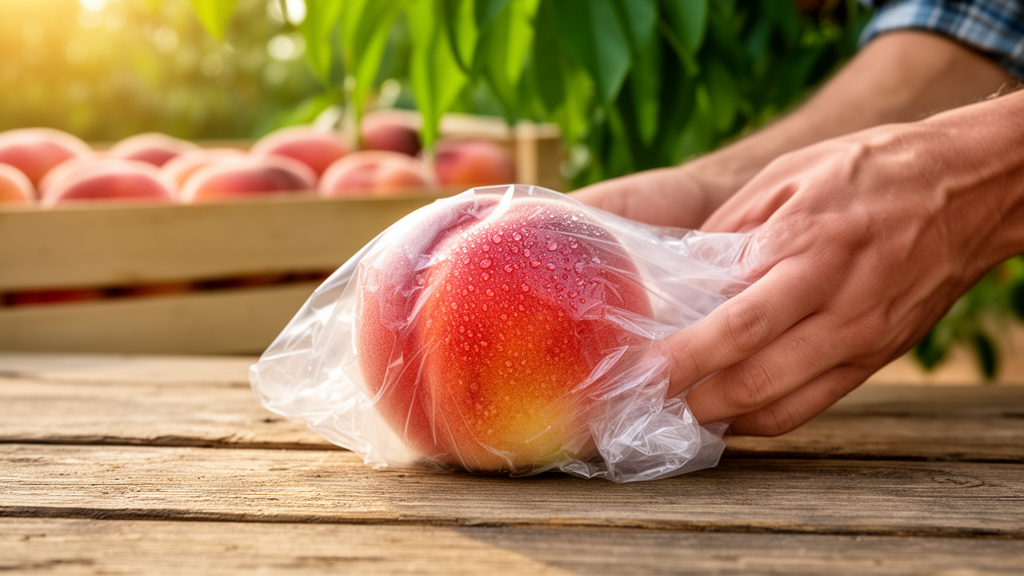
More than one third of the world’s fruits and vegetables are wasted every year across the global supply chain, lost to senescence, metabolic disorders, microbial infection and physical damage during storage and transport. A new review published on 8 October 2026 in the open-access journal Agricultural Products Processing and Storage argues that part of the solution may not come from better boxes or smarter films wrapped around produce, but from packaging that is built directly onto the produce itself. The paper, led by Si Tang and colleagues including Kunsong Chen, systematically surveys the fast-moving field of in-situ packaging, in which functional layers are formed on the surfaces of fruits and vegetables rather than applied as separate wrapping materials.
The core idea is simple but consequential. Conventional packaging surrounds produce with a barrier that must act from a distance: antimicrobial agents and antioxidants diffuse through the air inside the package, moisture barriers sit millimetres or centimetres away from the skin they protect, and sensors hang on package walls rather than on the fruit. In-situ packaging eliminates that gap. Using techniques such as in-situ reactions, deposition, polymerisation or self-assembly, researchers can construct customised barrier or functional layers that conform tightly to the surface of the produce, including irregularly shaped items that defeat standard wrapping. The review identifies three major implementation forms: coatings, fibrous membranes and hydrogels.
Coatings are the most industrially mature category. Dip coating, in which produce is immersed in a pre-formulated solution and dried, remains widely used because it is simple, cheap and adaptable to both whole and fresh-cut items. Classic wax coatings such as carnauba wax and beeswax form semi-permeable membranes that regulate gas exchange, reduce water loss and inhibit microbial growth, and recent studies have upgraded them into multi-component edible composites, including a sophorolipid-enhanced cellulose nanofiber coconut wax emulsion for cherry tomatoes and a sodium alginate-carnauba wax film with anti-browning activity for fresh-cut produce. Dip coating nevertheless struggles with precise control of film thickness, long drying times on high-moisture produce and poor uniformity on irregular shapes.
Spray coating offers greater flexibility for continuous industrial processing, and its optimised variant, electrostatic spraying, charges atomised droplets so that they deposit uniformly on target surfaces through electrostatic adsorption. Compared with conventional spraying, which relies on mechanical force and often causes droplet rebound and uneven coverage, electrostatic spraying achieves significantly higher deposition efficiency, better coverage on irregular surfaces and lower consumption of active agents. Reported applications include alginate-based edible coatings applied to strawberries and optimised chitosan coatings that enhance in-situ film formation on the same fruit. A third coating strategy, layer-by-layer self-assembly, sequentially deposits oppositely charged or complementary molecules to build multilayered films with precisely tunable thickness, composition and functionality. Demonstrations include a κ-carrageenan and carboxymethyl chitosan hydrogel film with kaolin clay for cherry tomatoes, a microporous nanocellulose film that regulates internal atmosphere and inhibits microbes, and a ZIF-8-initiated surface-moulding hydrogel that adsorbs ethylene and delays senescence in strawberries and bananas. The trade-off is throughput: multiple deposition cycles are time-consuming and poorly suited to large-scale postharvest operations.
The second implementation form, fibrous membranes, exploits nanofibers’ high specific surface area, high porosity and high loading capacity for active substances. In-situ spinning technologies can form fibers directly on produce surfaces in real time, adapting to different shapes and sizes. Conventional electrospinning requires a high-voltage electric field that may damage produce, so one team developed a battery-powered handheld device operating at much lower voltage to deposit polyvinyl butyral nanofibrous membranes loaded with camellia oil and zinc oxide-titanium dioxide nanoparticles onto fruit. Solution blow spinning avoids high voltage altogether by using pressurised gas to atomise polymer solution into fibers, and a microfluidic variant integrates microfluidic precision with gas-driven formation. Researchers have used these methods to deposit antimicrobial-loaded carboxymethyl chitosan and polycaprolactone nanofibers onto cherry tomatoes and to fabricate handheld-applied nanofibers carrying natamycin and trans-cinnamic acid on mangoes. A third technique, focused rotary jet spinning, uses centrifugal force and a focused air stream to coat irregularly shaped produce within two to four minutes, using water as the only solvent; one application produced biodegradable, rinsable pullulan fibers loaded with thyme oil, citric acid and nisin that extended shelf life and reduced weight loss.
Hydrogels represent the youngest and arguably most surprising category. Traditional hydrogel packaging serves as external filler and struggles to adhere uniformly to produce surfaces, but in-situ hydrogels form films directly on the target. The review’s authors describe a zinc sulfate-cross-linked double-network hydrogel built by immersing fruit in a precursor solution of sodium alginate, carboxylated cellulose nanofibers and gelatin, then transferring it into a zinc sulfate solution where synergistic ionic cross-linking and the Hofmeister effect trigger dual-network formation. The result is a uniform, transparent, easily peelable coating roughly two millimetres thick that requires no additional adhesives. In practical tests on kiwifruit, the coating significantly reduced bruise area and volume under vibration, compression and drop conditions, cutting vibration-induced damage by 34.8 to 53.3 percent, a quantifiable cushioning performance the authors note was previously unattainable with thin coatings.
Functionally, in-situ packaging draws on several preservation mechanisms. Antimicrobial systems incorporate essential oils, plant extracts and nanomaterials: quaternary chitosan combined with tea tree oil showed strong activity against pathogens such as Botrytis cinerea, while silver, copper and zinc nanoparticles embedded in natural polymer matrices enhanced controlled release and long-term inhibition. A distinct approach, photodynamic inactivation, uses photosensitizers that generate reactive oxygen species under light irradiation, inflicting multi-target oxidative damage on microbial cells and reducing the risk of antimicrobial resistance. One quercetin-loaded pectin coating achieved up to 100 percent inactivation of Staphylococcus aureus and Listeria monocytogenes under simulated sunlight and extended the shelf life of fresh-cut apples to ten days; a ferulic acid-gelatin coating achieved over 98.5 percent inactivation of foodborne pathogens under visible light. Beyond microbes, coatings inhibit colour darkening, slow firmness changes, retain vitamins and phenolics, create modified atmospheres that suppress respiration, and cut water loss, with one Janus-structured coating reducing mango weight loss to roughly ten percent over nine days compared with 21 percent in untreated controls.
The review also highlights a shift from passive protection to active monitoring. Colorimetric sensing labels built on porous metal-organic frameworks co-immobilise multiple chromogenic dyes, preconcentrating volatile organic compounds released by ripening bananas and enabling naked-eye, instrument-free freshness evaluation with a handheld device. A smartphone-integrated microneedle platform immobilising oxidase-like carbon dots on gelatin methacryloyl patches detects ascorbic acid in mango, nectarine, apple, pear and kiwifruit within ten minutes, with results matching a traditional ultraviolet method at a correlation coefficient of 0.97. On the conductive side, a self-adhesive pressure-responsive conductive hydrogel sensor attaches directly to apple surfaces and detects compressive forces in real time, while the zinc sulfate-cross-linked hydrogel doubles as a strain sensor, converting mechanical strain into electrical signals with stable response over 100 compression cycles. Flexible ethylene sensors, including a palladium nanoparticle-carbon nanotube composite device and a wireless MXene-printed radio frequency resonator, can be affixed directly to fruit to track ripening from green maturity to decay.
None of this is yet ready for the packing line without caveats, and the review is candid about the bottlenecks. The multi-scale interface interactions between packaging materials and complex produce surfaces remain poorly understood, so adhesion and film formation are unreliable across fruits with different hydrophobicity, roughness and moisture content. Most high-performance bio-based materials still cost significantly more than conventional plastics, and active-ingredient loading technologies such as nanoparticle encapsulation remain expensive with low yields. Safety evaluation lags behind: although the natural biopolymers used as matrices appear on permitted food additive lists in major regulatory systems, there are no unified international standards for emerging antimicrobial nanocomposites, and the long-term safety of multi-component systems needs further verification. Consumer acceptance is another hurdle, with concerns about edibility, additive residues, waxy textures, residual essential oil tastes and the extra washing steps some systems require.
The authors map five future directions: efficient and mild film-forming technologies, green process integration with existing washing and sorting lines, intelligent responsiveness in which pH- or ethylene-sensitive materials trigger on-demand release of antioxidants or antimicrobials in a sensing-decision-response loop, self-healing capability through dynamic covalent bonds or supramolecular interactions to survive weeks of cold-chain transport, and digital interconnection combining embedded sensors, blockchain traceability and digital twin models. Their overall conclusion is that the field is moving from single-function material development toward system-level integration, and that in-situ packaging could eventually act as an active, interconnected node in the digital supply chain rather than a passive protective layer. For now, the technology remains largely at laboratory proof-of-concept stage, but the convergence of conformal film formation, engineered cushioning and surface-integrated sensing suggests the next generation of produce packaging may be one the fruit itself wears.
Subject of Research: In-situ packaging technologies that form functional protective layers directly on postharvest fruits and vegetables
Article Title: Research progress of postharvest in-situ packaging of fruits and vegetables: realization form, functional mechanism and future trend
Article References: Tang, S., Dong, J., Chen, J., Li, Z., Yang, L., Feng, X., Zhang, W., Wu, D., & Chen, K. (2026). Research progress of postharvest in-situ packaging of fruits and vegetables: realization form, functional mechanism and future trend. Agricultural Products Processing and Storage, 2(1), Article 47. https://doi.org/10.1007/s44462-026-00082-4
Image Credits: AI Generated
DOI: 10.1007/s44462-026-00082-4
Keywords: in-situ packaging, postharvest preservation, fruits and vegetables, edible coatings, nanofibers, hydrogels, antimicrobial packaging, modified atmosphere, smart packaging, food waste, electrostatic spraying, food safety
Cite Scienmag News
Alan Morgan. (October 27, 2026). Packaging That Grows on the Fruit: The Science of In-Situ Preservation. Scienmag. https://scienmag.com/packaging-that-grows-on-the-fruit-the-science-of-in-situ-preservation/
Alan Morgan. "Packaging That Grows on the Fruit: The Science of In-Situ Preservation." Scienmag, 27 October 2026, https://scienmag.com/packaging-that-grows-on-the-fruit-the-science-of-in-situ-preservation/. Accessed 4 November 2026.
Alan Morgan. "Packaging That Grows on the Fruit: The Science of In-Situ Preservation." Scienmag. October 27, 2026. https://scienmag.com/packaging-that-grows-on-the-fruit-the-science-of-in-situ-preservation/