


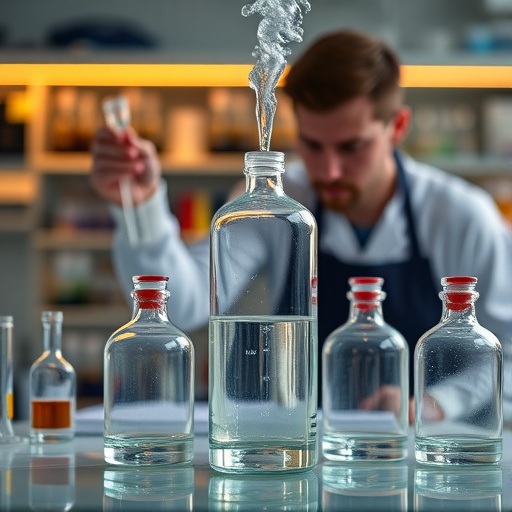
Alcohols are among chemistry’s most versatile raw materials, appearing in pharmaceuticals, agrochemicals, fragrances, polymers and countless industrial intermediates. Yet transforming an alcohol into an alkyl fluoride—a molecule in which fluorine is attached to a carbon atom—has remained unusually difficult. A team at the University of Oxford has now developed a potassium fluoride-based method that could make this important reaction safer, more efficient and far easier to scale than conventional approaches.
Fluorinated molecules are central to modern drug discovery and crop protection because fluorine can substantially alter a compound’s biological, chemical and physical properties. Introducing the element can improve metabolic stability, change acidity, influence how a medicine binds to its target or modify the way a material behaves. Despite these advantages, the chemical installation of fluorine often depends on hazardous reagents. One of the most widely used examples is DAST, or diethylaminosulfur trifluoride, a powerful fluorinating agent that is toxic, thermally unstable and operationally demanding in large-scale manufacturing.
The Oxford researchers, led by Professor Véronique Gouverneur of the University’s Department of Chemistry, revisited a reaction first developed more than a century ago: the Appel reaction. Traditionally, the Appel reaction converts alcohols into alkyl halides by activating the alcohol with a phosphonium reagent and then allowing a halide ion to replace the oxygen-containing group. Chlorides, bromides and iodides can generally be produced efficiently in this way. Fluoride, however, has resisted the same strategy because it reacts with the phosphorus reagent to form a stable, unproductive compound rather than fluorinating the alcohol.
The problematic species is known as PPh₃F₂, or difluorotriphenylphosphorane. Its formation effectively traps fluoride before the ion can attack the activated alcohol. In chemical terms, the reaction pathway is diverted into a thermodynamic dead end. This explains why the classic Appel process, although broadly useful for other halides, has not provided a practical general method for converting alcohols into alkyl fluorides using a simple inorganic fluoride salt.
Oxford’s solution is a newly designed neopentoxyphosphonium salt. The reagent changes the behavior of the phosphorus-containing reaction system, preventing the formation of the unwanted PPh₃F₂ side product. In the presence of potassium fluoride, the salt generates a reactive intermediate that can activate the alcohol substrate. The resulting activated species is then attacked by fluoride, replacing the alcohol-derived group and forming the carbon–fluorine bond. The approach is catalytic in key components, meaning that the researchers can reduce the amount of material required while retaining high reactivity.
Potassium fluoride is particularly attractive because it is inexpensive, widely available and considerably easier to handle than many specialized fluorinating reagents. The Oxford team demonstrated the method across more than 80 substrates, producing a broad collection of fluorinated molecules with yields reaching 98 percent. The compounds included cyclic and heterocyclic structures as well as alkyl fluorides related to biologically relevant molecular frameworks. Such breadth is critical: a reaction that works only with one simple alcohol would have limited practical value, whereas a method compatible with diverse molecular architectures could become a valuable tool for medicinal and synthetic chemistry.
The researchers also achieved a more demanding feat: the preparation of enantioenriched fluorochemicals from racemic alcohols. Enantiomers are molecules that possess the same atoms and bonds but differ in three-dimensional arrangement, like left and right hands. Because biological targets are themselves chiral, the distinction can determine whether a compound is therapeutically useful, inactive or toxic. Conventional fluorination strategies often require an enantiomerically enriched starting material. The new reaction can instead use a readily available racemic alcohol and generate products with useful stereochemical enrichment, potentially simplifying the preparation of chiral fluorinated building blocks.
The sustainability implications extend beyond the reaction itself. The process does not depend on hydrogen fluoride, or HF, the hazardous fluorine source used throughout much of industrial fluorine chemistry. The fluoride-containing materials needed to prepare the new reagent can be made from fluorspar, an abundant mineral. In earlier work published in Nature in 2024, Gouverneur’s team demonstrated that fluorspar could be converted into fluorochemicals through low-temperature activation in water, offering a potential alternative to supply chains built around concentrated HF.
The Oxford researchers further report that both the catalyst and the phosphine oxide by-product can be recovered and recycled. This reduces waste and introduces elements of circular chemistry into a transformation traditionally associated with difficult-to-manage reagents and by-products. By combining a common fluoride salt, a recyclable reaction system and a broader source of fluorine derived from fluorspar, the strategy could help move fluorination toward safer and more resource-efficient manufacturing. The study, published in Science, suggests that a reaction once considered unsuitable for fluoride may now provide a practical route to valuable fluorinated medicines, crop-protection compounds and advanced materials.
News Publication Date: 30 July 2026
Web References: University of Oxford: Véronique Gouverneur; Fluorspar to fluorochemicals upon low-temperature activation in water
References: Science, DOI: 10.1126/science.aec6298
Keywords
Potassium fluoride, Appel fluorination, alcohols, alkyl fluorides, fluorine chemistry, catalytic chemistry, sustainable chemistry, circular chemistry, medicinal chemistry, University of Oxford
Cite Scienmag News
Bethany Barker. (August 1, 2026). Oxford chemists unlock Appel fluorination using potassium fluoride. Scienmag. https://scienmag.com/oxford-chemists-unlock-appel-fluorination-using-potassium-fluoride/
Bethany Barker. "Oxford chemists unlock Appel fluorination using potassium fluoride." Scienmag, 1 August 2026, https://scienmag.com/oxford-chemists-unlock-appel-fluorination-using-potassium-fluoride/. Accessed 4 September 2026.
Bethany Barker. "Oxford chemists unlock Appel fluorination using potassium fluoride." Scienmag. August 1, 2026. https://scienmag.com/oxford-chemists-unlock-appel-fluorination-using-potassium-fluoride/


