


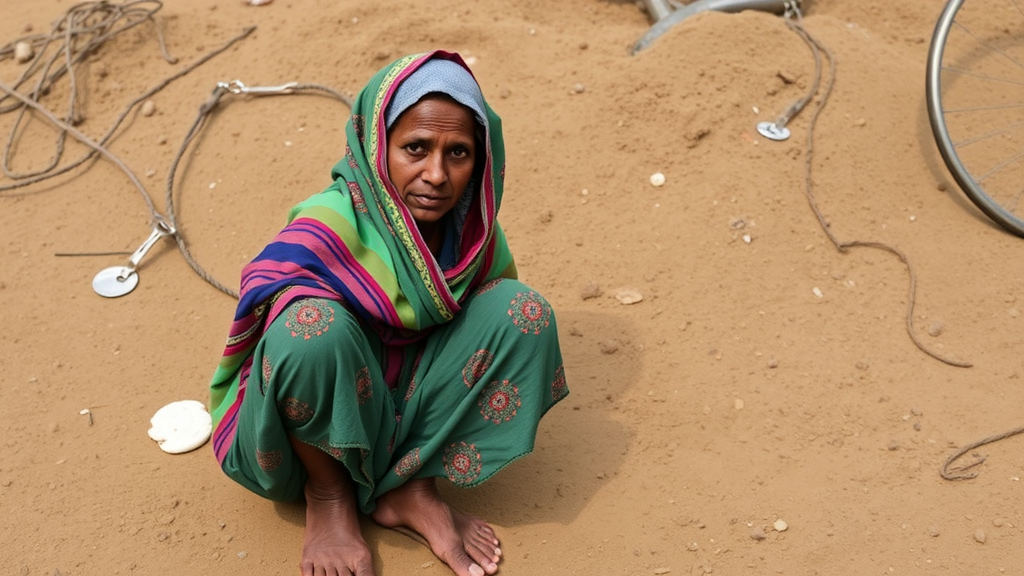
When a village runs short of water, the reflexive response of engineers and policymakers is often to drill deeper, pump harder, or lay more pipes. But a new study from Mohlai village in the central Indian state of Chhattisgarh argues that the real drivers of water insecurity are not hydrological at all. Water access there, researchers found, is shaped by economic capacity, infrastructural position, institutional authority and social power relations rather than by physical scarcity alone. The finding, published in the journal Discover Sustainability, comes not from remote sensing or hydrological modelling, but from an ethnographer who embedded himself in village life as a self-consciously non-native researcher, using participatory tools to let the community map its own water realities.
The study, conducted by Tonderai Manezhu, S. Sruthy and Raji Pushpalatha of Amrita Vishwa Vidyapeetham’s Amrita School for Sustainable Futures in Kerala, sits at the intersection of two methodological traditions. The first is Participatory Rural Appraisal, or PRA, a family of techniques developed in the 1980s that transfers the tools of analysis from the outside expert to the community itself, using exercises such as resource maps, seasonal calendars and transect walks. The second is non-native ethnography, in which a researcher works in a cultural and linguistic setting that is not their own. The study’s central contribution is to show how these two traditions, often treated separately, can be woven together to investigate water governance in complex rural environments.
The theoretical spine of the research is hydrosocial theory, a framework that rejects the idea of water as a purely physical substance moving through a natural cycle. Instead, hydrosocial analysis treats water and society as mutually constitutive: political decisions, economic inequalities and cultural norms shape how water is captured, distributed and valued, while the resulting water systems in turn reinforce those social arrangements. Viewed through this lens, a tap that runs dry in one neighbourhood while another overflows is not a technical malfunction. It is an expression of the social order, made visible in infrastructure.
Applying that lens in Mohlai, the researchers identified a cluster of systemic problems. The village suffers seasonal drinking water scarcity, with availability fluctuating across the year rather than remaining uniformly poor. Distribution and supply are marked by inequality, meaning that some households reliably obtain water while others are left with insecure access. Wastewater management is inefficient, allowing greywater to circulate in ways that pose hygiene concerns. And groundwater levels are declining, a slow-moving crisis familiar across much of rural India where aquifers are drawn down faster than they recharge.
The crucial interpretive move came in the analysis of why these problems persist. The study concludes that water access in Mohlai is driven by economic capacity, infrastructural position, institutional authority and social power relations rather than physical scarcity. In other words, even where water physically exists, the ability to obtain it is unevenly distributed along social lines. Households with money, connections to functioning infrastructure and standing within local institutions fare better than those without. This reframing matters enormously for policy: interventions that simply add supply, without addressing the social architecture of distribution, risk reproducing the very inequalities that produce scarcity in the first place.
Reaching that conclusion required a methodological journey that the paper documents with unusual candour. The fieldwork was ethnographic and conducted across multiple stakeholder groupings, engaged through household and session-level PRA exercises rather than a fixed enumerated sample. That design choice reflects the logic of ethnography itself: instead of extracting data from a statistically representative cross-section, the researcher builds an understanding of the village as a lived social system, following conversations, events and relationships as they unfold. PRA exercises then structured that immersion, giving villagers tools to record their own knowledge and making community members co-investigators rather than passive subjects.
Being a non-native researcher presented formidable barriers, and the study treats these not as noise to be filtered out but as central to the research process. Linguistic limitations complicated everyday communication, since an outsider cannot catch nuance, idiom or irony in a language learned late. Cultural barriers risked misreading social cues and local etiquette. Perhaps most intractable were power asymmetries in developmental deliberations: in village meetings about water and development, dominant voices can crowd out marginalised ones, and an outside researcher with institutional backing can inadvertently add yet another powerful presence to the room. The researchers’ positionality, meaning their social position relative to the community, shaped every interaction.
Their response to these barriers was a strategy of deliberate rapport-building and collaborative validation. Rapport, in the ethnographic tradition, is the trust that allows a researcher to move from visitor to participant, and the study identifies it as the key to effective engagement in fieldwork, alongside strategic engagement for gaining entry into the research field in the first place. Collaborative validation then worked on two fronts. Technocentric PRA tools, such as a seasonal calendar in which villagers charted water availability month by month, and resource mapping, in which the community depicted its own water infrastructure and sources, produced structured records that could be checked against interview and observational data. Cross-cultural immersion, sustained over the fieldwork period, allowed the researcher to test interpretations against lived experience and reduce translation error. The study describes this as supporting triangulation across evidence sources, the practice of confirming a finding through multiple independent routes.
The ethical scaffolding of the research was correspondingly careful. Ethical clearance was obtained from the Institutional Ethics Review Board of Amrita Vishwa Vidyapeetham, with procedures conducted in accordance with Indian Council of Medical Research guidelines and the principles of the Declaration of Helsinki. Informed consent was obtained from all participants, who were told the study’s purpose, the voluntary nature of participation, how confidentiality would be protected and how data would be used for academic publication. The board’s approval noted the study’s focus on waste and water management with little to no sensitive inquiry, and a contingency plan addressed potential risks of greywater contact during the intervention. The work was supported by the E4LIFE International Ph.D Fellowship Program at Amrita Vishwa Vidyapeetham, with field support from the Amrita Live-in-Labs programme, the village local authority and Mohlai villagers themselves.
The wider significance of the study lies in its methodological lesson for sustainability science. As funding bodies and governments push for participatory approaches to resource governance, a persistent critique has been that participation can become tokenistic, with communities consulted but power relations left untouched. By foregrounding the researcher’s own positionality, the Mohlai study models a form of reflexivity in which the outsider’s limits, and the strategies for working within them, become explicit parts of the method rather than hidden assumptions buried in a methods section. For the millions of rural households across India facing seasonal water scarcity and declining groundwater, the message is that durable solutions will not come from pipes alone. They will require understanding who controls the taps, who is heard in village deliberations, and how a community, working with an honest outsider, can chart its own path to equitable water governance.
Subject of Research: Participatory rural appraisal and hydrosocial analysis of community-based water governance in rural India
Article Title: Participatory rural appraisal for community-based water governance in rural India through a researcher’s positionality-informed approach
Article References: Manezhu, T., Sruthy, S., & Pushpalatha, R. (2026). Participatory rural appraisal for community-based water governance in rural India through a researcher’s positionality-informed approach. Discover Sustainability. https://doi.org/10.1007/s43621-026-04753-x
Image Credits: AI Generated
DOI: 10.1007/s43621-026-04753-x
Keywords: water governance, participatory rural appraisal, hydrosocial theory, ethnography, rural India, groundwater, wastewater management, positionality, Chhattisgarh, water scarcity, PRA methods, sustainability
Cite Scienmag News
Violet Maxwell. (September 27, 2026). Outsider Eyes: How a Non-Native Ethnographer Uncovered the Social Fault Lines of Water Scarcity in Rural India. Scienmag. https://scienmag.com/outsider-eyes-how-a-non-native-ethnographer-uncovered-the-social-fault-lines-of-water-scarcity-in-rural-india/
Violet Maxwell. "Outsider Eyes: How a Non-Native Ethnographer Uncovered the Social Fault Lines of Water Scarcity in Rural India." Scienmag, 27 September 2026, https://scienmag.com/outsider-eyes-how-a-non-native-ethnographer-uncovered-the-social-fault-lines-of-water-scarcity-in-rural-india/. Accessed 4 October 2026.
Violet Maxwell. "Outsider Eyes: How a Non-Native Ethnographer Uncovered the Social Fault Lines of Water Scarcity in Rural India." Scienmag. September 27, 2026. https://scienmag.com/outsider-eyes-how-a-non-native-ethnographer-uncovered-the-social-fault-lines-of-water-scarcity-in-rural-india/


