


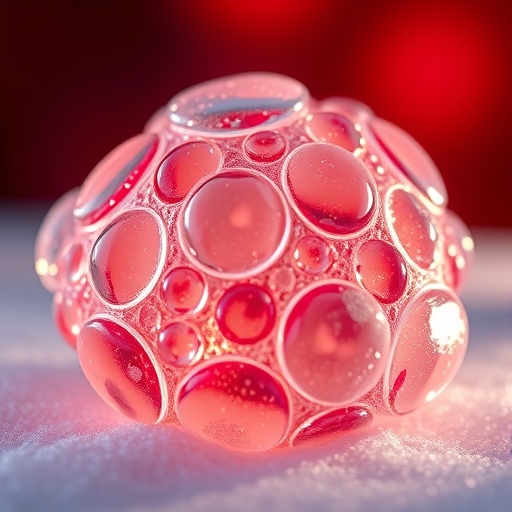
In the depths of the world’s oceans, beneath layers of sediment, lie enigmatic crystalline structures known as clathrate hydrates. These naturally occurring compounds are formed when water molecules organize into cage-like lattices, trapping gases such as methane or carbon dioxide within their framework. While fascinating in their complexity and stability, clathrate hydrates have long remained an elusive and underutilized material in technological applications. That status, however, may be poised for transformation thanks to pioneering research led by Alberto Striolo, Ph.D., a professor at the University of Oklahoma’s Gallogly College of Engineering.
Clathrate hydrates resemble ice in appearance and structure, but their physical and chemical properties render them far more stable under specific temperature and pressure conditions found on ocean floors. Such stability suggests enormous potential for their use in fields ranging from energy storage to environmental management. Despite this promise, the practical deployment of clathrate hydrates has been limited primarily due to their notoriously slow growth rates—a barrier that Dr. Striolo’s team has tackled with unprecedented insight.
The research, published in the prestigious Proceedings of the National Academy of Sciences, introduces groundbreaking findings revealing the critical role of a mysterious quasi-liquid layer that exists at the interface of the hydrate surface. Unlike pure solid ice or liquid water, this interfacial zone is a semi-ordered, semi-fluid layer that fosters unique molecular dynamics, playing a decisive role in controlling how quickly hydrates can form and grow under natural conditions.
Utilizing advanced computational models, the researchers simulated the behavior of hydrate formation in the presence of chemical additives, focusing on the mechanisms at the quasi-liquid interface. They discovered that certain adsorbed additives significantly increase the thickness of this layer, thereby enhancing the mobility of carbon dioxide molecules within it. These findings identified the quasi-liquid layer’s thickness not merely as a passive boundary but as an active moderator of molecular diffusion — a key factor that accelerates the growth kinetics of clathrate hydrates.
This discovery challenges previous assumptions that limited hydrate formation was an immovable characteristic and opens new avenues for engineering faster, more efficient growth of hydrate materials in laboratory and industrial settings. The realization that carbon dioxide molecules can traverse this layer more rapidly than through bulk water introduces novel strategies for manipulating hydrate growth, with significant implications for carbon capture and sequestration technologies.
Beyond the fundamental science, the practical implications of understanding and harnessing this quasi-liquid layer are profound. Clathrate hydrates could provide eco-friendly, low-pressure storage solutions for gases, reducing the costs and environmental impact of transporting methane or carbon dioxide over long distances. Furthermore, their unique “cage” structures could be optimized to selectively trap different molecules, enabling breakthroughs in gas separation processes that are critical for energy and environmental sustainability.
Another promising application lies in water desalination. As hydrates expel salt when forming from saltwater, controlled formation of clathrate hydrates could revolutionize desalination technologies, offering potentially energy-efficient alternatives to traditional methods. Such advances may address growing global concerns over freshwater scarcity while reducing reliance on energy-intensive chemical processes.
However, the significance of this research extends beyond technological development. In the oil and gas industry, clathrate hydrates also represent a double-edged sword — often forming unintentionally within pipelines, where they can block flow and cause structural damage, leading to costly leaks and environmental hazards. By elucidating the molecular-level mechanisms governing hydrate growth, Dr. Striolo’s work has the potential to inform better mitigation strategies, preventing operational disruptions and enhancing safety standards.
Alberto Striolo, who holds the Asahi Glass Chair in Chemical Engineering and the Lloyd and Jane Austin Presidential Professorship, leads this innovative endeavor with a global collaborative approach. His contributions, alongside co-authors Matteo Salvalaglio and Xinrui Cai from the Thomas Young Centre and University College London, exemplify the power of international interdisciplinary research. Together, they are charting new terrains in molecular-scale understanding that bridge fundamental chemistry with tangible engineering solutions.
Looking forward, the team aims to extend these insights to larger hydrate formations capable of capturing more molecules per unit volume, thus amplifying the technological viability of hydrate-based storage and separation systems. By tailoring the cage sizes within these crystalline matrices, researchers hope to develop bespoke materials that could underpin next-generation sustainable energy and environmental technologies.
The broader scientific community already recognizes the novelty and importance of this work. It reframes the narrative around clathrate hydrates—from geological curiosities and industrial nuisances to versatile materials with transformative potential for addressing climate change, energy efficiency, and resource management.
Dr. Striolo emphasizes that the continued progress in this field will depend on sustained international cooperation among academia, industry, and government stakeholders. Such partnerships are crucial to translate computational and experimental breakthroughs into scalable, real-world technologies that can meet pressing global challenges.
In sum, the discovery of the quasi-liquid layer’s controlling influence on clathrate hydrate growth stands as a landmark advancement. It not only deepens our scientific understanding of these unique substances but also unlocks a spectrum of practical applications that could reshape how we store and manage critical gases, desalinate water, and mitigate environmental impacts on a planetary scale.
Cite Scienmag News
Denise Maddox. (March 27, 2026). OU Researcher Uncovers Growth Mechanisms Behind Ice-Like Materials. Scienmag. https://scienmag.com/ou-researcher-uncovers-growth-mechanisms-behind-ice-like-materials/
Denise Maddox. "OU Researcher Uncovers Growth Mechanisms Behind Ice-Like Materials." Scienmag, 27 March 2026, https://scienmag.com/ou-researcher-uncovers-growth-mechanisms-behind-ice-like-materials/. Accessed 5 September 2026.
Denise Maddox. "OU Researcher Uncovers Growth Mechanisms Behind Ice-Like Materials." Scienmag. March 27, 2026. https://scienmag.com/ou-researcher-uncovers-growth-mechanisms-behind-ice-like-materials/


