


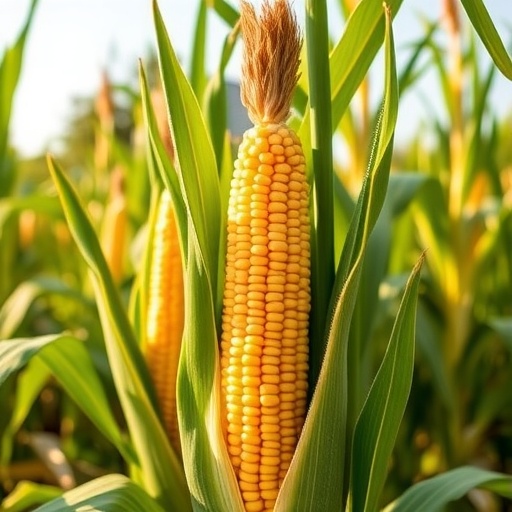
As the cornerstone of China’s food security, corn occupies a critical place in the nation’s agricultural landscape. As the most widely planted and highest-yielding grain crop in China, any advance in maize production directly influences the overall stability of food supply. However, with the mounting pressures of global population growth and shrinking arable land, China faces an urgent imperative: increase corn yields sustainably without exacerbating environmental degradation. In a groundbreaking study recently published in Frontiers of Agricultural Science and Engineering, a team led by Professor Peng Hou from the Institute of Crop Sciences at the Chinese Academy of Agricultural Sciences offers a pioneering solution to this multifaceted challenge. Their research introduces a quantitatively designed production strategy that marries high yield with resource efficiency, setting a new benchmark for sustainable maize cultivation.
Corn production in China is currently beset by a confluence of environmental and management-related constraints that throttle yield potential. From the standpoint of climate, declining solar radiation and increasingly erratic weather events such as droughts, floods, and heatwaves severely impair the plant’s photosynthetic capacity and nutrient assimilation. These climatic stressors impose a fluctuating biophysical ceiling on maximum attainable yields, especially in regions that are traditionally high producers. Simultaneously, soil degradation has become an insidious barrier. Decades of conventional shallow tillage have compacted the plow layer, limiting root penetration and water retention—effects that cumulatively stunt plant growth and curtail yield by as much as 20%. This acute soil compaction presents a formidable structural bottleneck that undermines standard agronomic inputs.
Beyond these biophysical limitations, crop management practices in China reveal significant inefficiencies. Most notably, planting densities remain substantially lower compared to benchmarks in countries like the United States, resulting in suboptimal canopy formation and light interception. Fertilizer application is another double-edged sword; while over-application is prevalent in some regions causing nutrient leaching and groundwater pollution, uneven or insufficient fertilization in others reduces nutrient uptake efficiency. This imbalance not only wastes valuable inputs but also drives environmental consequences such as soil acidification and greenhouse gas emissions. Together, these factors articulate a clear narrative—China’s maize production system is ripe for optimization through science-driven, precision agriculture.
To confront this challenge head-on, the research team harnessed quantitative design principles to architect a triad of integrated strategies optimized for both spatial and physiological parameters. Foremost among these is the dynamic calibration of planting density tailored to regional solar radiation profiles. By evaluating solar flux gradients across China’s vast territorial expanse, their model advocates escalating plant density to leverage abundant sunlight in western regions, especially the arid Northwest. Conversely, in eastern, cloudier zones, density adjustments aim to prevent resource wastage where solar input is comparatively limited. This fine-tuned density modulation ensures maximized photosynthetic efficiency while minimizing intra-species competition.
Complementing density optimization is the strategic selection and breeding of maize varieties with architectural traits tuned to canopy light dynamics. The researchers emphasize ‘compact’ maize cultivars characterized by smaller leaf angles, which reduce mutual shading among plants. This canopy architecture enables better light penetration to mid and lower leaves, effectively boosting total canopy photosynthetic capacity. By facilitating deeper light penetration within the plant matrix, compact varieties convert solar energy into biomass more efficiently than sprawling counterparts. This variety-to-canopy matching achieves a critical balance between plant geometry and environmental resource use that can unlock previously inaccessible yield gains.
The third pillar of their system marries agronomic interventions with soil-root-plant functional compatibility. Here, deep loosening tillage disrupts the compacted plow layer, revitalizing root zone aeration and water infiltration. This physical soil amelioration enhances root proliferation deeper into the soil profile, expanding nutrient and moisture acquisition zones. Concurrently, the integration of drip irrigation and fertigation technologies delivers precise water and nutrient dosages directly to the root zone, minimizing losses and improving uptake efficiency. This harmonized approach generates a synergistic effect where improved root function supports vigorous above-ground growth, translating into higher grain yields without escalating inputs.
Quantitative modeling integrating these factors yielded promising forecasts that have been validated through experimental trials. Post-implementation data reveal regional yield enhancements of 10.5% in Southwest China, 2.7% in the Huang-Huai-Hai Plain, 5.2% in North China, and 10.3% in the Northwest, all achieved without increasing nitrogen fertilizer inputs. These improvements underscore the efficiency of the design principles and their potential scalability. Notably, drip irrigation combined with fertigation in the arid Northwest has revolutionized water use efficiency by over 30%, demonstrating how precision resource management can thrive in water-scarce environments and markedly outperform traditional practices.
The transformative impact of these technologies has transcended experimental plots, expanding across approximately 4 million hectares—constituting nearly 9% of China’s total maize cultivation area. The dissemination is particularly robust in arid and semi-arid zones such as the Northwest and Northeast, where the benefits of water and nutrient stewardship are magnified by environmental constraints. This widespread adoption signals a shift towards more sustainable agricultural modalities capable of sustaining yield growth while curbing ecological footprints, a critical advance in the face of escalating climatic and resource pressures.
Environmental sustainability sits at the heart of this production redesign. Beyond quantifiable yield gains, these approaches offer tangible reductions in nitrogen fertilizer usage and water consumption, directly mitigating associated greenhouse gas emissions including nitrous oxide—a potent climate forcing agent. By enabling better synchronization between plant demand and resource supply, the approach diminishes nutrient runoff and soil degradation, addressing core environmental challenges that have plagued conventional corn production systems. Thus, it represents a holistic leap forward in coupling productivity with sustainability in Chinese agriculture.
Looking ahead, the researchers advocate for further refinement through regional customization, amplifying the responsiveness of their framework to localized climatic and edaphic variables. For example, the Southwest region stands to gain from intensified density and light regime optimization, while the Huang-Huai-Hai region would benefit from accelerating the breeding of varieties resilient to abiotic stresses, including heat and drought. This push towards personalized production schemes, guided by big-data analytics and precision breeding, heralds a future where maize cultivation is not only highly productive but also resilient and low-impact.
This study exemplifies a paradigm shift from heuristic-based farming practices toward scientifically engineered, quantitatively optimized agriculture. By systematically dissecting the multiple layers constraining current production—climatic limits, soil physical state, plant architecture, and resource management—the research draws an integrated portrait of yield enhancement that is both effective and environmentally conscious. It positions China at the forefront of global efforts to meet burgeoning food demands sustainably, leveraging agronomic innovation as a weapon against both hunger and climate change.
The integration of canopy structure, root system optimization, and advanced irrigation-fertilization management encapsulates a systems-thinking approach rarely actualized at scale. It underscores how interdisciplinary collaboration—spanning plant physiology, soil science, environmental engineering, and agronomy—can engineer breakthroughs that single-discipline approaches cannot achieve. The work by Professor Peng Hou and collaborators thus provides a replicable blueprint not only for China but for maize growers worldwide facing similar climatic and resource constraints.
In summary, this research marks a transformative step in sustainable maize production by combining regional solar radiation data, cultivar architectural traits, and integrated soil-rhizosphere management. The demonstrated ability to boost yields by up to 10% without increasing nitrogen inputs, alongside dramatic enhancements in water and nutrient use efficiency, signals the dawn of a new era of green production in corn farming. As policy makers, agronomists, and farmers rally around these innovations, China’s maize sector will simultaneously feed its growing population and safeguard the environment, blending productivity with stewardship in a model for the future of agriculture.
Cite Scienmag News
Alan Morgan. (August 14, 2025). Optimizing High Corn Yields While Enhancing Resource Efficiency. Scienmag. https://scienmag.com/optimizing-high-corn-yields-while-enhancing-resource-efficiency/
Alan Morgan. "Optimizing High Corn Yields While Enhancing Resource Efficiency." Scienmag, 14 August 2025, https://scienmag.com/optimizing-high-corn-yields-while-enhancing-resource-efficiency/. Accessed 3 September 2026.
Alan Morgan. "Optimizing High Corn Yields While Enhancing Resource Efficiency." Scienmag. August 14, 2025. https://scienmag.com/optimizing-high-corn-yields-while-enhancing-resource-efficiency/


