


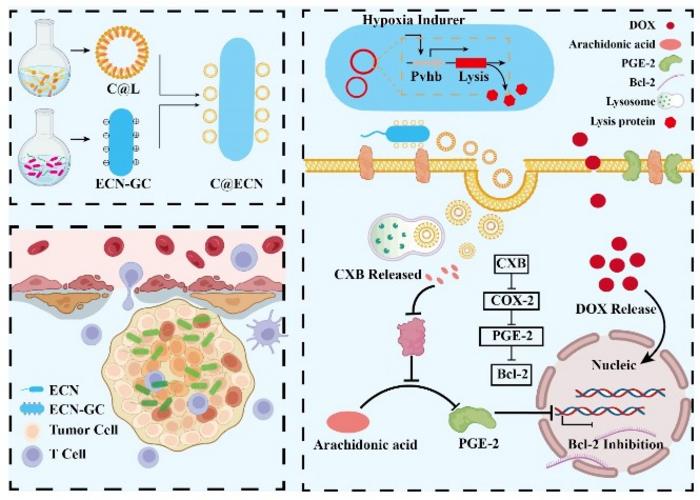
Live bacteria can be applied in cancer therapy given their ability to deplete nutrients and induce cell death in tumors. However, the interaction between bacteria and tumor cells is risky and can exacerbate the inflammatory response and the expression of anti-apoptotic genes. Now, researchers from China have engineered a strain of Escherichia coli (C@ECN-PL) with liposomes and a self-lysis circuit to optimize targeted tumor cell killing and improve biosafety.

Credit: BioDesign Research
Live bacteria can be applied in cancer therapy given their ability to deplete nutrients and induce cell death in tumors. However, the interaction between bacteria and tumor cells is risky and can exacerbate the inflammatory response and the expression of anti-apoptotic genes. Now, researchers from China have engineered a strain of Escherichia coli (C@ECN-PL) with liposomes and a self-lysis circuit to optimize targeted tumor cell killing and improve biosafety.
Researchers probing the next frontiers in cancer therapy have turned to bacteria given their ability to inhibit tumor proliferation by colonizing tumors. Crucially, the Achilles heel of this approach is suboptimal treatment efficiency caused by the bacteria-induced inflammatory response. The concern is the ensuing signaling cascade spurs cyclooxygenase II (COX-2) upregulation in the tumor microenvironment. COX-2 promotes anti-apoptotic gene expression in tumor cells and resistance to chemotherapy and immunotherapy.
To overcome this limitation, researchers are exploring how engineered bacteria can optimize the process of tumor colonization and targeted drug delivery while maximizing biosafety. Salmonella engineered to target tumors have delivered positive results in the laboratory but were highly toxic and produced insufficient therapeutic effects in clinical trials. Moving forward, the developments being pursued to improve the efficiency of these bacterial vectors include surface modifications, molecular modifications, and chemical encapsulation.
Recently, a team of researchers in China engineered a strain of Escherichia coli (E. coli) with liposomes to deliver an anticancer drug and explored its ability to colonize the tumor microenvironment. The team was helmed by Dr. Jiaofang Huang from the State Key Laboratory of Bioreactor Engineering at East China University of Science and Technology. “The tumor microenvironment is hypoxic (oxygen deprived) so it lends itself to being colonized by anaerobic microbes. Optimizing this colonization to deliver anticancer drugs, and doing so safely, holds great promise in oncology,” says Dr. Huang when questioned about his motivation to pursue the research. The study (doi: 10.34133/bdr.0038) was published in BioDesign Research on 25 June 2024.
To overcome limitations inherent to bacterial vectors, the team developed an E. coli strain (C@ECN-PL) as their anticancer drug delivery platform. E. coli Nissle 1917 (ECN) was engineered with a hypoxia-induced lysis circuit expressed via the pGEX-Pvhb-Lysis plasmid. This self-lysis circuit ensured that drug delivery in the oxygen-deprived tumor microenvironment could be coupled with minimal unintended bacterial proliferation. The anti-inflammatory COX-2 inhibitor celecoxib (CXB) was sequestered in liposomes electrostatically anchored to the surface of ECN cells (C@ECN). Drug delivery systems based on liposomes have been trialed before but were found to be hampered by low drug utilization at the target. This occurred due to reticuloendothelial clearance and an inability to penetrate the dense tumor extracellular matrix. It is worth noting that CXB is toxic so delivering it via liposomes secured to bacteria curbed any unwanted inflammatory response, ensured targeted delivery, and minimized toxicity. The team was keen to understand if C@ECN-PL could increase the sensitivity of tumor cells to chemotherapy drugs and tested the effect of C@ECN-PL combined with doxorubicin (DOX) on tumor cells.
“When we tested our C@ECN-PL drug delivery platform in the lab, we found it delivered CXB accurately to tumor cells. Furthermore, our engineered bacterial vector was less toxic, minimized CXB’s adverse effects, and increased the action of DOX toward tumor cells,” explains Dr. Huang when discussing the study’s significant findings, “Following our experiments in mice, we were satisfied to find C@ECN-PL colonized the tumor microenvironment and was safely eliminated from this region via activation of the self-lysis circuit. Additionally, we measured strong inhibition of COX-2 by CXB and increased tumor cell sensitivity to DOX during our research.”An important finding was ECN’s ability to act as an immune adjuvant. The team found it reversed tumor-induced suppression and successfully recruited CD3+, CD4+, and CD8+ cells to the tumor microenvironment.
Dr. Huang is buoyed by the potential of C@ECN-PL to revolutionize drug delivery in oncology. “Subduing the inflammatory response against ECN and ensuring biocompatibility remains crucial to its success. However, I’m confident future developments will make the ECN platform more robust and allow us to deliver a broad range of drugs spanning small molecules, RNA, and proteins,” he concludes.
###
References
Original Source URL
About BioDesign Research
BioDesign Research is dedicated to information exchange in the interdisciplinary field of biosystems design. Its unique mission is to pave the way towards the predictable de novo design and assessment of engineered or reengineered living organisms using rational or automated methods to address global challenges in health, agriculture, and the environment.
Journal
BioDesign Research
Article Title
Lipid-Encapsulated Engineered Bacterial Living Materials Inhibit Cyclooxygenase II to Enhance Doxorubicin Toxicity
Article Publication Date
25-Jun-2024
COI Statement
The authors declare that they have no competing interests.
Cite Scienmag News
Nathaniel Bowman. (July 1, 2024). Opportunistic Colonizers: Selectively Targeting Tumor Cells with Bacteria. Scienmag. https://scienmag.com/opportunistic-colonizers-selectively-targeting-tumor-cells-with-bacteria/
Nathaniel Bowman. "Opportunistic Colonizers: Selectively Targeting Tumor Cells with Bacteria." Scienmag, 1 July 2024, https://scienmag.com/opportunistic-colonizers-selectively-targeting-tumor-cells-with-bacteria/. Accessed 4 September 2026.
Nathaniel Bowman. "Opportunistic Colonizers: Selectively Targeting Tumor Cells with Bacteria." Scienmag. July 1, 2024. https://scienmag.com/opportunistic-colonizers-selectively-targeting-tumor-cells-with-bacteria/

