


CORVALLIS, Ore. – Oregon State University researchers have discovered compounds that convert a protein known for protecting cancer cells into a tumor killer.

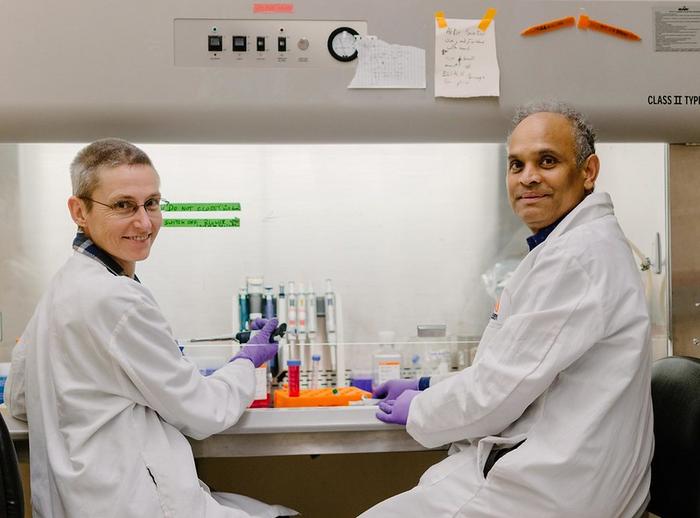
Credit: Photo by Taylor Cockrell, OSU Daily Barometer.
CORVALLIS, Ore. – Oregon State University researchers have discovered compounds that convert a protein known for protecting cancer cells into a tumor killer.
Scientists say their findings, several years in the making, open the door to promising therapies for breast cancer and other malignancies whose cells rely on the Bcl-2 protein to evade treatment and develop drug resistance.
“The holy grail in cancer research is finding a molecular target that plays a major, essential role in cancer cell growth that you can go after without causing side effects – that is, without affecting regular cells,” said Siva Kolluri, professor of environmental and molecular toxicology in the College of Agricultural Sciences. “Multiple pathways control a normal cell to be normal, and cancer cells hijack one of those pathways that control the rate of proliferation and/or death.”
Many types of cells are recycled, Kolluri said, through a programmed cell death process called apoptosis. Cancer cells, however, neutralize pathways that ordinarily kill cells, allowing these cells to grow out of control and in many cases metastasize, or spread, to other parts of the body.
Bcl-2 is an anti-apoptosis protein produced in higher levels by some cancer cells and has been used as a target by many drug researchers, Kolluri said. Inhibiting Bcl-2 has been successful in treating certain blood cancers, but not for solid cancers such as breast cancers.
“Cancer cells are so smart, they figure out ways to survive,” Kolluri said. “Many therapies do work for a while. But it’s like making a car stop, only to have the car move again. Here we’re completely taking the wheels off the car. We used the same Bcl-2 pathway but fundamentally made a new discovery: changing how this protein functions so it starts killing cancer cells.”
The research led by Kolluri and Christiane Löhr, professor of anatomic pathology in the Carlson College of Veterinary Medicine, involved studying triple-negative breast cancer in cell cultures and mouse models.
Triple-negative breast cancer, so called because its cells lack three specific receptors found in other breast cancers, is one of the most aggressive forms of breast cancer. It accounts for roughly 20% of all breast cancer diagnoses, the scientists note – including 15% of those with the worst prognoses.
Kolluri and Löhr have presented their findings in a pair of recently published studies.
The first, which appears in Cancer Research Communications, describes how they discovered and tested a new compound that changes the shape of the Bcl-2 molecule. The change exposes what they call Bcl-2’s “killer conformation,” which leads to cell death.
The second, in ACS Pharmacology and Translational Science, shows that another compound induces the death of breast cancer cells in culture and suppresses breast cancer lung metastasis in a mouse model. The lungs are a primary location to which breast cancer spreads.
“This is very promising because many metastatic cancers have high Bcl-2 levels,” Löhr said. “This increased Bcl-2 expression is also common in cancer that has become resistant to therapies. Changing the conformation of Bcl-2 and using that pathway to kill cells is a distinctively different approach than has been tried before. Altering the function of a protein in a live cell is pretty amazing and the potential to attack cancers that have escaped other treatments, while leaving normal cells intact, is there.”
The scientists note that their results follow years of highly detailed, mechanistic research.
“We were studying a protein that typically regulates genes in the nucleus, finding that the same protein also killed cells, and that it migrates from the nucleus into the mitochondria,” Kolluri said. “That migration is leading cells to die – how does it go to the mitochondria and how does it kill cells? That nuclear protein interacts with Bcl-2 – that’s how Bcl-2 changes into a killer.”
“A breakthrough like this is many years in the works,” Löhr added. “We’ve proven all the pieces that need to be in place and shown a proof of concept. And this has potential beyond humans, such as lymphoma cases in dogs. It’s an easier step from the lab to veterinary use than human use.”
Other OSU scientists contributing to the research were Prasad Kopparapu, Martin Pearce and Shanthakumar Tyavanagimatt. The work also involved Harikrishna Nakshatri of the Indiana University School of Medicine.
The U.S. Department of Agriculture’s National Institute of Food and Agriculture, the U.S. Army Medical Research and Material Command, and the National Cancer Institute of the National Institutes of Health supported the work.
“The next steps involve identifying partners to advance this research towards translation, testing in additional preclinical models, and eventually advancing the compounds to human trials,” Kolluri said.
Journal
ACS Pharmacology & Translational Science
Method of Research
Experimental study
Subject of Research
Animals
Article Title
Small Molecule Functional Converter of B-Cell Lymphoma-2 (Bcl-2) Suppresses Breast Cancer Lung Metastasis
Article Publication Date
1-May-2024
Cite Scienmag News
Nathaniel Bowman. (July 1, 2024). Oregon State University researchers discover novel way to make breast cancer cells die. Scienmag. https://scienmag.com/oregon-state-university-researchers-discover-novel-way-to-make-breast-cancer-cells-die/
Nathaniel Bowman. "Oregon State University researchers discover novel way to make breast cancer cells die." Scienmag, 1 July 2024, https://scienmag.com/oregon-state-university-researchers-discover-novel-way-to-make-breast-cancer-cells-die/. Accessed 7 September 2026.
Nathaniel Bowman. "Oregon State University researchers discover novel way to make breast cancer cells die." Scienmag. July 1, 2024. https://scienmag.com/oregon-state-university-researchers-discover-novel-way-to-make-breast-cancer-cells-die/

