


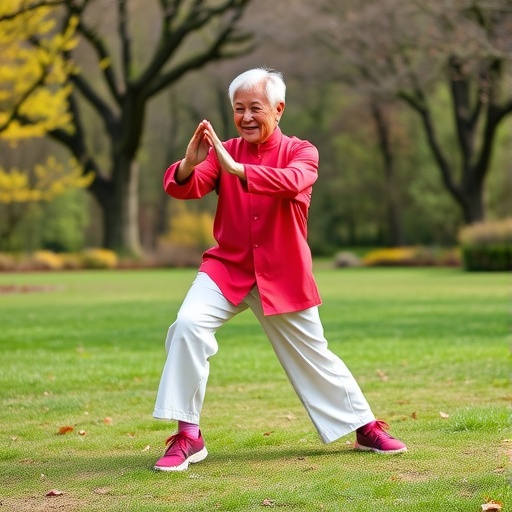
A recent randomized clinical trial published in JAMA Internal Medicine has unveiled promising results regarding an innovative unsupervised online tai chi intervention designed to alleviate knee pain and improve functional capacity in individuals afflicted with osteoarthritis. This study leverages technology to provide accessible, scalable, and guideline-concordant exercise therapy, which could revolutionize current osteoarthritis management paradigms.
Osteoarthritis, a progressive joint disease largely characterized by cartilage degradation and resultant pain, especially in load-bearing joints like the knee, affects millions globally. Traditional management emphasizes physical exercise due to its efficacy in pain relief and functional enhancement. However, barriers such as limited accessibility to in-person programs deter widespread participation. Herein, this study offers a compelling alternative through a multimodal online tai chi regimen capable of overcoming these obstacles.
Tai chi, an ancient Chinese martial art involving slow, deliberate movements and controlled breathing, has increasingly gained recognition in medical communities for its neuromuscular benefits and pain-modulating properties. By integrating tai chi into an online, unsupervised format, the trial taps into both biophysical mechanisms inherent to the practice and the flexibility afforded by digital platforms, offering a potentially transformative treatment option.
The randomized clinical trial rigorously evaluated this intervention over 12 weeks, comparing outcomes between participants engaging in the tai chi program and those receiving usual care. Outcome measures focused predominantly on knee pain intensity and function, employing validated scales common in osteoarthritis research. Statistical analyses underscored significant improvements in the intervention arm, demonstrating clinical and practical relevance.
Importantly, the study’s methodology ensured robust randomization procedures to minimize selection bias, leveraging statistical theory principles to underpin group allocation. This approach bolstered the credibility of findings and reinforced the scientific rigor of the trial. Moreover, the incorporation of digital tools enabled real-time monitoring and adherence tracking, despite the unsupervised nature of the program.
The intervention’s design capitalized on computer networking and internet technologies to deliver content, host interactive modules, and facilitate virtual support communities. Such integration not only addressed the logistical challenges posed by in-person therapy sessions but also tapped into evolving digital health frameworks, emphasizing scalability and cost-effectiveness without compromising quality or safety.
Mechanistically, the trial posits that tai chi’s emphasis on balance, muscular strength, and proprioception may restore functional biomechanics in osteoarthritic knees, particularly influencing structures like the patella. Additionally, rhythmic movement patterns likely mediate anti-inflammatory effects and pain perception modulation through neuroimmune pathways, aligning with current understanding of inflammatory arthritis pathophysiology.
Pain reduction stood as a cornerstone outcome, with patients reporting diminished symptom severity and enhanced daily function. These findings resonate with broader clinical medicine principles, wherein nonpharmacological interventions form a cornerstone of chronic disease management. Moreover, the study underscores tai chi’s potential for integration within multidisciplinary treatment algorithms for osteoarthritis.
From a public health perspective, the intervention’s accessibility and lack of supervision requirements markedly lower barriers to exercise adherence, traditionally a significant challenge in chronic musculoskeletal conditions. This democratization of therapy aligns with contemporary policy goals aimed at extending effective care to underserved populations through innovative modalities.
Financial disclosures and conflict of interest statements accompanying the article affirm the independence of the research, emphasizing its unbiased contribution to osteoarthritis literature. Funding support also reflects institutional commitment to advancing digital health interventions, a growing area intersecting applied sciences, computer science, and clinical research.
Looking ahead, this trial sets a precedent for expanding the scope of multimodal online interventions targeting musculoskeletal and inflammatory disorders. As digital health continues to evolve, the seamless integration of therapeutic exercise regimens may become a staple in internal medicine and beyond, potentially reshaping chronic disease management frameworks.
To explore this paradigm-shifting study further, inquiries can be directed to the corresponding author, Dr. Kim L. Bennell, at the University of Melbourne’s Department of Physiotherapy. The full article posted in JAMA Internal Medicine offers a comprehensive account of the methodology, statistical models employed, and nuanced clinical implications that enrich the osteoarthritis treatment landscape.
In summary, this groundbreaking study provides compelling evidence that an unsupervised, web-based tai chi program significantly reduces knee pain and improves function over 12 weeks in people with osteoarthritis. Its accessible, scalable, and evidence-based design exemplifies the innovative potential of digital health interventions to meet current and future clinical needs.
Cite Scienmag News
Reid Dalton. (October 27, 2025). Online Unsupervised Tai Chi Program Improves Knee Pain and Function in Osteoarthritis Patients. Scienmag. https://scienmag.com/online-unsupervised-tai-chi-program-improves-knee-pain-and-function-in-osteoarthritis-patients/
Reid Dalton. "Online Unsupervised Tai Chi Program Improves Knee Pain and Function in Osteoarthritis Patients." Scienmag, 27 October 2025, https://scienmag.com/online-unsupervised-tai-chi-program-improves-knee-pain-and-function-in-osteoarthritis-patients/. Accessed 5 September 2026.
Reid Dalton. "Online Unsupervised Tai Chi Program Improves Knee Pain and Function in Osteoarthritis Patients." Scienmag. October 27, 2025. https://scienmag.com/online-unsupervised-tai-chi-program-improves-knee-pain-and-function-in-osteoarthritis-patients/


