


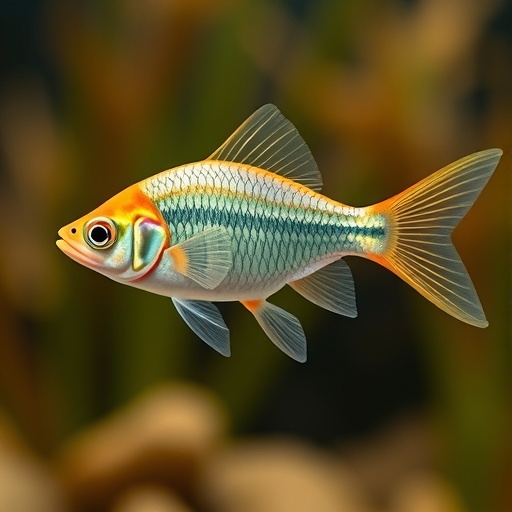
In a groundbreaking leap for developmental biology and genetic engineering, researchers have unveiled a pioneering technique to generate semi-cloned zebrafish with predetermined genetic modifications in a single step. This remarkable advancement, led by Ai, Y., Li, S., Liu, S., and colleagues, represents not only a significant technical accomplishment but also opens new horizons in rapid gene editing and model organism generation, streamlining efforts to study complex biological processes and disease mechanisms. Published in Cell Research in 2026, this study promises to reshape how genetic modifications are introduced into vertebrate models.
For decades, scientists have harnessed zebrafish as a premier model organism due to their transparent embryos, rapid development, and genetic similarity to humans in many biological pathways. However, genetic manipulation in zebrafish typically involves multiple laborious and time-consuming steps, often requiring breeding generations to stabilize desired traits. The advent of a method to semi-clone zebrafish circumvents such constraints by enabling one-step integration of specific genetic edits, allowing for immediate generation of offspring with uniform modifications.
The researchers capitalized on the concept of semi-cloning, a hybrid reproduction strategy that combines alterations in genome inheritance. This technique involves the fusion of a haploid genome from a genetically engineered donor cell with a normal maternal genome, resulting in viable, fertile organisms harboring the desired edit. By honing in on zebrafish embryogenesis, the team successfully crafted a protocol that ensures efficient fusion and reprogramming of genetic material within a single cellular event.
Central to this innovation was the use of advanced genome editing tools tailored to the zebrafish model. The team utilized precision CRISPR-Cas systems optimized for zebrafish embryonic cells, ensuring targeted gene modifications could be introduced seamlessly prior to semi-cloning. This pre-emptive editing allowed the subsequent semi-cloning procedure to perpetuate the genetic changes faithfully, bypassing mosaicism and off-target effects commonly encountered in standard protocols.
One of the critical technical challenges addressed was ensuring proper epigenetic resetting and genomic imprinting during the fusion of donor and recipient genomes. Zebrafish embryos exhibit specific epigenetic landscapes essential for normal development, and dysregulation can lead to developmental abnormalities. The authors addressed this by modulating key epigenetic factors and leveraging cytoplasmic conditions conducive to correct imprinting, thereby producing healthy, viable offspring with stable genetic traits.
The implications of this one-step semi-cloning approach extend beyond mere technical convenience. It profoundly accelerates functional genomic studies by enabling rapid generation of animals with precise gene disruptions, insertions, or reporter tags. This acceleration holds potential not only for basic science but also for drug discovery pipelines, where swiftly generating disease models with defined mutations can facilitate screening and therapeutic interventions.
Furthermore, the technique harbors profound relevance for synthetic biology and regenerative medicine. By enabling controlled introduction of designed genetic circuits or regenerative factors in a single step, it fosters rapid prototyping of biological systems. This capability paves the way for investigating gene regulatory networks and developmental processes in intact, living organisms with unprecedented precision.
Ethical considerations surrounding cloning and genetic engineering have long been subjects of debate, particularly regarding mammals. While zebrafish, as a lower vertebrate, present fewer ethical complexities, this technique nonetheless prompts discussions on the potential applications and limitations. The straightforward, reproducible methodology diminishes technical barriers but also necessitates rigorous oversight to prevent misuse or unintended ecological consequences.
In addition to the biological and technical advances, the study provides compelling evidence for scalability and robustness of the procedure. The authors demonstrated consistent success rates across different genetic modifications and zebrafish strains, underscoring the method’s versatility and adaptability. This robustness ensures the approach can be broadly adopted by laboratories worldwide, democratizing access to powerful genetic tools.
The integration of live-cell imaging and single-cell transcriptomics further substantiated the fidelity of genetic transmission and normal developmental trajectories in semi-cloned zebrafish. Comprehensive phenotypic analyses revealed no overt abnormalities, confirming that the one-step approach preserves embryo viability and functional genetics. These findings reassure that the semi-cloning technique does not compromise organismal integrity.
Looking forward, the research team envisions expanding this approach to other aquatic and terrestrial vertebrates, potentially revolutionizing transgenic animal production across species. While technical hurdles remain, the foundational principles established here provide a blueprint for adapting semi-cloning strategies tailored to species-specific developmental contexts.
Moreover, this innovation holds promise in ecological and evolutionary studies. By facilitating rapid generation of fish populations with predefined genetic traits, researchers can dissect gene-environment interactions and adaptive mechanisms more effectively. Such insights could underpin conservation efforts and the management of threatened species through controlled breeding programs.
The study also sparks intriguing possibilities for personalized medicine models. Zebrafish genetically engineered via this pathway could mimic patient-specific mutations, providing cost-effective, high-throughput platforms for phenotype screening and therapeutic testing. This could bridge the gap between genotype and clinical phenotypes, accelerating translational research.
Importantly, the authors highlight how semi-cloning alleviates current bottlenecks in mosaicism reduction, a common obstacle in standard gene-editing techniques. Most existing methods suffer from incomplete gene editing or the presence of wild-type cells within tissues, confounding experimental results. The single-step semi-cloning method circumvents this by establishing genetically homogeneous organisms from inception.
Nonetheless, further investigations are warranted to fully understand long-term genetic stability and intergenerational effects. The potential for unintended epigenetic alterations or genomic rearrangements remains a consideration, especially as the method is scaled for more complex or longer-lived species. Future studies will undoubtedly focus on longitudinal assessments to ensure safety and efficacy.
In summary, the one-step generation of semi-cloned zebrafish carrying defined genetic modifications represents a transformative advance in biology and biotechnology. This streamlined, efficient, and reliable method empowers researchers with a powerful tool to unravel genetics, development, and disease with unprecedented speed and precision. As this technique permeates the scientific community, it is poised to catalyze remarkable discoveries and applications across multiple disciplines.
This breakthrough underscores the accelerating convergence of gene editing, developmental biology, and reproductive technologies. By synthesizing these domains, the research inaugurates a new era where the generation of genetically tailored model organisms is not a cumbersome, multi-generational endeavor but an achievable, single-event feat. The future of genetics research may well hinge on such innovative frontiers.
Cite Scienmag News
Juliet Wilcox. (June 12, 2026). One-Step Creation of Semi-Cloned Genetically Modified Zebrafish. Scienmag. https://scienmag.com/one-step-creation-of-semi-cloned-genetically-modified-zebrafish/
Juliet Wilcox. "One-Step Creation of Semi-Cloned Genetically Modified Zebrafish." Scienmag, 12 June 2026, https://scienmag.com/one-step-creation-of-semi-cloned-genetically-modified-zebrafish/. Accessed 4 September 2026.
Juliet Wilcox. "One-Step Creation of Semi-Cloned Genetically Modified Zebrafish." Scienmag. June 12, 2026. https://scienmag.com/one-step-creation-of-semi-cloned-genetically-modified-zebrafish/


