


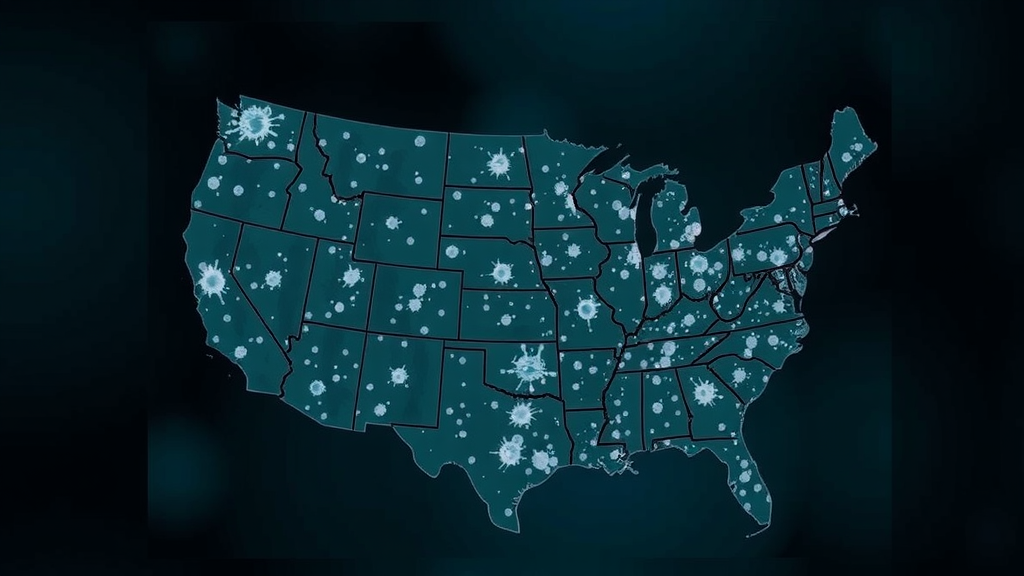
A surge in cyclosporiasis cases across the United States has exposed a critical weakness in the nation’s foodborne disease surveillance apparatus: the persistent inability to identify contaminated food sources before infections spread across state lines. Although cyclosporiasis has been a nationally notifiable disease for years and follows a well-recognized seasonal pattern that peaks each spring and summer, recurring outbreaks continue to confound public health authorities because the source of contamination is typically identified only after hundreds of people have already been exposed. Researchers writing in the journal New Microbes and New Infections argue that the time has come to move beyond reactive case-counting and toward an integrated One Health surveillance framework that simultaneously monitors human health, agricultural production, environmental contamination, food supply chains, and molecular epidemiology to enable earlier detection and even prediction of outbreaks.
The scale of the 2026 cyclosporiasis season has sharpened the urgency of that argument. According to surveillance data from the Centers for Disease Control and Prevention updated on September 1, 2026, 18,445 laboratory-confirmed domestically acquired cases were reported across 49 states and the District of Columbia between May 1 and August 31. Those infections resulted in 990 hospitalizations and two deaths, a dramatic escalation from the 1,180 cases recorded during the comparable period in 2025. Affected individuals reported no international travel during the 14 days preceding illness onset, which supports domestic foodborne exposure as the principal source of infection. As of September 3, 2026, a single outbreak cluster alone had caused 11,458 confirmed illnesses, 495 hospitalizations, and two deaths across 20 states, yet investigators emphasize that this cluster does not account for the entire national increase. The CDC and the U.S. Food and Drug Administration are continuing to investigate additional clusters for which contaminated food sources have not yet been pinpointed.
Understanding why cyclosporiasis is so difficult to control requires an appreciation of the unique biology of its causative agent, the single-celled parasite Cyclospora cayetanensis. Unlike many bacterial foodborne pathogens, Cyclospora is not transmitted directly from person to person because the parasite must spend several days to weeks in the environment before its oocysts sporulate and become infectious. Human infections therefore occur almost exclusively through ingestion of food or water contaminated with fully mature oocysts derived from human fecal waste. Contamination frequently takes place during agricultural production, through inadequately treated irrigation water, contaminated wash water, poor sanitation facilities for farm workers, or improper handling during harvesting, packaging, and processing. This environmental maturation requirement means that the parasite effectively travels through a hidden ecological reservoir before it ever reaches a consumer, which is precisely the gap that conventional human-centered surveillance cannot see into.
Over the past decade, the CDC, in collaboration with state health departments and the FDA, has significantly strengthened national cyclosporiasis surveillance through mandatory disease reporting, improved laboratory diagnostics, enhanced molecular epidemiology, and coordinated multistate outbreak investigations. These improvements have measurably increased the capacity to detect outbreaks and to monitor seasonal trends. Nevertheless, the current framework remains predominantly reactive in structure. Public health action generally begins only after infected individuals develop symptoms, seek healthcare, receive laboratory confirmation, and are linked to one another through time-consuming epidemiological investigations. While these approaches are essential for outbreak response, they provide limited opportunity to prevent transmission before contaminated food reaches consumers. Consequently, interventions such as recalls and public advisories often arrive only after substantial community exposure has already occurred, a pattern repeatedly observed during fresh-produce-associated outbreaks of the past several years.
The core of the proposed solution is food supply chain surveillance, an integrated strategy that exploits the digitalization of modern food distribution. Contemporary supply networks transport fresh produce across multiple states within a matter of days, which makes rapid traceback investigations essential during an outbreak. Emerging technologies such as blockchain-enabled traceability, digital supply chain management platforms, radio-frequency identification systems, and electronic shipment records now provide unprecedented opportunities to monitor the movement of produce from farms through processing facilities, distribution centers, retailers, restaurants, and ultimately to consumers. The researchers argue that integrating these traceability systems directly with epidemiological surveillance databases would allow investigators to reconstruct distribution pathways within hours rather than weeks, substantially reducing the time required to identify contaminated food sources, issue targeted recalls, and remove hazardous product from commerce before further exposures accumulate.
Clinical surveillance itself also requires modernization to improve the speed and sensitivity of outbreak detection. The authors call for electronic laboratory reporting to be seamlessly integrated with hospital electronic health records and state surveillance systems, enabling immediate notification of confirmed cyclosporiasis cases rather than delayed batch reporting. Syndromic surveillance systems capable of monitoring upticks in acute diarrheal illness could provide additional early warning signals before laboratory confirmation becomes available, since Cyclospora diagnosis often lags symptom onset by days or weeks. Coupling these systems with automated statistical anomaly-detection algorithms would allow public health authorities to recognize unusual disease clusters earlier and to initiate investigations before outbreaks expand across multiple jurisdictions, converting surveillance from a historical record into a genuine forecasting tool.
Molecular epidemiology is positioned as a central pillar of future cyclosporiasis surveillance. Genetic characterization of Cyclospora cayetanensis has historically been constrained by technical limitations and by the parasite’s relatively low genetic diversity, which has made it difficult to confidently link cases from different geographic areas or to distinguish outbreak-associated strains from background sporadic infections. Recent advances in molecular biology are changing that calculus. Whole-genome sequencing, multilocus sequence typing, targeted amplicon sequencing, and metagenomic approaches now have the potential to discriminate outbreak-associated strains from unrelated infections with increasing precision. When genomic data are combined with epidemiological and supply chain information, investigators gain a triangulated picture of an outbreak that can withstand the scrutiny required for regulatory action, and genomic signatures recovered from environmental and food samples can potentially be matched to clinical isolates to confirm contamination routes.
Effective implementation of a One Health surveillance framework will, however, demand unprecedented collaboration among professions and agencies that historically operate in separate silos: clinicians, epidemiologists, microbiologists, environmental scientists, agricultural specialists, food safety regulators, veterinarians, and policymakers. One of the greatest barriers to effective outbreak response remains the fragmentation of surveillance data across multiple agencies with limited interoperability. Clinical reports, laboratory findings, environmental monitoring results, genomic sequencing data, and food traceability information currently reside in disconnected systems governed by different jurisdictions and data standards. Establishing standardized national data-sharing platforms capable of integrating all of these data streams would significantly improve coordination among federal, state, and local agencies while accelerating outbreak investigations and public health decision-making. The One Health framing also extends the surveillance gaze upstream to the agricultural and environmental conditions—irrigation water quality, worker sanitation, and wildlife or wastewater contributions—that seed contamination in the first place, offering points of intervention that purely clinical systems cannot reach.
The 2026 outbreak season serves as a stark demonstration of what is at stake. A more than fifteen-fold increase in reported cases compared with the same months of the previous year, nearly a thousand hospitalizations, and two deaths occurred despite an established notifiable-disease infrastructure and experienced investigative teams at federal and state agencies. The authors contend that these outcomes are not evidence that surveillance personnel failed, but evidence that a fundamentally reactive architecture cannot keep pace with a pathogen embedded in a vast, fast-moving, and complex food production and distribution network. Their proposal reframes cyclosporiasis control as a systems problem spanning human clinical medicine, environmental science, agricultural practice, genomics, and information technology. If adopted, an integrated One Health surveillance system would aim to detect contamination signals in the environment or the supply chain before consumers are exposed, shrinking outbreak response from a matter of weeks to a matter of hours and converting a recurring public health burden into a largely preventable event.
Subject of Research: Integrated One Health surveillance for foodborne cyclosporiasis outbreaks in the United States
Article Title: An integrated One Health surveillance on cyclosporiasis outbreaks in the United States
Article References: Aborode, A. T., Allison, M. O., Akinyosoye, F. O., & Aliyu, A. A. (2026). An integrated One Health surveillance on cyclosporiasis outbreaks in the United States. New Microbes and New Infections, 73, Article 101851. https://doi.org/10.1016/j.nmni.2026.101851
Image Credits: AI Generated
DOI: 10.1016/j.nmni.2026.101851
Keywords: cyclosporiasis, Cyclospora cayetanensis, One Health, foodborne disease, surveillance, CDC, outbreak investigation, molecular epidemiology, food supply chain, whole-genome sequencing, public health, fresh produce safety
Cite Scienmag News
Joyce Wexler. (September 12, 2026). One Health Surveillance Proposed to Curb Rising Cyclosporiasis Outbreaks in the United States. Scienmag. https://scienmag.com/one-health-surveillance-proposed-to-curb-rising-cyclosporiasis-outbreaks-in-the-united-states/
Joyce Wexler. "One Health Surveillance Proposed to Curb Rising Cyclosporiasis Outbreaks in the United States." Scienmag, 12 September 2026, https://scienmag.com/one-health-surveillance-proposed-to-curb-rising-cyclosporiasis-outbreaks-in-the-united-states/. Accessed 5 October 2026.
Joyce Wexler. "One Health Surveillance Proposed to Curb Rising Cyclosporiasis Outbreaks in the United States." Scienmag. September 12, 2026. https://scienmag.com/one-health-surveillance-proposed-to-curb-rising-cyclosporiasis-outbreaks-in-the-united-states/


