


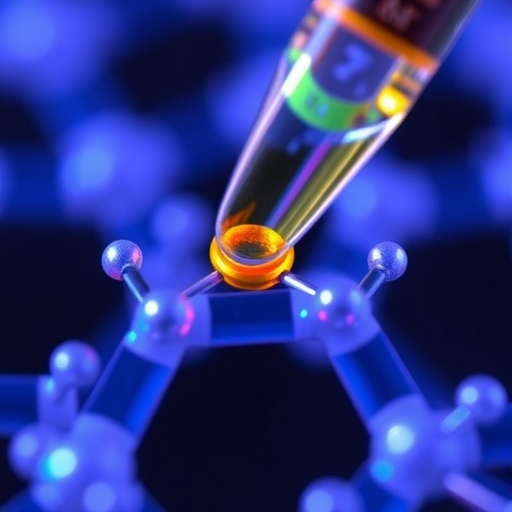
A smartphone-linked sensor that reads dopamine from a single tiny droplet of biological fluid could bring neurochemical monitoring closer to the point of care, according to research published in Advanced Composites and Hybrid Materials. The thumb-sized device combines an electrochemical electrode with a nanocomposite made from two-dimensional MXene sheets, gold nanoparticles and carbon dots derived from banana peels. In tests, the system detected dopamine across a broad concentration range, distinguished it from common interfering chemicals and measured the neurotransmitter in rat brain homogenate, stimulated human neuroblastoma cells and human sweat. The researchers describe the platform as a possible bridge between conventional laboratory assays and portable, non-invasive monitoring, although it remains a research prototype rather than a clinical diagnostic.
Dopamine is a chemically simple molecule with an outsized role in the nervous system. It acts as a neurotransmitter, carrying signals between nerve cells and helping regulate movement, motivation, reward, attention and several other physiological processes. Abnormal dopamine signaling is associated with neurological and psychiatric conditions including Parkinson’s disease, Alzheimer’s disease and schizophrenia. Yet measuring dopamine outside a laboratory is difficult. The molecule is present in complex mixtures alongside compounds such as ascorbic acid and uric acid, which can generate similar electrical responses at an electrode. Dopamine concentrations can also change rapidly and vary substantially between biological compartments, meaning that a useful sensor must be sensitive, selective, fast and capable of working with very small sample volumes.
The new device uses electrochemistry to solve part of that problem. Rather than identifying dopamine through a bulky analytical instrument, the sensor measures the current produced when dopamine undergoes oxidation at the electrode surface. The resulting electrical signal depends on the amount of dopamine available to react. In practice, however, an unmodified electrode may provide a weak or poorly resolved response. The researchers therefore coated a screen-printed electrode with a composite engineered to improve several stages of the sensing process at once. The resulting MX-CD-Au/SPE sensor uses MXene as a conductive framework, banana-peel carbon dots as functional nanoscale components and gold nanoparticles to increase catalytic activity and facilitate electron transfer.
MXenes are two-dimensional transition-metal carbides or nitrides known for their electrical conductivity, hydrophilic surfaces and large effective area. Their sheet-like structure can provide abundant sites where target molecules interact and where electrochemical reactions occur. In the composite, MXene acts as a conductive highway, allowing electrons generated during dopamine oxidation to move efficiently toward the electrode. Its surface chemistry can also support the attachment and distribution of other nanomaterials. The researchers paired it with gold nanoparticles, which are widely used in electrochemical sensing because their high surface area and favorable electronic properties can accelerate redox reactions. Together, the materials were intended to amplify the signal without requiring a large electrode or a conventional laboratory setup.
The third component, carbon dots produced from banana peel, adds a sustainability angle as well as chemical functionality. Carbon dots are nanoscale carbon particles with abundant surface groups that can influence how molecules bind and how electrons are transferred. In this design, the bio-derived dots were distributed with MXene and gold, creating a hybrid surface rather than three isolated materials operating independently. Structural and morphological characterization confirmed that the components had been integrated uniformly, according to the researchers. That architecture is important because a composite’s performance depends not only on the properties of its ingredients but also on how closely those ingredients contact one another. Efficient interfaces can reduce resistance to electron movement and expose more active sites to the sample.
The sensor produced a linear response to dopamine from 2 to 914 micromolar and reported a detection limit of 0.15 micromolar. A linear range means that, within those limits, changes in dopamine concentration correspond predictably to changes in the measured electrochemical signal, allowing an unknown sample to be quantified against a calibration curve. The low detection limit indicates that the device could register relatively small amounts of dopamine under the reported experimental conditions. The researchers also tested selectivity in the presence of common interferents, a critical challenge for real biological samples. According to the study, the MX-CD-Au/SPE platform retained a strong dopamine response despite those competing substances, suggesting that the engineered surface improved discrimination as well as sensitivity.
To test whether the chemistry worked beyond prepared solutions, the team examined several increasingly realistic biological settings. First, they added known amounts of dopamine to rat brain homogenate, a complex mixture containing proteins, salts, metabolites and cellular debris. The sensor quantified the spiked neurotransmitter in that matrix, demonstrating that the response was not limited to a clean laboratory solution. The researchers then monitored dopamine released from human SH-SY5Y neuroblastoma cells after stimulation with potassium ions. Raising extracellular potassium concentration depolarizes cell membranes, encouraging electrically excitable cells to release signaling molecules. Detecting the resulting extracellular dopamine provided an in vitro test of whether the sensor could follow a biologically generated signal rather than merely measure a prepared standard.
The platform’s most attention-grabbing feature is its one-drop format. Instead of requiring milliliters of sample, the system is designed to analyze a microvolume droplet placed directly on the sensing area. The researchers integrated the electrode with a smartphone-compatible portable device and used it to quantify dopamine in droplets of human sweat. Sweat is attractive for non-invasive monitoring because it can be collected without needles, although it is chemically variable and generally does not provide a direct readout of neurotransmitter levels in the brain. A sweat measurement therefore should not be interpreted as a simple substitute for neural sampling. It is better understood as a demonstration that the sensor can operate in a readily accessible biological fluid while using only a very small amount of material. The study reports that sample collection followed the Declaration of Helsinki, received institutional review approval and involved informed consent.
The work illustrates how several trends in biosensing are converging: nanostructured electrodes, waste-derived materials, smartphone integration and microvolume analysis. Screen-printed electrodes are especially useful for portable devices because they can be manufactured inexpensively and in compact formats, while smartphones can provide display, processing and connectivity without adding a dedicated laboratory instrument. A one-drop system could eventually support rapid measurements in settings where centralized testing is impractical. However, substantial barriers remain before such a platform could be used to diagnose or manage disease. Future studies would need to establish long-term stability, calibration across individuals, resistance to sweat composition differences, manufacturing reproducibility, storage life, clinical accuracy and the relationship between peripheral dopamine measurements and neurological status. The current findings show that the composite can detect dopamine in several experimental matrices; they do not yet demonstrate clinical diagnosis, continuous wearable operation or direct measurement of dopamine inside the human brain. Funded by the National Research Foundation of Korea, the study nevertheless presents a striking example of how a discarded fruit peel and advanced nanomaterials could be combined into a pocket-sized tool for real-time chemical sensing.
Cite Scienmag News
Denise Maddox. (August 29, 2026). One-Drop Electrochemical Platform Uses Bio-Derived Nanocomposite to Monitor Dopamine Across Matrices. Scienmag. https://scienmag.com/one-drop-electrochemical-platform-uses-bio-derived-nanocomposite-to-monitor-dopamine-across-matrices/
Denise Maddox. "One-Drop Electrochemical Platform Uses Bio-Derived Nanocomposite to Monitor Dopamine Across Matrices." Scienmag, 29 August 2026, https://scienmag.com/one-drop-electrochemical-platform-uses-bio-derived-nanocomposite-to-monitor-dopamine-across-matrices/. Accessed 3 September 2026.
Denise Maddox. "One-Drop Electrochemical Platform Uses Bio-Derived Nanocomposite to Monitor Dopamine Across Matrices." Scienmag. August 29, 2026. https://scienmag.com/one-drop-electrochemical-platform-uses-bio-derived-nanocomposite-to-monitor-dopamine-across-matrices/


