


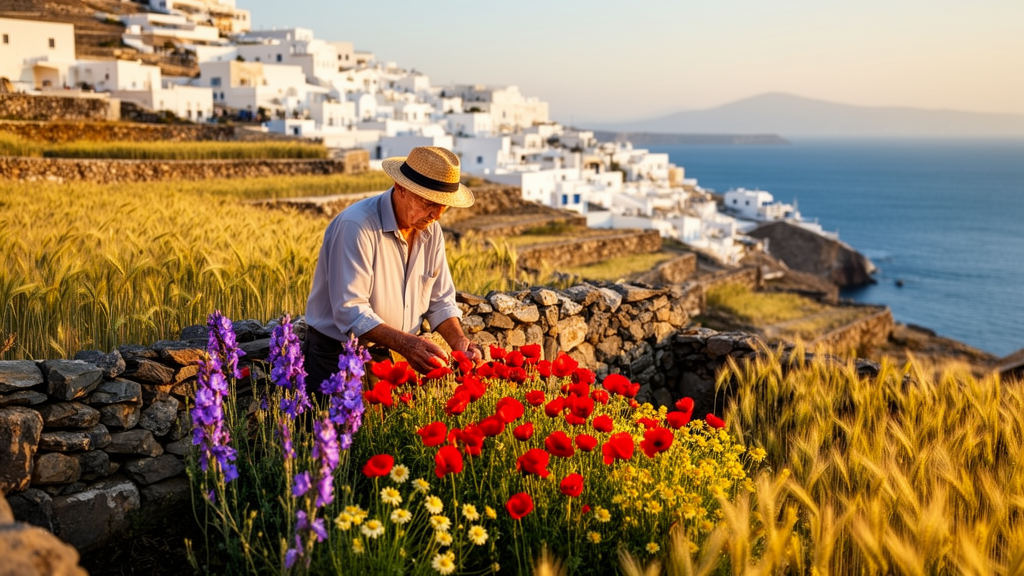
On the Aegean island of Lemnos, fields of barley and oat still ripple with poppies, corncockle, and golden chamomile in a way that has vanished from almost all of Europe. A new study published in Vegetation Classification and Survey offers the first comprehensive analysis of the wild plant communities that live within the island’s traditionally farmed fields, and it reveals a hidden world structured by two powerful forces: the chemistry and texture of the soil beneath the crops, and the rhythm of the seasons above them. The findings carry a warning as well as a celebration, because the specialized plants that depend on low-intensity farming are among the fastest-disappearing species on the continent.
Lemnos occupies a special place in the history of agriculture. Farming spread into Europe from the Fertile Crescent through Greece roughly 9,000 to 8,500 years ago, and Lemnos has been inhabited since at least the Neolithic, prized for its fertile plains and cultivable soils. Over millennia, farmers selected crops suited to local conditions, producing distinctive landraces, while wild plants co-evolved alongside the sown species to form what ecologists call agrestal communities, the wild flora of arable land. Today, arable fields still cover a substantial and relatively stable share of the island, and agriculture remains largely traditional: winter cereals grown as fodder, often in mixed intercropping systems of barley and oat, rotated with pulses and fallows, followed by grazing on stubble.
This system, which has largely disappeared elsewhere, is precisely what makes Lemnos scientifically valuable. Across most of Europe, less intensive agriculture has become rare, squeezed between abandonment on marginal land and intensification on fertile soil. Because many arable plants depend on the regular disturbance of traditional farming, both trends drive biodiversity loss. The habitat type that the study addresses, arable land managed by low-intensity methods, is listed as Endangered on the European Red List of Habitats. Understanding the species composition, land-use requirements, and environmental constraints of these communities is therefore essential for their conservation, and Lemnos offers a rare living laboratory in which rotational fallowing and stubble fields still exist.
Between 2018 and 2022, with additional sampling in May 2025, researchers recorded vegetation in 174 plots across the island: 130 in spring, during April and May, and 44 in fall, during September and October. The plots, mostly 100 square meters, lay within field interiors growing cereals such as six-rowed barley, oat, and durum wheat, pulses such as common vetch and garden pea, and in fallow and stubble fields. Fields showing signs of herbicide use or heavy fertilization were excluded. The team estimated the cover of every species using the Braun-Blanquet scale and analyzed the resulting data with non-metric multidimensional scaling, a technique that arranges plots in space according to how similar their species compositions are, together with a modified TWINSPAN clustering algorithm to classify the spring communities.
The seasonal contrast proved to be the single strongest driver of floristic variation. A permutational multivariate analysis of variance confirmed that season significantly shaped community composition, and a test of group dispersion showed the difference was driven by species identity rather than variability among plots. Spring fields belonged to early-flowering annuals such as rigid ryegrass, scarlet pimpernel, corn poppy, wild radish, and corn gromwell, plants that complete their life cycle and set seed before the May harvest. Fall plots, by contrast, were dominated by late-flowering annuals, biennials, and perennials such as stinking fleabane, European heliotrope, yellow star-thistle, and chicory, species that germinate or form rosettes in spring and flower after the harvest. Many of them share adaptations, including basal rosettes, prostrate growth, and low-attached branches, that reduce damage from mowing and grazing, allowing them to persist in the post-harvest landscape.
Within the spring fields, the clustering analysis revealed four distinct plant communities, and their distribution mapped cleanly onto the island’s geology. Volcanic rocks and tuffs cover about 30 percent of Lemnos and produce shallow, stony, acidic soils, while Eocene-Oligocene molasse sediments and Holocene alluvial deposits yield deeper, often base-rich ground. The first community, named for Anchusa hybrida and Hypecoum imberbe, occupied dry, well-drained, sandy soils derived from molasse, often on young fallows and pulse fields. The second, the Raphanus raphanistrum-Cladanthus mixtus community, preferred sandy, acidic, base-poor soils that were partly seasonally wet, indicated by species such as toad rush and corn spurrey. The third, the Glebionis segetum-Ranunculus marginatus community, grew on productive alluvial lowlands with intermediate to seasonally wet moisture, and the fourth, the Hypericum triquetrifolium-Leontice leontopetalum community, was tied to loamy, stony, base-rich soils, where it hosted striking geophytes including the pink-flowered Gladiolus italicus.
Ecological indicator values for Europe, which assign each plant species numerical scores for its preferences regarding soil reaction, moisture, nutrients, light, and temperature, allowed the researchers to quantify these relationships. Fitting the community-weighted indicator means into a three-dimensional ordination showed that the primary gradient, the first ordination axis, was strongly correlated with soil reaction, with a coefficient of determination of 0.777 and a p-value of 0.001, cleanly separating the acidic-soil communities from the base-rich ones. A second axis was marginally correlated with temperature and moisture, distinguishing the drier communities from the wetter ones. Light and nutrients were not significant. A chi-squared test further confirmed that the underlying geological substrates differed significantly among the communities, with alluvial deposits underlying 73 percent of the Glebionis segetum-Ranunculus marginatus fields and molasse and tuffs dominating the base-rich community.
Crop type and management also left their fingerprints. Barley was the most common crop overall and dominated the base-rich community, while mixed maslins of barley and oat appeared in at least 21 percent of fields in every spring community and reached 42 percent in the alluvial community. Pulse fields were concentrated in the Anchusa hybrida-Hypecoum imberbe community, and wheats were most frequent in the acidic-soil community. The base-rich and alluvial communities contained the island’s most productive fields, rich in nutrient-demanding species and in speirochorous plants such as corncockle and darnel ryegrass, which are sown inadvertently with farm-saved crop seed, a hallmark of traditional seed use. Species richness averaged 26.6 taxa per plot in spring against 15.6 in fall, and the base-rich community was the richest of all, with a median above 30 species per plot and a maximum of 62.
Perhaps the most consequential result concerns the obligate agrestal species, plants that in Greece occur almost exclusively in arable fields. The surveys recorded 33 such species, including several classified as threatened on the national Red List: darnel ryegrass and Leontice leontopetalum as Vulnerable, and corncockle, rough poppy, and Anagallis foemina as Near Threatened or Vulnerable. Rarer still were Adonis annua, Allium cyrilli, Bupleurum subovatum, Glaucium corniculatum, Vaccaria hispanica, and others, each found in only one to four plots, and most of them concentrated in the base-rich Hypericum triquetrifolium-Leontice leontopetalum community. The mean number of obligate species per plot was highest in that community, confirming that the least productive-looking loamy fields are in fact the island’s most important refuges for specialized arable flora.
The study’s authors place their communities within the broader syntaxonomic framework of Eurasian arable vegetation, finding affinities with alliances described from the western Mediterranean while noting that some diagnostic species of those western alliances are rare or absent in the east, and that Leontice leontopetalum appears to characterize the eastern Mediterranean branch of the base-rich alliance. Beyond classification, the message is ecological and urgent. Arable plants sustain pollinators and farmland birds, and the succession of early- and late-flowering species on Lemnos provides continuous floral resources throughout the growing season. As agricultural intensification proceeds across Europe, initiatives such as the Terra Lemnia project, which supports the island’s traditional practices, landraces, and farmland biodiversity, demonstrate that low-intensity farming and conservation are not opposing goals. Lemnos, the authors conclude, stands as a rare in situ refuge for segetal biodiversity and a reference system for restoring biodiversity-rich agricultural landscapes elsewhere.
Subject of Research: Agrestal plant communities and their soil and seasonal drivers in less intensively managed farmland on the Greek island of Lemnos
Article Title: Soil and season shape less intensively managed agro-ecosystems of a Mediterranean island—Insights from Lemnos (Greece)
Article References: Rinne, L., Meyer, S., & Bergmeier, E. (2025). Soil and season shape less intensively managed agro-ecosystems of a Mediterranean island—Insights from Lemnos (Greece). Vegetation Classification and Survey, 6, 253-271. https://doi.org/10.3897/vcs.164437
Image Credits: AI Generated
DOI: 10.3897/VCS.164437
Keywords: agro-ecosystems, arable plants, Lemnos, Greece, Mediterranean agriculture, plant communities, soil gradients, seasonality, biodiversity conservation, vegetation classification, traditional farming, threatened species
Cite Scienmag News
Margaret Porter. (October 16, 2026). On a Greek Island, Ancient Farming Keeps Rare Wildflowers Alive. Scienmag. https://scienmag.com/on-a-greek-island-ancient-farming-keeps-rare-wildflowers-alive/
Margaret Porter. "On a Greek Island, Ancient Farming Keeps Rare Wildflowers Alive." Scienmag, 16 October 2026, https://scienmag.com/on-a-greek-island-ancient-farming-keeps-rare-wildflowers-alive/. Accessed 16 October 2026.
Margaret Porter. "On a Greek Island, Ancient Farming Keeps Rare Wildflowers Alive." Scienmag. October 16, 2026. https://scienmag.com/on-a-greek-island-ancient-farming-keeps-rare-wildflowers-alive/


