


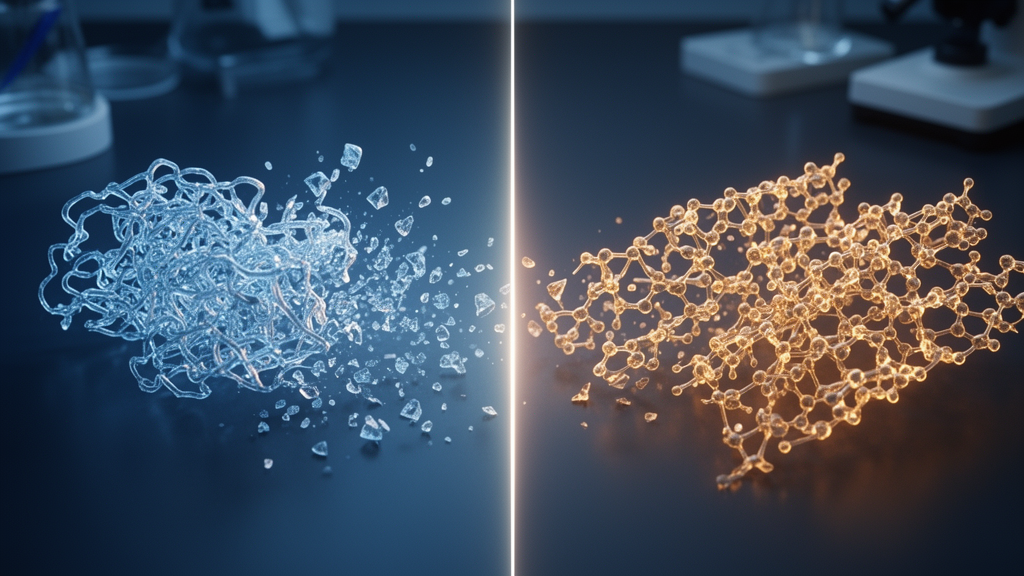
For more than a hundred years, one of the quietest laws in electronics has governed how insulating materials fail. Make a dielectric layer larger, and it breaks down sooner; make it smaller, and it survives longer. This inverse area-scaling law of dielectric breakdown has been recognized since the 1920s, when researchers studying cotton yarn strength first formalized the weakest-link idea that underlies it. Yet despite its ubiquity in transistors, memories, and high-energy capacitors, the physical basis of this law has rarely been discussed. Now, a new study published in Frontiers in Nanotechnology by Ernest Y. Wu of the University of Vermont and Takashi Ando of IBM Research argues that the law is not merely a statistical curiosity but the visible signature of a hidden physical competition — one that can be modulated, and even reversed, by process innovation.
The traditional picture treats dielectric breakdown as a purely random process. Under sustained electric stress, defects such as oxygen vacancies accumulate in the insulating layer until a conducting filament bridges two electrodes, an event whose time of occurrence is statistically distributed and traditionally characterized by the Weibull model. Because a larger area contains more potential breakdown sites, the weakest of them fails first, and the time-to-breakdown shrinks with area according to extreme-value statistics. Wu and Ando contend that this weakest-link competition has been misinterpreted as a simple winner-takes-all process, obscuring the fact that breakdown statistics involve a distribution nested within many underlying distributions — many near-breakdown events in competition that ultimately control the observed extreme-value outcome.
What makes breakdown unique among failure mechanisms is that the dielectric layer itself transforms under stress, moving from pristine to degraded and ultimately to a fragmented state. Recent conductive atomic force microscopy reconstructions of a 25 square micrometer ReRAM device vividly revealed multiple completed filaments — 89 percent complete and 11 percent incomplete — of various sizes, directly confirming this fragmental picture. After breakdown, electrical measurements show current fluctuations spanning orders of magnitude, with current sometimes recovering to near-original levels before the final hard breakdown. Until now, there has been no clear account for these recovery events. The new model proposes a physically plausible explanation: defects are not permanently created but can be annihilated.
The key insight is that oxygen vacancies, the defects widely identified with breakdown filament formation, cannot exist in isolation. Their counterpart, the oxygen interstitial, is generated in pairs with them through a Frenkel-pair process whose thermodynamics closely resemble electron-hole pair generation in semiconductors. The separation between two chemical potentials plays the role of the energy gap, and the interstitial oxygen acts as an annihilation center, readily recombining with a vacancy. Density functional theory calculations have shown a recombination time of roughly 500 femtoseconds for positively charged oxygen vacancies in intrinsic undoped HfO2, driven by Coulombic attraction. Extrinsic species such as hydrogen can also passivate vacancies, providing a second annihilation channel.
Building on this thermodynamic foundation, Wu and Ando extended the classic cell-based percolation model to include both defect generation and annihilation. In their framework, defects and annihilation centers are randomly distributed across the device area, and both processes scale with area. The time evolution of each density follows a power law, with annihilation-center density decaying over time as centers are consumed by the ongoing recombination process. Crucially, this time-decaying behavior is naturally compatible with maximum-value statistics, in contrast to the minimum-value statistics that govern defect generation. The joint interplay of these two extreme-value statistics, combined over all possible annihilation times, yields a net defect-generation probability density function whose peaks coincide with the onset of breakdown observed experimentally.
The experimental trigger for this theoretical advance came from hydrogen plasma-treated HfO2 ReRAM devices. Wu, Ando, and colleagues demonstrated that the traditional inverse area-scaling law can be reversed and diminished through process innovation. In bilayer stacks exposed to hydrogen plasma, forming voltages obtained from ramped voltage stress showed reverse and diminishing area dependence across a range of process conditions. In some samples, larger devices actually survived longer than smaller ones — a result that contradicts a century of conventional wisdom. The new model captures these diverse area-scaling schemes, from reverse through diminishing to forward and traditional inverse scaling, using a single set of parameters for each split, demonstrating both validity and predictability.
The probability density function analysis reveals the underlying dynamics in detail. For reverse area scaling, the defect-generation PDF decreases monotonically with time, while the annihilation PDF rises to a peak at roughly 0.1 microseconds and then declines. At short times, generated defects are quickly annihilated and cannot contribute to breakdown. Beyond the peak, annihilation becomes less effective, defects survive, and net defect generation dominates filament formation. The annihilation PDF at device level drops by approximately seven orders of magnitude from the unit-cell PDF, reflecting the large imbalance between annihilation-center and defect densities — a dominant factor responsible for reversing the traditional scaling law. Notably, the estimated time span of the annihilation PDF aligns well with DFT-based estimates of 1.6 nanoseconds to 1.6 microseconds for hydrogen substitution into oxygen vacancies, based on a swap activation energy of roughly 0.5 electron volts.
Perhaps the most striking conclusion is that the traditional inverse area-scaling law is merely a special case of the more general defect-generation-annihilation framework, obtained by assuming infinitely long annihilation times. Even in conventional breakdown, where annihilation is not obviously at work, the model suggests it plays an equally critical role. The authors found a strong correlation between the variability of the time-to-breakdown-versus-area relationship and the net defect-generation rate, a quantity strongly modulated by the presence of annihilation. This correlation spans the full range of experimental area-scaling behaviors, implying that annihilation is not a peripheral effect but an essential and dynamic process ultimately leading to breakdown.
The implications reach beyond fundamental physics. The traditional inverse area-scaling law has become one of the most critical bottlenecks for technology scaling in ReRAM chips and metal-insulator-metal capacitors in CMOS technology. A diminishing area dependence would mean that devices of different areas can share the same breakdown reliability, offering a pathway to overcome scaling limits for the semiconductor industry. The authors also note that contemporary modeling efforts, including sophisticated multiscale atomistic simulations, sidestep the area-dependent competition between defect generation and annihilation. One multiscale simulation predicted a progressive breakdown residual time of roughly 10^8 seconds, which would imply an unphysically large breakdown spot density; including annihilation could delay the first filament formation and yield more reasonable residual times.
Wu and Ando conclude that area-dependent defect-generation-annihilation competition is an essential, inevitable physical process that distinguishes breakdown from other degradation phenomena such as bias-temperature instability and hot-carrier degradation, which leave the dielectric in a degraded but unfragmented state. Their work highlights a large gap between experimental reality and theoretical modeling frameworks, particularly for large-scale and high-throughput approaches, and argues that a comprehensive physical understanding of dielectric breakdown cannot be achieved without acknowledging that the root cause of area dependency is the most critical and inevitable element of the phenomenon itself.
Subject of Research: Physics
Article Title: Statistics and physics of area-dependent dielectric breakdown: an overlooked yet inevitable natural phenomenon
Article References: Wu, E. Y., & Ando, T. (2026). Statistics and physics of area-dependent dielectric breakdown: an overlooked yet inevitable natural phenomenon. Frontiers in Nanotechnology, 8, Article 1885901. https://doi.org/10.3389/fnano.2026.1885901
Image Credits: AI Generated
DOI: 10.3389/fnano.2026.1885901
Keywords: dielectric breakdown, area scaling, HfO2, ReRAM, defect annihilation, extreme-value statistics, oxygen vacancies, hydrogen doping, nanotechnology, semiconductor reliability, Statistics, physics
Cite Scienmag News
Denise Maddox. (October 16, 2026). The Century-Old Breakdown Law That Just Got Reversed. Scienmag. https://scienmag.com/the-century-old-breakdown-law-that-just-got-reversed/
Denise Maddox. "The Century-Old Breakdown Law That Just Got Reversed." Scienmag, 16 October 2026, https://scienmag.com/the-century-old-breakdown-law-that-just-got-reversed/. Accessed 16 October 2026.
Denise Maddox. "The Century-Old Breakdown Law That Just Got Reversed." Scienmag. October 16, 2026. https://scienmag.com/the-century-old-breakdown-law-that-just-got-reversed/


