


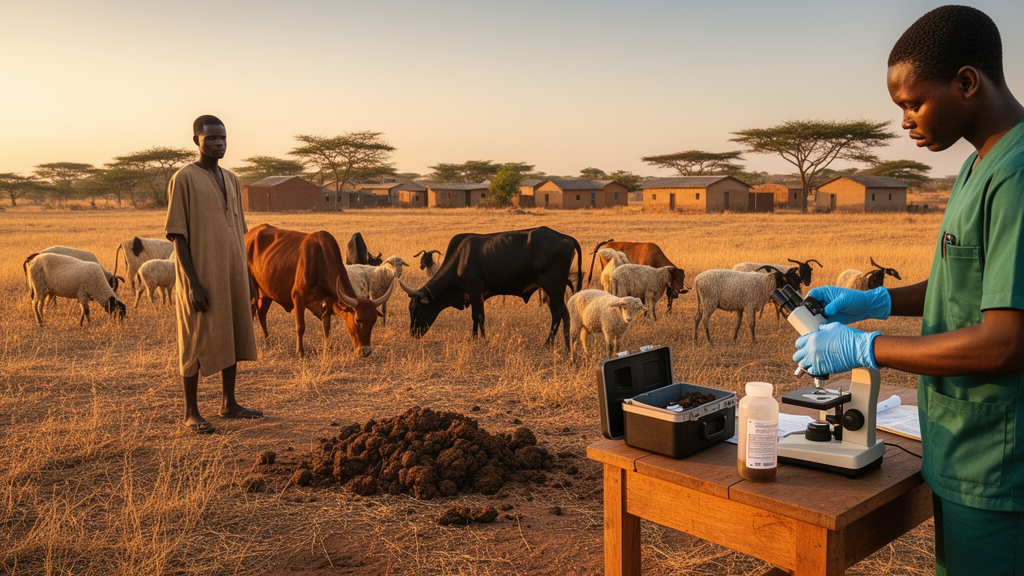
Nearly six in ten cattle, sheep, and goats examined across sub-Saharan Africa carry gastrointestinal parasites detectable in their feces, according to the first region-wide synthesis of its kind. The systematic evidence map and meta-analysis, published in Frontiers in Veterinary Science, pooled data from 111 studies conducted in 18 countries and covering 57,500 animals, arriving at a combined prevalence of 59.1 percent for infection with one or more gastrointestinal parasite taxa. Behind that headline figure lies a far more complicated story: an extreme spread of estimates from 0.7 to 98.2 percent across individual studies, a 95 percent prediction interval stretching from 14.7 to 95.6 percent, and a heterogeneity statistic of I² = 99.2 percent that signals just how profoundly local conditions shape parasite burdens. The work, led by Christian A. Bateki of the University of Kassel and Georg-August-Universität Göttingen together with Simon Tielkes of the German Institute for Tropical and Subtropical Agriculture and Eva Schlecht, offers the most complete picture yet of a silent constraint on African livestock production.
The stakes are enormous. Sub-Saharan Africa is home to an estimated 1.1 billion cattle, sheep, and goats, roughly 27 percent of the global population of these species. They convert grasses and other fiber-rich feeds into meat and milk that underpin food and nutritional security for millions of Africans, supply draft power and manure to smallholder farms, and account for up to 75 percent of household incomes in some rural areas. Demand for animal-source proteins is projected to rise by as much as 55 percent per person by 2050, and many governments in the region are betting on livestock to drive economic growth. Yet parasites quietly erode that potential. Previous estimates suggest livestock keepers lose on average one animal per cattle sold and one animal for every two sheep or goats sold, and gastrointestinal parasites remain a major pathological cause of low efficiency and high mortality. Because many of these parasites also infect humans, the burden extends beyond the farm gate into public health.
To build the evidence map, the researchers followed PRISMA guidelines, searching Web of Science and Google Scholar between April and July 2025 for studies published between 2015 and 2024 that reported fecal-based parasite prevalence in cattle, sheep, or goats. Google Scholar was deliberately included because research outputs from sub-Saharan Africa are under-represented in major bibliographic databases, and the platform indexes African Journals Online and other regional sources. The search retrieved 507 records, which were filtered down to 111 eligible studies, including two doctoral theses. Studies based on experimental infections, intervention trials, case reports, reviews, or modeling were excluded, as were those lacking clear sample sizes or prevalence figures. The team applied the Joanna Briggs Institute checklist to appraise risk of bias and used the Condition, Context, Population framework to define eligibility, focusing on non-apparently sick ruminants in sub-Saharan Africa examined through field-applicable coprological methods.
The statistical machinery behind the pooled estimate is technically demanding. Because individual studies reported positive cases and total sample sizes rather than treatment effects, the team used meta-analysis of proportions, the recommended approach for prevalence synthesis. Raw proportions were normalized with the Freeman-Tukey double-arcsine transformation to address skewness and stabilize variance, then pooled with random-effects models estimated by restricted maximum likelihood, using the meta and metafor packages in R. Heterogeneity was quantified with Cochran’s Q, I², and 95 percent prediction intervals. Sensitivity analyses included leave-one-out assessments, identification of influential studies via externally studentized residuals with a z-score cutoff of 2.0, and risk-of-bias stratification. The results proved robust: excluding influential studies shifted the combined estimate only from 59.1 to 58.9 percent, and restricting the analysis to low-risk studies yielded 55.8 percent, with fully overlapping confidence intervals across all scenarios.
The pooled figures reveal a consistent host-species pattern. Sheep carried the highest prevalence at 64.0 percent, goats followed closely at 63.3 percent, and cattle trailed at 48.2 percent. The overlapping confidence intervals for sheep and goats suggest their regional burdens are broadly similar, and the authors attribute the small-ruminant disadvantage to a web of behavioral, immunological, and physiological factors. Sheep and goats, particularly when forage is scarce, graze closer to the ground and consume shorter herbage, increasing contact with infective third-stage larvae concentrated near the herbage-soil interface. Differences in acquired immunity, body size, and nutritional status may further depress average fecal detection in cattle. The authors caution, however, that the synthesis cannot pin the species gap on any single mechanism because these variables were not consistently reported across the primary studies.
Geography mattered just as much. Prevalence peaked in West Africa at 74.9 percent and Central Africa at 74.0 percent, fell to 55.0 percent in East Africa, and dropped to 26.4 percent in Southern Africa. Wetter, more humid conditions in parts of West and Central Africa likely favor the development and survival of free-living parasite stages and increase pasture contamination, while drier Southern African systems may experience lower transmission pressure. Regional differences in veterinary service coverage and anthelmintic use may reinforce these climatic effects: irregular deworming and limited access to veterinary inputs in many smallholder systems in East and West Africa are associated with sustained high prevalence, whereas more structured parasite control programs in some Southern African commercial systems likely contribute to lower burdens. The authors stress these explanations remain plausible hypotheses rather than causal inferences, and that the region variable is confounded by production systems, host composition, diagnostic methods, and uneven country representation.
Sample source also shaped the picture. On-farm studies, comprising 86 studies and 50,480 animals, yielded a pooled prevalence of 52.6 percent, while 21 abattoir-based studies covering 5,996 animals produced 48.2 percent. The on-farm data confirm that fecal-detected parasitism is widespread in the animals from which meat, milk, and manure are derived, while the abattoir figures show that infected animals routinely enter slaughter channels. Abattoir populations are selected animals, which may differ from farm populations in age, sex, and health status, so the two evidence streams should be treated as complementary rather than interchangeable. The authors argue that abattoirs deserve closer attention as surveillance interfaces, since slaughter and carcass processing involve direct contact with intestinal contents, blood, offal, and fecal material, creating recognized points of zoonotic exposure.
The parasite taxa most frequently reported tell their own story. Across all species, Strongyloides appeared in 137 records and Fasciola in 79, making them the dominant genera, while Trichuris, Eimeria, and Moniezia were also commonly detected. Among the smaller subset of records with species-level identification, Haemonchus contortus appeared in 18 records and Fasciola gigantica in 15. In cattle, F. gigantica and Schistosoma bovis were the most frequently reported species, while Fasciola, Strongyloides, and Eimeria dominated at genus level. In sheep and goats, H. contortus was the most frequently identified species, with Strongyloides and Trichuris prominent at genus level. These patterns point to strongyle-type nematodes in small ruminants and Fasciola species in cattle as priority targets for improved surveillance and integrated parasite management, particularly in areas with freshwater-snail habitats suitable for fluke transmission.
Perhaps the most sobering finding concerns what the evidence map does not show. Although sub-Saharan Africa encompasses 46 countries, the 111 eligible studies came from only 18, with roughly 73 percent originating from Ethiopia and Nigeria alone. No eligible published studies were identified from Angola, Guinea, Mali, Mozambique, or Sudan, among others. This absence should not be read as evidence of low parasite risk; rather, it reflects limited local surveillance, constraints in diagnostic capacity, limited international visibility of national research outputs, and the inaccessibility of unpublished reports and theses in languages other than English. The English-language eligibility criterion may have excluded relevant evidence from Francophone and Lusophone countries, local journals, government reports, and unpublished theses. The authors argue that countries with sparse evidence should be regarded as priority settings for representative baseline surveys rather than assumed low-risk areas.
Diagnostic limitations compound the geographic gaps. Flotation combined with sedimentation was the most frequently used method, appearing in 79 studies, followed by flotation alone in 19 and sedimentation alone in 10. These approaches are practical and field-applicable, but routine coprological examination often identifies eggs or oocysts only to broad taxonomic levels, particularly for strongylid nematodes. Consequently, genus-level identification dominated the evidence base, and the true species composition of gastrointestinal parasite communities across the region is likely largely unknown, fundamentally limiting the capacity to implement targeted, species-specific control strategies. The authors recommend that future studies report a minimum set of contextual variables, including season, agroecological zone, host details, production system, sample source, analytical detection threshold, and species-level identification, ideally adhering to the STROBE framework for observational studies to enhance transparency and reproducibility.
The implications ripple outward into economics, food safety, and even climate. Perry and colleagues previously ranked gastrointestinal parasite infection as a major poverty alleviation constraint for smallholder livestock keepers in sub-Saharan Africa, because infections depreciate animal condition and performance, limiting farmers’ chances to tap growing markets for animal-source foods. Yet clear and recent quantitative estimates of the impact of strongyle-type nematodes and Fasciola species on productive and reproductive performance in the region remain absent, leaving the true economic benefit of reducing prevalence unclear. Ruminants are also under increasing scrutiny as major emitters of enteric methane, and only one study to date has quantified the effect of gastrointestinal parasitism on methane emissions in sheep, despite the close relation between animal health, feed use efficiency, and greenhouse gas output. Improved parasite control could represent a low-cost co-benefit strategy for enhancing productivity while reducing emissions intensity.
The authors are careful about what their headline number means. The very broad prediction interval and extreme heterogeneity suggest the expected prevalence in any individual comparable setting could range from low to very high, so the 59.1 percent figure is best interpreted as a summary of the scale of the problem across the available evidence base rather than a substitute for locally representative surveillance. The review also focused exclusively on fecal-based diagnostics, excluding evidence generated solely through post-mortem inspection, serology, or other non-coprological methods, so the results describe fecal-detected parasitism rather than a complete estimate of infection or disease burden for all parasite taxa. Nevertheless, the sensitivity analyses strengthen confidence that frequent fecal detection of gastrointestinal parasites is not attributable solely to studies with greater risk of bias, and the persistence of moderate-to-high pooled estimates across all quality strata supports the conclusion that parasitism is a genuine and widespread constraint.
By mapping where fecal-based prevalence evidence is geographically sparse, diagnostically limited, or insufficiently resolved at species level, the study provides a foundation for the more representative surveillance and burden data needed to support Global Burden of Animal Diseases assessments of livestock disease impacts in the region. The authors call for representative surveillance in underrepresented settings, standardized diagnostics with improved species-level confirmation, and studies linking parasitism to productivity, economic loss, food safety, and anthelmintic resistance. For a region betting its food security on 1.1 billion ruminants, the message is clear: the parasites are there, they are measurable, and the first step to controlling them is knowing exactly where and what they are.
Subject of Research: Prevalence of fecal-detected gastrointestinal parasites in cattle, sheep, and goats across sub-Saharan Africa: a systematic evidence map and meta-analysis
Article Title: Prevalence of fecal-detected gastrointestinal parasites in cattle, sheep, and goats across sub-Saharan Africa: a systematic evidence map and meta-analysis
Article References: Bateki, C. A., Tielkes, S., & Schlecht, E. (2026). Prevalence of fecal-detected gastrointestinal parasites in cattle, sheep, and goats across sub-Saharan Africa: a systematic evidence map and meta-analysis. Frontiers in Veterinary Science, 13, Article 1984505. https://doi.org/10.3389/fvets.2026.1984505
Image Credits: AI Generated
DOI: 10.3389/fvets.2026.1984505
Keywords: Prevalence, fecal-detected, gastrointestinal, parasites, cattle, sheep, goats, across, sub-Saharan, Africa, systematic, evidence
Cite Scienmag News
William Thompson. (October 16, 2026). Prevalence of fecal-detected gastrointestinal parasites in cattle, sheep, and goats across sub-Saharan Africa: a systematic evidence map and meta-analysis. Scienmag. https://scienmag.com/prevalence-of-fecal-detected-gastrointestinal-parasites-in-cattle-sheep-and-goats-across-sub-saharan-africa-a-systematic-evidence-map-and-meta-analysis/
William Thompson. "Prevalence of fecal-detected gastrointestinal parasites in cattle, sheep, and goats across sub-Saharan Africa: a systematic evidence map and meta-analysis." Scienmag, 16 October 2026, https://scienmag.com/prevalence-of-fecal-detected-gastrointestinal-parasites-in-cattle-sheep-and-goats-across-sub-saharan-africa-a-systematic-evidence-map-and-meta-analysis/. Accessed 16 October 2026.
William Thompson. "Prevalence of fecal-detected gastrointestinal parasites in cattle, sheep, and goats across sub-Saharan Africa: a systematic evidence map and meta-analysis." Scienmag. October 16, 2026. https://scienmag.com/prevalence-of-fecal-detected-gastrointestinal-parasites-in-cattle-sheep-and-goats-across-sub-saharan-africa-a-systematic-evidence-map-and-meta-analysis/


