


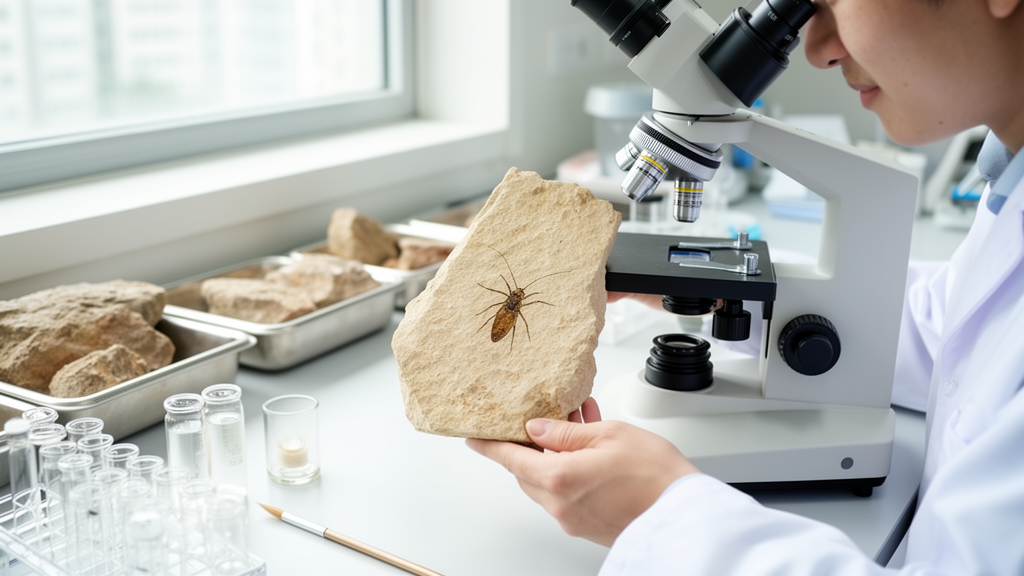
A remarkably well-preserved insect fossil from northwestern China is rewriting what scientists know about one of the most enigmatic branches of the hemipteran family tree. The specimen, a 238-million-year-old forewing of the species Dracaphis angustata, was recovered from the Tongchuan Formation in Shaanxi Province and represents the oldest known member of Naibiomorpha, an entirely extinct infraorder of plant-feeding insects related to modern aphids, whiteflies, scale insects and jumping plant lice. What makes this discovery extraordinary is not merely its age but its completeness: for the first time, researchers have documented the full forewing venation of a Middle Triassic naibiomorphan, resolving a long-standing gap that has hampered comparisons among early sternorrhynchan lineages.
The order Hemiptera, commonly known as true bugs, encompasses six suborders, including Sternorrhyncha, the group that houses today’s aphids, scale insects, whiteflies and psyllids. Within Sternorrhyncha, Naibiomorpha occupies a pivotal position as an early-diverging branch that flourished from the Middle Triassic to the Paleocene. Previous phylogenetic analyses have consistently placed Naibiomorpha as a monophyletic group near the base of the sternorrhynchan tree, confirming its status as a basal clade rather than a direct ancestor of any modern lineage. Yet the fossil record of this group has remained frustratingly sparse, with most known specimens preserving body outlines but incomplete or obscured wing venation, the very characters that taxonomists rely upon most heavily for identification and comparison.
The new specimen, catalogued as NIGP 210919, was collected from mudstone at the top of the Lower member of the Tongchuan Formation at the Qishuihe Section near Hejiafang Village in Tongchuan City. The Ordos Basin, the second-largest sedimentary basin in northwestern China, spans five provinces and is renowned for its rich petroleum and natural gas deposits. The Tongchuan Formation itself measures approximately 596 metres in thickness and contains a diverse fossil assemblage including bivalves, spinicaudatans, ostracods, insects, tadpole shrimps, fish, reptiles, plants and pollen. Uranium-lead dating of the formation has yielded ages of 238.0 ± 1.0 and 237.4 ± 0.9 million years, placing the fossil insects firmly in the latest Ladinian stage of the Middle Triassic.
Imaging of the specimen was carried out using a Zeiss Stereo Discovery V16 microscope system under both vertical reflected and polarised light, with approximately 50 individual focal planes digitally stacked to produce sharp composite photographs. The forewing measures 6.20 millimetres in length and 1.69 millimetres in width, giving a length-to-width ratio of about 3.65, notably narrow for the group. The venation follows the nomenclature established by Shcherbakov in 2007, comprising the subcosta (Sc), radius (R), radius sector (Rs), media (M), cubitus anterior (CuA) and cubitus posterior (CuP). In this specimen, the R vein is the longest, extending from the wing base to the apex, while the M vein is unbranched and originates from the base of the cubitus, a combination that is diagnostic for Naibiomorpha.
Detailed comparison of the new fossil with the holotype of Dracaphis angustata, described in 2009, reveals minor venational differences that the researchers interpret as taphonomic artefacts, likely resulting from compression and vein obscuration in the original specimen. Given the morphological consistency and shared provenance from the same deposit, the new material is confidently assigned to D. angustata, thereby complementing and refining the species diagnosis. The revised diagnosis for the family Dracaphididae now specifies a forewing of 6.20 millimetres or longer, a weak or invisible Sc vein, an Rs vein that branches from R near its base with the R stem about three times longer than the Rs stem, an unbranched M vein, and CuA veins that are typically straight and similar in length.
The taxonomic position of Naibioidea has undergone substantial revision over the years. It was initially placed within the infraorder Aphidomorpha, alongside extant groups such as Aphidoidea, Adelgoidea and Phylloxeroidea, as well as several extinct superfamilies. This placement was later contested, with alternative hypotheses aligning Naibioidea with Coccidomorpha, the scale insects. To resolve this systematic uncertainty, Szwedo erected the infraorder Naibiomorpha in 2018 to accommodate Naibioidea and its constituent families Dracaphididae, Naibiidae and Sinojuraphididae. Within the modern phylogenetic framework established by Drohojowska and colleagues in 2020, Naibiomorpha is recognised as an entirely extinct infraorder positioned as the sister group to Aphidomorpha, the true aphids, with the two branches having diverged from a common ancestor approximately 290 million years ago.
The new specimen also provides critical evidence for distinguishing Naibiomorpha from other early sternorrhynchan stem groups. Pincombeomorpha is characterised by an Rs vein originating anterior to the pterostigma and by M and CuA forming a short common stalk, while Aphidomorpha is defined by the lack of fusion between M and Rs and by M typically having three branches. Naibiomorpha, by contrast, is diagnosed by an unbranched M vein that originates near the base of the cubitus. Another Triassic species, Coccavus supercubitus from Kyrgyzstan, can be distinguished from D. angustata by its distinctly three-branched CuA vein. These morphological distinctions indicate that by the Middle Triassic, the three major stem groups of Sternorrhyncha were already clearly differentiated, having likely originated from a common ancestor during the Early Permian before following independent evolutionary trajectories.
Intriguingly, the detailed venational comparison also challenges the current inclusion of the genus Sinojuraphis within Naibiomorpha. The venation of Sinojuraphis, characterised by a two-branched M vein and a distinct basal separation of veins M and Cu, differs significantly from the diagnostic pattern observed in core naibiomorphans. The researchers therefore propose a taxonomic revision, recommending the removal of Sinojuraphis from Naibiomorpha to reflect a more accurate phylogeny. This kind of reassessment underscores how a single well-preserved specimen can ripple through an entire classification, forcing palaeontologists to reconsider boundaries that were previously drawn on incomplete evidence.
Beyond taxonomy, the fossil illuminates a striking macroevolutionary trend. With the venational supplement of Dracaphis now documented, Naibiomorpha exhibits a clear trajectory toward miniaturisation. Its earliest and largest known representative, D. angustata from the Middle Triassic, attained a forewing length of up to 6.20 millimetres, whereas younger species such as the Middle Jurassic Panirena tenella, the Early Cretaceous P. sukatshevae and the Paleogene Naibia zherichini, at roughly one millimetre, are markedly smaller. The researchers propose a forewing miniaturisation hypothesis for this clade, analogous to Koteja’s 1985 sexual selection model for scale insects, in which male dwarfism evolved to facilitate active crawling through leaf litter in search of sedentary females. Given the limited fossil record, however, this interpretation remains tentative.
Palaeogeographic reconstructions indicate that Naibiomorpha likely originated in northern Laurasia, consistent with a Northern Hemisphere origin hypothesis for Sternorrhyncha as a whole. Despite this shared early history, the evolutionary fates of these lineages diverged markedly. Naibiomorpha remained geographically confined to Laurasia and eventually became extinct, whereas aphids achieved a nearly global distribution in temperate zones and whiteflies and scale insects radiated into tropical and subtropical regions worldwide. The radiation of angiosperms likely intensified competition among sternorrhynchans for limited gymnosperm resources while simultaneously promoting the diversification of predatory ladybird beetles, whose ancestral lineages are inferred to have been aphidophagous. Under these combined pressures of resource competition and increased predation, Naibiomorpha and potentially other minute sternorrhynchans may have ultimately been driven to extinction during the Paleogene, leaving behind fossils such as this remarkable Triassic forewing as the only testament to their existence.
Subject of Research: Early evolution and forewing morphology of the extinct hemipteran infraorder Naibiomorpha based on a Middle Triassic fossil from China
Article Title: The oldest Naibiomorpha ( Insecta , Hemiptera ): new fossil from NW China with implications for their early evolution
Article References: Xu, L., Zhao, X., & Zhang, Q. (2026). The oldest Naibiomorpha (Insecta, Hemiptera): new fossil from NW China with implications for their early evolution. Fossil Record, 29(1), 429-436. https://doi.org/10.3897/fr.29.194991
Image Credits: AI Generated
DOI: 10.3897/fr.29.194991
Keywords: Naibiomorpha, Sternorrhyncha, Hemiptera, Dracaphis angustata, Middle Triassic, Tongchuan Formation, forewing venation, paleontology, insect evolution, Ordos Basin, Laurasia, fossil insects
Cite Scienmag News
Gavin Prescott. (October 17, 2026). Oldest Known Fossil of Extinct Plant-Lice Relative Unveiled in China. Scienmag. https://scienmag.com/oldest-known-fossil-of-extinct-plant-lice-relative-unveiled-in-china/
Gavin Prescott. "Oldest Known Fossil of Extinct Plant-Lice Relative Unveiled in China." Scienmag, 17 October 2026, https://scienmag.com/oldest-known-fossil-of-extinct-plant-lice-relative-unveiled-in-china/. Accessed 17 October 2026.
Gavin Prescott. "Oldest Known Fossil of Extinct Plant-Lice Relative Unveiled in China." Scienmag. October 17, 2026. https://scienmag.com/oldest-known-fossil-of-extinct-plant-lice-relative-unveiled-in-china/


