


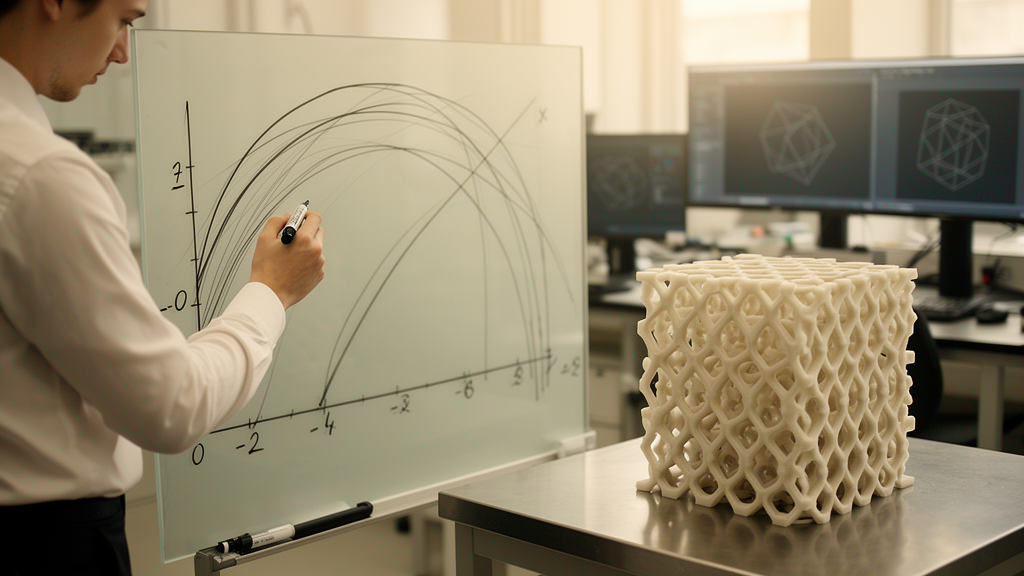
For decades, engineers hunting for exotic wave behavior in metamaterials have worked the way a sculptor works: start with a block of raw material, carve out a unit cell, test it, and hope the resulting structure exhibits the topological properties they wanted. If it does not, they go back to the drawing board. A new study published in Frontiers in Acoustics flips that workflow on its head. Instead of building a lattice and then analyzing its topology, Hasan B. Al Ba’ba’a of Union College and Jihong A. Ma of the University of Vermont show how to start with the topology itself—expressed as a curve in the complex plane—and work backwards to the exact spring network that produces it. The result is a rigorous inverse design methodology for one-dimensional diatomic lattices, one that could accelerate the development of mechanical computers, energy harvesters, and noise-isolation devices built on the back of topological physics.
The work sits within the rapidly growing field of topological phononics, the mechanical and acoustic cousin of topological insulators in electronics. Topological insulators are strange materials: they insulate in their bulk but conduct flawlessly along their surfaces or edges, thanks to special states that are protected against local defects and disorder. In the past decade, researchers have realized that vibrating chains of masses and springs, acoustic cavities, and elastic plates can host analogous states—vibrational modes that live inside frequency bandgaps and cling stubbornly to boundaries, immune to backscattering. That robustness makes them attractive for waveguides, diodes, logic gates, switches, and even acoustic versions of field-effect transistors. But designing a phononic crystal with a prescribed number of these protected states has remained stubbornly trial-and-error.
The traditional approach relies on what physicists call bulk-boundary correspondence: the topological features observed at a structure’s edges are dictated by the properties of its repeating unit cell, its bulk. To characterize those properties, one typically computes the eigenvectors of the effective Hamiltonian—the mathematical object describing the unit cell’s dynamics—and extracts a topological invariant, most famously the winding number. For the canonical example, the one-dimensional Su–Schrieffer–Heeger (SSH) model, the mechanical analog is disarmingly simple: identical masses connected by springs with alternating stiffnesses. When the two stiffnesses differ, a bandgap opens in the dispersion diagram, and a complex-valued phase function traces a perfect circle in the complex plane as the wavenumber sweeps through its full range. The number of times that circle winds around the origin is the winding number, and the difference in winding numbers between two adjacent domains tells you how many topological states appear at their boundary.
That tidy picture, however, breaks down once the connection network grows more complicated. Recent studies have shown that when a diatomic lattice includes interactions beyond nearest neighbors—say, springs reaching across multiple cells—the phase locus abandons its circular path and grows intricate internal loops. More strikingly, the old assumption that the winding-number difference alone determines the count of boundary states turns out to be false in these systems. The detailed geometry of the locus, captured by quantities like the Berry connection in one dimension, becomes crucial. The true number of domain-boundary states reflects the phonon realization of Jackiw–Rebbi modes and is determined by the number of Dirac points—band crossings in the first Brillouin zone—rather than by the winding numbers alone. An analytical description of the full winding trajectory is therefore essential for accurately characterizing lattices with complex connection networks.
Al Ba’ba’a and Ma’s contribution is to turn this characterization tool into a design tool. The key insight is that the complex phase locus is derived from the off-diagonal elements of the chiral matrix, obtained by stripping the constant diagonal terms out of the stiffness matrix. Each term in that off-diagonal function carries a specific physical meaning through the Bloch theorem: a term independent of the wavenumber couples the two degrees of freedom within the current unit cell; a term multiplied by the exponential for the next cell represents a nearest-neighbor coupling; and terms carrying exponentials for more distant cells encode beyond-nearest-neighbor springs. By writing down a desired locus shape in parametric form and matching its terms to these physical roles, the researchers can read off the spring constants—and even the topology of the connection network—directly from the mathematics of the curve.
The authors demonstrate the method with three representative families of loci. The first is the ellipse, a natural generalization of the SSH circle. An elliptical locus with its center on the positive real axis translates into a lattice with an intra-cell spring, a nearest-neighbor spring, and a next-nearest-neighbor spring of equal magnitude but opposite sign—a cancellation that leaves the diagonal elements of the stiffness matrix identical to those of the conventional diatomic lattice. The winding number, computed in closed form, depends only on the center shift and the semi-major axis, so the designer can dial the lattice between topologically trivial, critically gapped, and topologically nontrivial regimes simply by choosing ellipse parameters. When the ellipse encloses the origin, the lattice is topological; when it does not, it is trivial.
The second and third families are far more exotic: epitrochoids and hypotrochoids, the closed-loop roulette curves traced by a point attached to a circle rolling outside or inside a stationary circle. These curves, cousins of the spirograph patterns familiar to generations of children, can sprout internal loops whose number is set by an integer parameter. That integer has a direct mechanical meaning: it dictates how many cells away the non-local coupling reaches, requiring the lattice spacing constraint that the wavenumber multiplier be an integer. For epitrochoid loci, the winding numbers sweep through positive odd and even integers as the non-local spring constant grows and the internal loops swell to wind counter-clockwise around the origin; for hypotrochoid loci, the winding runs negative, with clockwise-winding internal loops. In both cases, the maximum possible winding number equals the integer parameter, and the maximum number of Dirac points in the Brillouin zone matches the spread between the extreme winding values—consistent with the Jackiw–Rebbi picture.
To make the design space navigable, the researchers mapped winding numbers onto barycentric triangles whose corners represent limiting combinations of the three governing stiffness parameters. For the case of a five-loop locus, the triangles reveal five distinct topological regions separated by boundaries where the bandgap closes—the signature of a topological transition. Perhaps counterintuitively, the area of each region says nothing about the size of the bandgap. Instead, the gap width is governed by the degree of space-inversion-symmetry breaking within the unit cell: near the triangle’s corners, where one spring dominates, the gap balloons; near the center, where the three stiffnesses compete and their symmetry-breaking effects partially cancel, the gap narrows. One practical wrinkle also emerged: the epitrochoid construction implies a negative stiffness coupling, so the authors prescribe an elastic foundation to keep the lattice dynamically stable.
The implications reach well beyond one-dimensional chains. Because the methodology ties locus geometry directly to network connectivity, it lays the foundation for wave-based acoustic and mechanical devices with complex and unconventional topological features that simple lattices cannot deliver—multiple localized states, engineered one-way propagation, and higher winding numbers on demand. The authors note that the framework can be extended to higher dimensions by analyzing complex phase surfaces or Berry curvatures, opening the door to two- and three-dimensional metamaterials designed with the same curve-first philosophy. For a field where a single topological device might otherwise emerge only after weeks of numerical trial and error, the ability to sketch a trajectory in the complex plane and have it dictate the springs, masses, and connections of the physical lattice is a genuine shift—turning topological phononics from a science of discovery into one of deliberate engineering.
Subject of Research: Inverse design of one-dimensional topological diatomic lattices using complex phase loci
Article Title: Inverse design of topological diatomic lattices based on complex phase locus
Article References: Al Ba’ba’a, H. B., & Ma, J. A. (2025). Inverse design of topological diatomic lattices based on complex phase locus. Frontiers in Acoustics, 3, Article 1529474. https://doi.org/10.3389/facou.2025.1529474
Image Credits: AI Generated
DOI: 10.3389/facou.2025.1529474
Keywords: topological phononics, inverse design, diatomic lattice, Su–Schrieffer–Heeger model, winding number, complex phase locus, epitrochoid, hypotrochoid, acoustic metamaterials, bandgap, Dirac points, bulk-boundary correspondence
Cite Scienmag News
Reid Dalton. (October 17, 2026). Engineers Reverse-Design Metamaterials by Drawing Curves in the Complex Plane. Scienmag. https://scienmag.com/engineers-reverse-design-metamaterials-by-drawing-curves-in-the-complex-plane/
Reid Dalton. "Engineers Reverse-Design Metamaterials by Drawing Curves in the Complex Plane." Scienmag, 17 October 2026, https://scienmag.com/engineers-reverse-design-metamaterials-by-drawing-curves-in-the-complex-plane/. Accessed 17 October 2026.
Reid Dalton. "Engineers Reverse-Design Metamaterials by Drawing Curves in the Complex Plane." Scienmag. October 17, 2026. https://scienmag.com/engineers-reverse-design-metamaterials-by-drawing-curves-in-the-complex-plane/


