


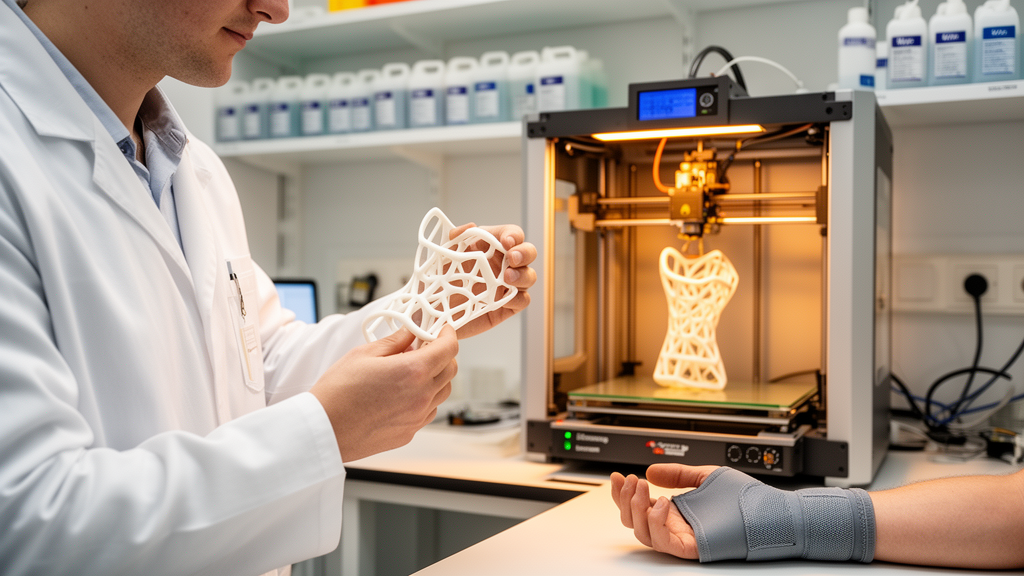
Every year, millions of people with broken arms, legs, or hands are wrapped in rigid plaster or thermoplastic casts. These devices do their job — they hold fractured bones still so they can heal — but they come at a cost. Casts are heavy, they itch, they trap moisture, and they make it nearly impossible to treat wounds or keep the injured limb clean. A team of researchers in the Netherlands believes there is a better option, and they have now published a detailed roadmap showing exactly how a hospital can start printing lightweight, patient-specific splints on its own premises. The study, led by L. A. van Ginkel of the Radboudumc 3D Lab at Radboud University Medical Centre in Nijmegen, appeared in the journal 3D Printing in Medicine and distills the messy, real-world process of clinical implementation into a structured, step-by-step guide.
The appeal of 3D printed splints is easy to understand. Because each device is designed from a digital scan of the individual patient’s anatomy, it can be shaped to fit precisely while remaining far lighter than a conventional cast. The printed structure can be open and lattice-like, allowing air to circulate against the skin. That improved aeration reduces the moisture buildup and skin irritation that plague cast wearers, and it also improves hygiene around the injury. Perhaps most importantly for trauma care, an open splint leaves room for wound treatment: dressings can be changed, sutures can be inspected, and infections can be managed without cutting the device off and starting over. For patients, that can mean a dramatically more comfortable recovery and fewer return visits to the emergency department.
Yet despite these advantages, patient-specific printed splints remain rare in daily clinical practice. The reason is not that the technology does not work — small studies and prototype programs have demonstrated it repeatedly — but that getting from a working prototype to a routine hospital service is genuinely hard. The Nijmegen team, which included trauma surgeons, 3D printing specialists, and a biomechanical engineer from the University of Twente, identified three intertwined categories of difficulty. There are technical and logistical challenges, such as choosing scanners, design software, and printers that can produce medically acceptable devices reliably. There are workflow adjustments, because the path from patient to finished splint must fit into the fast-paced routines of an acute care setting. And there are regulatory constraints, because a hospital that manufactures its own medical devices steps into the role of a device producer under European medical device regulation, with all the documentation and quality obligations that entails.
To confront these barriers, the researchers did something unusually practical for an academic paper: they ran the implementation on-site, at a level-one trauma center with military affiliation in the Netherlands. Rather than designing a theoretical framework in an office, they organized multidisciplinary workshops in which the people who would actually operate the service — trauma surgeons, 3D lab staff, and other stakeholders — sat down together to identify, document, and discuss every essential obstacle they encountered. The workshops served as a structured forum for surfacing problems that might otherwise remain invisible until they caused a failure: who is responsible when a printer breaks mid-production, how a scan moves from the emergency room to the design workstation, which software licenses the hospital must hold, and how the finished device is documented for regulatory purposes.
The output of this process was a taxonomy of challenges. The team categorized the difficulties into essential barriers, each with multiple subitems, and then translated every barrier into a concrete step in a roadmap. Each step specifies the stakeholders involved and the actions required, so that a hospital following the guide knows not just what must be done but who must do it. Examples of the barriers include software and hardware selection for in-house splint production — decisions that ripple outward into training needs, maintenance contracts, and quality assurance. Other barriers concern the clinical workflow, the regulatory pathway, and the organizational changes needed to make in-house manufacturing sustainable rather than a one-off demonstration project.
The regulatory dimension deserves particular attention, because it is where many hospital innovation projects stall. Under the European Medical Device Regulation, a hospital producing custom-made devices in house is not merely using a product; it is manufacturing one. That role carries requirements for documentation, production standards, and traceability that most clinical departments have never had to meet. The roadmap addresses this by embedding the regulatory steps directly into the implementation sequence, so that quality obligations are built in from the start rather than retrofitted after problems arise. This is a significant shift from the way many hospitals have approached 3D printing, treating it as a research activity with looser obligations rather than a clinical service with strict ones.
The military affiliation of the participating hospital adds an interesting layer to the work. Military medicine has long been an early adopter of portable and on-demand manufacturing, since deployed units cannot rely on supply chains for specialized equipment. The involvement of the Military Health Organisation of the Dutch Ministry of Defence, reflected in the author affiliations, suggests that the roadmap was shaped by perspectives from both civilian trauma care and military health logistics. A hospital that can print its own splints from digital scans is also a hospital that can maintain essential capability when external suppliers are unavailable — a resilience argument that resonates well beyond the trauma ward.
To make sure the roadmap was actually usable by the people it is meant for, the researchers put the finished implementation guide in front of end-users and collected their feedback through a questionnaire. This review step is more than a courtesy; it is a check on whether the document communicates clearly to clinicians and technical staff who were not part of the workshops. The team reports that the roadmap provides a structured approach to meeting the requirements for implementation into both research and daily clinical practice — a dual purpose that matters, because many hospitals will want to run a research program first, gather evidence on safety and effectiveness, and only then transition to routine service.
For hospital administrators reading the study, the practical message is that in-house 3D printing of patient-specific splints is achievable, but only with deliberate planning across multiple domains simultaneously. The roadmap’s structure — essential barriers broken into subitems, each mapped to stakeholders and actions — gives institutions a checklist for the conversations they must have before buying a single printer. Which department owns the service? Who designs the devices, and with what software? How are scans acquired, stored, and protected? What documentation satisfies the regulator? How are staff trained, and how is the service maintained when key personnel leave? None of these questions is individually difficult, but the study’s central insight is that they must all be answered together, in a coordinated sequence, for the implementation to succeed.
The broader significance of the work lies in what it represents for hospital-based manufacturing as a whole. Splints are a relatively simple class of medical device, which makes them an ideal proving ground for the organizational machinery of in-house production. A hospital that masters the workflow, regulatory, and quality challenges of printed splints has built the institutional capability to produce other custom devices — surgical guides, prosthetic components, and beyond. The Nijmegen team’s roadmap, born from the friction of real implementation rather than from theory, offers other institutions a way to skip some of that friction. As 3D printing hardware becomes cheaper and design software more accessible, the limiting factor in bringing personalized devices to patients is increasingly not the technology but the organization around it — and that is precisely the problem this study set out to solve.
Subject of Research: In-house production of patient-specific 3D printed splints in acute care
Article Title: An implementation roadmap for in-house production of patient-specific 3D printed splints in an acute care setting
Article References: van Ginkel, L. A., de Bruijn, M. A. N., Hermans, E., Maal, T. J. J., Stirler, V. M. A., & Tuijthof, G. J. M. (2026). An implementation roadmap for in-house production of patient-specific 3D printed splints in an acute care setting. 3D Printing in Medicine. https://doi.org/10.1186/s41205-026-00343-9
Image Credits: AI Generated
DOI: 10.1186/s41205-026-00343-9
Keywords: 3D printing, patient-specific splints, trauma surgery, medical device regulation, implementation roadmap, acute care, hospital manufacturing, 3D Printing in Medicine, Radboudumc, custom medical devices, clinical workflow, immobilization
Cite Scienmag News
Denise Maddox. (October 17, 2026). How a Dutch trauma center built a step-by-step roadmap for 3D printing patient-specific splints in house. Scienmag. https://scienmag.com/how-a-dutch-trauma-center-built-a-step-by-step-roadmap-for-3d-printing-patient-specific-splints-in-house/
Denise Maddox. "How a Dutch trauma center built a step-by-step roadmap for 3D printing patient-specific splints in house." Scienmag, 17 October 2026, https://scienmag.com/how-a-dutch-trauma-center-built-a-step-by-step-roadmap-for-3d-printing-patient-specific-splints-in-house/. Accessed 17 October 2026.
Denise Maddox. "How a Dutch trauma center built a step-by-step roadmap for 3D printing patient-specific splints in house." Scienmag. October 17, 2026. https://scienmag.com/how-a-dutch-trauma-center-built-a-step-by-step-roadmap-for-3d-printing-patient-specific-splints-in-house/


