


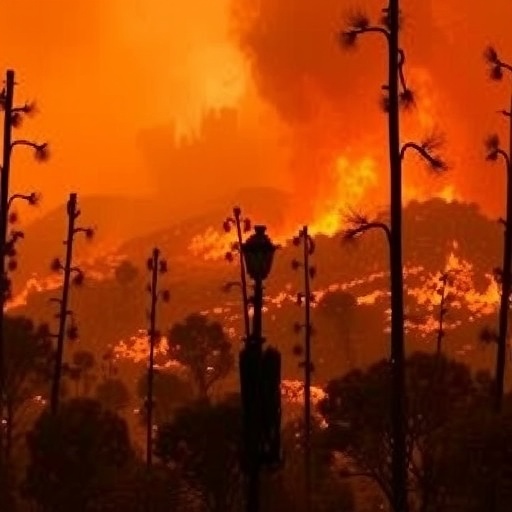
In the early weeks of 2025, Southern California witnessed a calamitous series of wildfires that swept across Los Angeles County with unprecedented ferocity. Official reports tally a heartbreaking 31 fatalities directly linked to the blaze, yet pioneering research from Boston University School of Public Health (BUSPH) and the University of Helsinki reveals a far grimmer reality. Using advanced excess mortality modeling techniques, researchers estimate that the true death toll attributable to these wildfires may be closer to 440—nearly fifteen times higher than previously recorded.
This groundbreaking study, published recently in the Journal of the American Medical Association (JAMA), delves into all-cause mortality data from January 5 through February 1, 2025, encompassing the period when the wildfires engulfed vast stretches of Los Angeles County. The Palisades Fire and the Eaton Fire, ignited on January 7, ravaged over 50,000 acres, destroying close to 16,000 homes and businesses. Initial death counts captured only direct trauma fatalities, overshadowing a vast undercurrent of indirect health consequences now emerging through statistical analysis.
By leveraging novel excess mortality methodologies—previously employed by BUSPH researchers to assess the hidden impact of COVID-19—the investigative team isolated sharp deviations from expected baseline death trends. During the four-week span under study, 6,371 total deaths were recorded, surpassing the forecasted 5,931 deaths by 7%. This 440-person increase signals a significant mortality burden attributable not just to direct fire exposure but also to climate-exacerbated health crises triggered by environmental and systemic stressors.
Researchers explain this stark discrepancy by pointing to multifaceted pathways linking wildfire smoke and disaster conditions to heightened cardiac and pulmonary mortality. Millions of residents inhaled toxic particulate matter, including fine particles, asbestos fibers, microplastics, and hazardous chemicals released from burning vehicles and structures. These pollutants exacerbate chronic respiratory conditions such as asthma and chronic obstructive pulmonary disease (COPD), while also triggering acute cardiovascular events, especially among vulnerable populations.
Moreover, the indirect effects rippled through strained healthcare infrastructure. Disruptions in medical services, reduced access to emergency care, and amplified mental health challenges likely contributed to excess deaths. Evacuees, caught in mass evacuations and gridlocks, faced additional risks. The study’s authors emphasize that standard mortality tracking overlooks these latent fatalities, which reflect the broader systemic impacts of environmental disasters worsened by climate change.
The firestorm’s intensity was driven by a cascade of climatic factors. Prolonged drought, extremely dry vegetation, and gusts exceeding 90 miles per hour created a ‘perfect storm’ allowing flames to ignite and spread with lethal speed. Over 179,000 people were forced into hasty evacuations, highlighting the extraordinary human displacement and logistical challenges faced during the emergency. The authors warn that without improved surveillance mechanisms, many wildfire-related deaths will continue to go unrecorded, obscuring the full human cost of these catastrophes.
Dr. Andrew Stokes, Associate Professor of Global Health at BUSPH and senior author of the study, stresses the critical importance of revising disaster mortality metrics. “Official death tolls often miss the broader health consequences of disasters like wildfires,” he notes. Stokes argues for incorporating both direct and indirect fatalities within response frameworks to better safeguard public health and guide resource allocation amid increasingly volatile climate conditions.
Dr. Eugenio Paglino, postdoctoral researcher at the University of Helsinki and lead author, adds that complementing traditional death certificate analysis with statistical excess mortality estimates is essential. This dual approach unearths “hidden” impacts of disasters that conventional reporting systems overlook. Understanding these silent, cumulative effects will help researchers and policymakers construct a more accurate and complete narrative of disaster impacts.
The research arrives in the context of increasing wildfire prevalence across North America. Already, 2025’s wildfire season has exhibited above-average activity, with heightened fire events reported in Canada, Arizona, Utah, and Oregon. The study’s implications extend beyond Los Angeles, signaling urgent needs to anticipate and mitigate escalating health hazards posed by wildfire smoke and associated disruptions at local, regional, and national levels.
Experts unaffiliated with the study also underscore the growing threats posed by converging environmental stressors. Dr. Gregory Wellenius, Director of the Center for Climate and Health at BUSPH, warns, “Wildfires, heat waves, and severe storms are increasing in frequency and intensity, threatening air quality advancements.” He warns that tens of millions of Americans face recurrent exposure to unsafe air pollution levels, with official death figures historically underestimating these hazards.
Sociodemographic disparities further complicate the wildfire mortality landscape. Though media coverage concentrated on affluent, celebrity-filled neighborhoods ravaged by fire, the devastation spread across diverse communities of every demographic. Smoke exposure effects likely extended even beyond Los Angeles County’s borders, disproportionately affecting lower-income and less visible populations. This uneven burden highlights pressing equity concerns in climate disaster response and public health protection.
The study’s revelations portray a sobering truth about the wider unseen human toll of climate-fueled wildfires. As Stokes poignantly reflects, “The lives lost are not just statistics—they were grandparents, neighbors, workers, and caregivers.” Capturing the full scope of mortality ignited by such disasters is imperative to forging just, informed strategies capable of navigating the mounting challenges climate change poses to public health and survival.
In sum, this crucial research charts a new course in disaster epidemiology by applying rigorous statistical techniques to illuminate excess mortality often obscured by traditional reporting. Its findings call for urgent improvements in mortality surveillance and emergency preparedness that recognize, measure, and address the multifaceted health consequences of wildfires and extreme weather events. As wildfire frequency and climate volatility accelerate, such innovations will be imperative to safeguard lives and communities across vulnerable regions worldwide.
News Publication Date: August 7, 2025
Web References:
- Published study in JAMA
- California Fire Incidents
- Drought and Wildfire Forecast
- Air Pollution Health Risks
References:
- Stokes, A. et al. (2025). Excess Deaths Attributable to Los Angeles Wildfires. JAMA. DOI: 10.1001/jama.2025.10556
Cite Scienmag News
Courtney Benton. (August 8, 2025). Official Death Toll for 2025 LA County Wildfires Likely Significantly Underreported, Potentially Hundreds Higher. Scienmag. https://scienmag.com/official-death-toll-for-2025-la-county-wildfires-likely-significantly-underreported-potentially-hundreds-higher/
Courtney Benton. "Official Death Toll for 2025 LA County Wildfires Likely Significantly Underreported, Potentially Hundreds Higher." Scienmag, 8 August 2025, https://scienmag.com/official-death-toll-for-2025-la-county-wildfires-likely-significantly-underreported-potentially-hundreds-higher/. Accessed 3 September 2026.
Courtney Benton. "Official Death Toll for 2025 LA County Wildfires Likely Significantly Underreported, Potentially Hundreds Higher." Scienmag. August 8, 2025. https://scienmag.com/official-death-toll-for-2025-la-county-wildfires-likely-significantly-underreported-potentially-hundreds-higher/


