


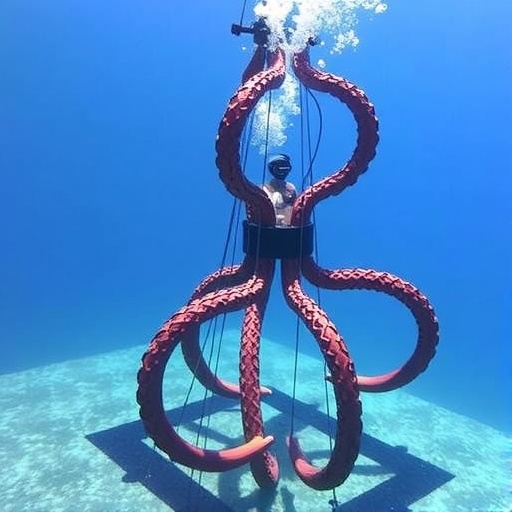
In the advancing frontier of underwater robotics, a groundbreaking development has emerged from the laboratories of Peking University, where an interdisciplinary team led by Professor Guangming Xie has engineered a highly innovative gripper system, marrying the strength of rigid mechanisms with the adaptability of soft materials. This pioneering device, known as the Octopus-Inspired Upward Transport Robot (OUT-Robot), represents a quantum leap in underwater manipulation technology. It solves long-standing challenges related to stiffness modulation, responsiveness, and energy efficiency, with a focus on mimicking the remarkable behaviors of one of nature’s most versatile marine creatures—the octopus.
The OUT-Robot’s design philosophy draws heavily on biomimicry, leveraging the octopus’s unique multimodal grasping strategies. Central to the robot’s capability are six articulated arms embedded with shape memory polymer (SMP) components made from polylactic acid (PLA), which allow for rapid and reversible tuning of stiffness underwater. These arms perform dual functions: initially adopting a soft state for flexible suction or conformal grasping and subsequently transitioning almost instantaneously to a rigid state, effectively locking the grasp without continuous energy consumption. This innovative capacity fundamentally distinguishes the OUT-Robot from conventional robotic grippers.
A critical breakthrough contributing to the system’s unprecedented stiffness-switching speed lies in the carefully engineered thermal interface of the SMP arms. By exploiting a sophisticated trilayer composite, the researchers orchestrated an interplay between the material’s intrinsic properties and the underwater environment’s natural cooling abilities. Inside, a uniform heat diffusion layer of silicone ensures even temperature distribution; the outer transient barrier layer modulates the heating phase; and notably, the surrounding water acts as an efficient heat sink during cooling, enabling swift shape locking. This synergy culminates in a rapid softening time of merely 1.3 seconds under voltage application and an impressively short rigidification time of 0.8 seconds after power cessation, a marked improvement over previous SMP systems that often required tens of seconds to cool in air.
The operational principle underpinning the “Soft-Rigid Hybrid” strategy is both elegant and groundbreaking. During the grasping phase, the robot’s arms remain inherently compliant, enabling suction cups integrated onto each arm to adapt subtly to the textures and contours of diverse underwater objects, from fragile biota to irregular debris. Once proper grip is achieved, the SMP arms undergo rapid cooling, locking into a rigid configuration that maintains a firm grasp, even on heavy items, without expending energy to sustain the clench. This zero-energy retention feature significantly extends mission durations and reduces power requirements, crucial for autonomous underwater vehicles with limited onboard energy.
Empirical testing has validated the efficacy of this approach. A singular SMP-rigidified arm exhibits stiffness approximately 25 times greater than its soft counterpart, and the collaborative effort of all six arms in the OUT-Robot achieves collective grasping forces exceeding four newtons. This force capability translates into seamless manipulation of items weighing over 400 grams, with the gripper adeptly switching between multiple modes to handle suction, single-arm, or multi-arm grasps. The suction mode itself is enhanced, demonstrating more than a twofold increase in pre-adhesion force compared to prior designs, allowing delicate and secure interaction with various materials and organisms.
Field trials conducted in a controlled two-meter-deep aquatic environment modeled realistic underwater scenarios, complete with obstacles such as stones, fishing nets, plastic bottles, sea cucumbers, scallops, fragile plates, and even a heavy 500-gram beer bottle. The OUT-Robot exhibited exceptional versatility: deftly disentangling lightweight nets, carefully collecting delicate biological samples, and powerfully elevating heavier solid waste. This capacity to handle a broad spectrum of object masses and textures in continuous operation underscores the robot’s adaptability and robustness, qualities indispensable for real-world marine applications.
Beyond manipulation prowess, the OUT-Robot integrates a sophisticated active buoyancy control mechanism. After securing an object, the robot inflates its soft outer shell, increasing buoyancy and initiating a passive ascent toward the water’s surface, transporting the object with minimal additional energy input. This buoyancy-driven upward transport is a strategic advancement toward efficient and sustainable underwater operations. The grasping phase’s energy consumption is approximately 75 joules over 1.3 seconds, while the ascent consumes nearly zero energy, marking a paradigm shift toward “pulse-actuation, zero-retention” operational models that dramatically curtail overall power requirements.
The robot’s locomotion abilities further complement its manipulation features. Utilizing coordinated arm bending, the OUT-Robot demonstrates omnidirectional crawling capabilities, achieving propulsion speeds of up to 70 centimeters in 55 seconds along predefined vectors. This combination of dynamic mobility and dexterous manipulation positions the OUT-Robot as a multifaceted tool capable of navigating complex underwater terrains and performing intricate collection and recovery tasks.
From a broader environmental and technological perspective, the implications of the OUT-Robot’s introduction are profound. The team envisions a future in which scalable, modular units of this design operate in coordinated swarms, executing distributed collection and restoration activities across vast marine ecosystems. By transforming the aquatic environment itself into a functional component of the robot’s thermal control system, the design paradigm transcends the traditional view of environmental resistance, instead harnessing nature to enhance device performance.
This development not only signals a leap forward in the quiet and efficient operation of underwater robotics but also constitutes a critical advance in the global effort to safeguard ocean health. By providing gentle yet reliable grasping capabilities tailored to marine contexts, the OUT-Robot is poised to revolutionize autonomous underwater missions in pollution cleanup, ecological research, and resource recovery, all while minimizing disturbances to delicate ecosystems.
The research team includes innovators Mingxin Wu, Yurong Liu, Jiaxi Wu, Waqar Hussain Afridi, Xingwen Zheng, Chen Wang, alongside Professor Guangming Xie—whose interdisciplinary expertise was key to realizing this sophisticated robotic system. Their work was supported by a consortium of funding bodies, including the National Natural Science Foundation of China, Beijing Natural Science Foundation, CPSF Postdoctoral Fellowship Program, and the Key Technology Research and Development Program of Henan Province.
This research was published in the esteemed journal Cyborg and Bionic Systems on March 31, 2026, under the title “Octopus-Inspired Underwater Gripper with Rapid Stiffness Tuning and Robot Enabling Upward Transport” (DOI: 10.34133/cbsystems.0528). The paper documents the full details of the design, performance metrics, and potential applications, marking a seminal contribution to the field of marine robotics engineering.
Cite Scienmag News
Denise Maddox. (May 7, 2026). Octopus-Inspired Underwater Gripper Features Rapid Stiffness Control for Enhanced Upward Transport in Robotics. Scienmag. https://scienmag.com/octopus-inspired-underwater-gripper-features-rapid-stiffness-control-for-enhanced-upward-transport-in-robotics/
Denise Maddox. "Octopus-Inspired Underwater Gripper Features Rapid Stiffness Control for Enhanced Upward Transport in Robotics." Scienmag, 7 May 2026, https://scienmag.com/octopus-inspired-underwater-gripper-features-rapid-stiffness-control-for-enhanced-upward-transport-in-robotics/. Accessed 3 September 2026.
Denise Maddox. "Octopus-Inspired Underwater Gripper Features Rapid Stiffness Control for Enhanced Upward Transport in Robotics." Scienmag. May 7, 2026. https://scienmag.com/octopus-inspired-underwater-gripper-features-rapid-stiffness-control-for-enhanced-upward-transport-in-robotics/


