


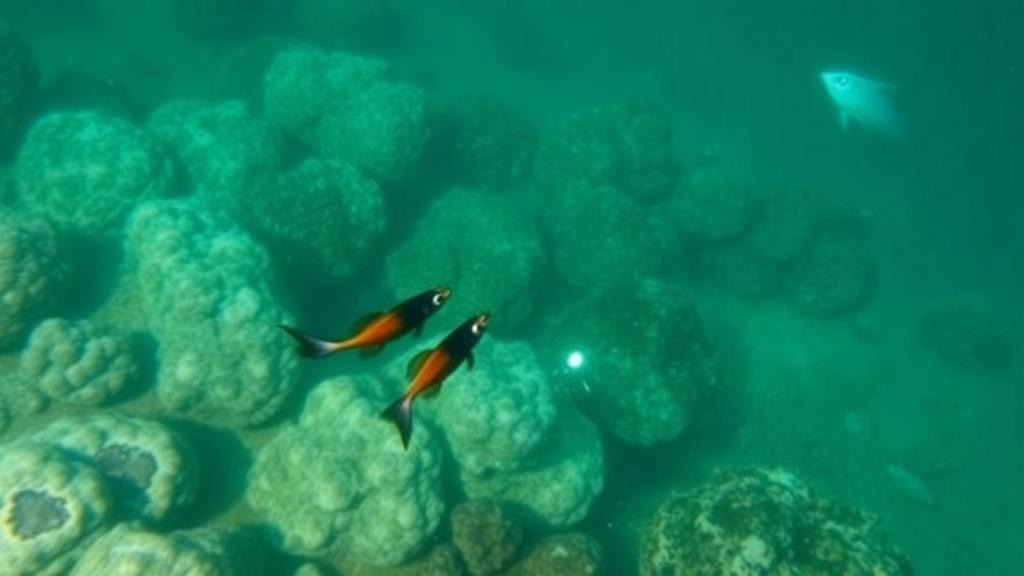
India’s seas are among the least documented on Earth, and a new smartphone application is trying to change that by turning fishermen, students, divers and beachcombers into a distributed network of biodiversity sensors. OceanEyes, short for Observing Citizen Engagement–Accessible Network of Environmental Sightings, was developed by the Centre for Marine Living Resources & Ecology (CMLRE) under India’s Ministry of Earth Sciences. Described in the journal Discover Oceans, the platform is designed to capture standardized, high-resolution records of marine species across India’s vast Exclusive Economic Zone, a marine domain of roughly 2.02 million square kilometers bordered by a coastline of nearly 11,100 kilometers. The app is now available on both Android and iOS, and its developers report that early adoption has been strong enough to suggest the model could eventually extend well beyond Indian waters.
The problem OceanEyes addresses is deceptively simple: nobody knows exactly what lives in India’s seas, or how those communities are changing. The ocean covers about 70 percent of the planet and may harbor more than 1.4 million species, yet scientists estimate that 70 to 80 percent of marine life remains undiscovered or formally classified. Tropical regions such as the Indian Ocean suffer from particularly pronounced data paucity, with existing datasets that are fragmented, inconsistent and poorly suited to long-term monitoring or predictive modeling. Climate-driven shifts in species distributions are simultaneously rendering historical ecological baselines obsolete. Monitoring change at that pace and scale, the authors argue, requires longitudinal datasets of a magnitude that no single research institution can generate alone.
Citizen science offers a way out of that bind, and the technology to support it is already in millions of pockets. Modern smartphones function as networked sensor nodes, combining high-fidelity cameras, GPS receivers and high-speed telemetry to enable real-time environmental monitoring at unprecedented spatial and temporal resolution. Mobile connectivity now reaches from Indian cities into remote coastal fishing communities, providing the infrastructure for a low-cost, scalable data acquisition framework. Global platforms such as iNaturalist and eBird have proven the concept at enormous scale, but their datasets carry a pronounced terrestrial bias, leaving the marine realm comparatively undersampled. Indian efforts such as Jalchar and Marlin fill important niches, focused on marine mammal strandings and fisheries catch reporting respectively, but a gap remained for documenting broader marine biodiversity, especially non-commercial vertebrates and the vast diversity of benthic and pelagic invertebrates.
OceanEyes was built to occupy precisely that middle ground, and the engineering choices behind it reveal how seriously the team took both usability and scientific rigor. Development followed an Agile software development life cycle, with rapid prototyping, continuous stakeholder feedback and incremental refinement rather than a rigid linear build. Requirements were defined through consultation sessions with marine biologists, scientists and software engineers, then translated into a technical roadmap. The interface was designed in Figma, whose cloud-based, platform-agnostic environment allowed multiple stakeholders to co-edit prototypes concurrently. Usability testing ran over four weeks in two iterative cycles, beginning with five internal experts and expanding to ten evaluators including taxonomists and research scholars, a process aimed at ensuring the app was intuitive, supported seamless offline functionality and delivered precise geotagging before full-scale development began.
The technical stack reflects a deliberate balance between cross-platform reach and data-intensive performance. The mobile front end was engineered with Flutter and the Dart language, allowing a single codebase to serve Android and iOS natively. On the server side, a PHP Laravel framework powers a modular administrative dashboard and RESTful APIs chosen for their ability to handle high-throughput transactions, while PostgreSQL serves as the relational database, optimized for complex spatial queries and secure retrieval. The Google Maps SDK provides geospatial tagging and a visualization layer with dynamic clustering of observation points, reducing interface load and helping users interpret species distribution patterns. A continuous testing protocol, including functional, usability, performance and regression testing, ran throughout development, and a collaborative defect-tracking matrix kept the scientific team and software engineers aligned through a structured status taxonomy from ‘Initiated’ to ‘Closed’.
What truly distinguishes OceanEyes, however, is its data architecture. Every observation is captured through a structured, Darwin Core-aligned schema, the community-developed biodiversity data standard that underpins global platforms publishing through the Global Biodiversity Information Facility. The app goes further than generalist tools by incorporating marine-specific metadata such as habitat type, observation depth and benthic substrate, alongside support for photo, video and audio evidence. Validated records are formatted for direct export to the Indian Ocean Biodiversity Information System (IndOBIS) and from there to the global Ocean Biodiversity Information System (OBIS), transforming citizen submissions into FAIR-aligned datasets that are findable, accessible, interoperable and reusable. That pipeline means a fisherman’s snapshot of an unfamiliar reef fish can, in principle, end up feeding international marine biodiversity assessments.
Quality control is where many citizen science projects stumble, and OceanEyes confronts the problem head-on with a two-tier expert validation pipeline. Unverified submissions are quarantined until reviewed by CMLRE-affiliated taxonomists, who assess the morphological features visible in uploaded media against the logged geospatial and temporal metadata to filter out erroneous, duplicated or misidentified records. Experts can refine generic submissions to species-level identifications or reject them as ‘Unqualified’, triggering an automated email feedback loop that advises contributors on improving data quality. Sharp, well-lit images showing diagnostic traits pass; obstructed or low-resolution shots fail. Only after this curation is an observation flagged as research-grade. The design directly targets known weaknesses of participatory monitoring, including inconsistent data quality, absent sampling protocols and taxonomic bias, in which volunteers disproportionately report charismatic megafauna while overlooking less conspicuous invertebrates.
Connectivity is the other great challenge of coastal data collection, and the app’s offline capability is its answer. Intermittent or absent cellular coverage has historically skewed biodiversity reporting toward urbanized coastlines and away from remote regions, creating a pronounced spatial bias. OceanEyes allows users to cache observations, including photographs and GPS coordinates, locally on their devices, with automatic synchronization to the central server once connectivity returns. Gamified elements such as contributor leaderboards are layered on top to sustain long-term engagement across historically data-deficient coastal and island communities. A comparative analysis against iNaturalist, eBird, Jalchar and Marlin, conducted across eight criteria ranging from metadata depth to global data integration, positions OceanEyes as a hybrid: broader in scope than the regional Indian apps, but more marine-focused and more tightly curated than the global generalists.
Usage data from the initial deployment between November 2023 and March 2026 traces a familiar but encouraging adoption curve. The platform accumulated 539 users globally, roughly 74 percent of them in India, with active users peaking at 232 during an initial surge driven by structured outreach such as training programs and field demonstrations. Engagement then declined as transient participants drifted away, a pattern consistent with crowd science research showing that a small core of committed contributors accounts for most sustained activity. Crucially, active users then stabilized at 60 to 100, indicating the emergence of a persistent contributor base rather than outright collapse. The presence of users across 68 additional countries hints at global potential, though the authors caution that the expert validation pipeline could become a scaling bottleneck, that spatial reporting will still favor accessible coasts, and that usability testing involved small samples of five to ten evaluators.
The team’s roadmap aims squarely at those limits. Future development will integrate machine learning frameworks for automated preliminary species identification, an AI-assisted triage system intended to lighten the manual burden on taxonomists and accelerate validation. Expanded multilingual interfaces are planned to improve accessibility for diverse coastal communities, and strategic alignment with India’s national Deep Ocean Mission, under which the work was carried out, may extend participatory data collection into undersampled pelagic and benthic ecosystems. The policy stakes are considerable: open, interoperable, high-fidelity biodiversity data underpins India’s commitments under the Convention on Biological Diversity, Sustainable Development Goal 14 and the emerging BBNJ Agreement, and feeds marine spatial planning, climate change tracking and conservation planning. If OceanEyes can keep its core of contributors growing while automation eases the curation load, the app may demonstrate that the most powerful ocean survey instrument ever deployed is the one already in people’s pockets.
Subject of Research: A citizen science mobile application for standardized documentation and expert validation of marine biodiversity observations across India's Exclusive Economic Zone
Article Title: OceanEyes a citizen science mobile application for documenting marine species in India
Article References: Johnny, K., Sahu, N., Saravanane, N., & T., S. (2026). OceanEyes a citizen science mobile application for documenting marine species in India. Discover Oceans, 3(1), Article 25. https://doi.org/10.1007/s44289-026-00139-z
Image Credits: AI Generated
DOI: 10.1007/s44289-026-00139-z
Keywords: citizen science, marine biodiversity, OceanEyes, India, mobile application, Darwin Core, OBIS, IndOBIS, species validation, ocean monitoring, FAIR data, marine conservation
Cite Scienmag News
Margaret Porter. (October 2, 2026). OceanEyes Turns India’s Coastlines Into a Living Lab for Marine Life. Scienmag. https://scienmag.com/oceaneyes-turns-indias-coastlines-into-a-living-lab-for-marine-life/
Margaret Porter. "OceanEyes Turns India’s Coastlines Into a Living Lab for Marine Life." Scienmag, 2 October 2026, https://scienmag.com/oceaneyes-turns-indias-coastlines-into-a-living-lab-for-marine-life/. Accessed 4 October 2026.
Margaret Porter. "OceanEyes Turns India’s Coastlines Into a Living Lab for Marine Life." Scienmag. October 2, 2026. https://scienmag.com/oceaneyes-turns-indias-coastlines-into-a-living-lab-for-marine-life/


