


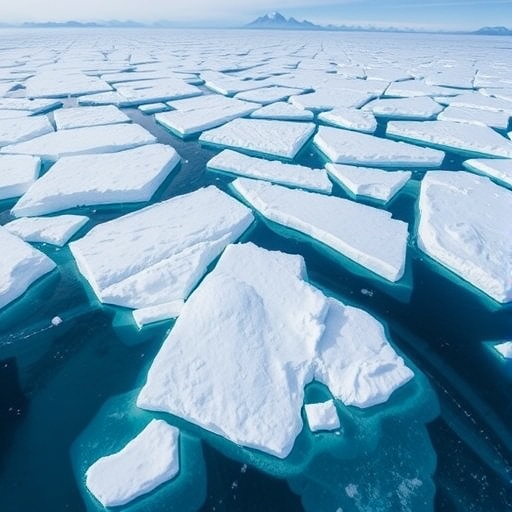
In a groundbreaking new study set to redefine our understanding of ice age dynamics, researchers have unveiled the crucial role of prolonged ocean circulation slowdowns in triggering extraordinary ice-sheet melting during the termination of Ice Age IV. Published in Nature Communications, this research provides unprecedented insights into the intricate interplay between oceanic processes and glacial disintegration, challenging existing paradigms about the pace and mechanisms driving these cataclysmic climatic transitions.
The phenomenon studied—termination IV—marks a pivotal period around 430,000 years ago when the Earth transitioned from a glacial maximum to an interglacial phase, characterized by the retreat of massive ice sheets that had engulfed large parts of the northern hemisphere. While the timing and general drivers of ice age terminations have been the subject of extensive research, the exact mechanisms responsible for the scale and speed of ice-sheet melting during these intervals have remained elusive. This new investigation spotlights the protracted slowdown in ocean circulation as a key factor accelerating ice melting beyond what previous models could explain.
At the heart of this discovery lies the ocean’s conveyor belt system, specifically its capacity to redistribute heat and regulate climate by moving vast amounts of water and heat between the tropics, high latitudes, and deep ocean basins. The Atlantic Meridional Overturning Circulation (AMOC), a critical component of this global system, was found to have undergone a prolonged and intense slowdown during termination IV. This sluggish circulation profoundly disrupted the heat budget of the Northern Hemisphere, allowing unprecedented warming and consequent ice-sheet retreat.
Utilizing a sophisticated combination of paleoclimate proxies and state-of-the-art climate modeling, the research team reconstructed past ocean circulation behaviors with remarkable temporal resolution. Insights from marine sediment cores, isotopic analysis, and sea surface temperature reconstructions provided empirical evidence of the extensive slowdown, revealing patterns of diminished North Atlantic Deep Water formation and altered salinity gradients that were previously undetected.
The implications of this multi-century slowdown suggest that the ocean’s thermal inertia offered a feedback mechanism that amplified global climatic changes. As ocean currents weakened, the heat previously sequestered in tropical and mid-latitude waters was redistributed toward high latitudes. This, in turn, elevated air and sea surface temperatures along ice-sheet margins, destabilizing the glacial mass balance and accelerating ablation rates.
One of the most striking aspects uncovered is that this oceanic slowdown was not a brief or localized event but rather a sustained shift lasting several millennia. Such longevity implies that ocean dynamics can exert a persistent influence on terrestrial ice masses, inadvertently setting the stage for rapid ice loss episodes and sea-level rise. This finding pushes climate scientists to rethink how gradual alterations in ocean processes can precipitate more abrupt and extreme climatic consequences.
Moreover, the study highlights intricate feedback loops where melting ice sheets themselves modulate ocean salinity and circulation. The influx of freshwater from retreating glaciers contributed to a further reduction in the density-driven sinking of cold, salty water in the North Atlantic, thereby reinforcing the slowdown. This vicious cycle exemplifies the complex interdependence between cryosphere dynamics and oceanic thermohaline circulation.
The researchers emphasize that previous conceptions of ice age terminations often underestimated the nuanced role of ocean circulation changes, focusing primarily on atmospheric greenhouse gas increases or orbital variations as dominant forcings. While these factors remain fundamental, the newfound evidence stresses that ocean circulation collapse can act as a critical amplifier, intensifying the conditions conducive to rapid deglaciation.
This work also challenges models that assumed rapid ice-sheet melting primarily resulted from temperature thresholds being crossed abruptly. Instead, the evidence supports a scenario where prolonged ocean circulation disruption gradually erodes ice-sheet stability, potentially making the system more sensitive and prone to tipping points once critical thresholds are reached. The gradual nature of this process could explain why some terminations feature extensive ice retreat occurring over remarkably short geological timescales.
In reconstructing paleoclimate conditions with high precision, the team employed isotope ratio mass spectrometry and advanced climate models integrating coupled ocean-atmosphere chemistry. These methodologies allowed a nuanced understanding of how carbon cycles, nutrient redistribution, and shifts in ocean stratification interplayed with ice-sheet melting, presenting a holistic narrative of Earth’s climate machinery during the mid-Pleistocene.
Perhaps one of the most profound takeaways is the study’s relevance to contemporary climate change scenarios. By elucidating how sustained ocean circulation perturbations historically triggered catastrophic ice-sheet decay, the findings underscore potential risks if ongoing anthropogenic influences cause similar disruptions. The parallels between past and present ocean dynamics offer a cautionary perspective on how fragile the coupled climate system can be under persistent stress.
The discovery also opens new avenues for exploring the role of other ocean basins and their circulation patterns. While much attention was paid to the North Atlantic in this research, the possibility exists that similar mechanisms operate on a global scale, amplifying climatic shifts in synchronous or asynchronous modes. Future research may focus on integrating these regional dynamics into a comprehensive understanding of Earth’s glacial cycles.
Technological advances in climate proxies and computational power were indispensable to this study. High-resolution temporal data allowed the researchers to identify distinct phases in ocean circulation changes, correlating them tightly with ice-sheet melting events. These data provided robust constraints for models, ensuring simulations faithfully represented observed historical climate behavior, setting a new standard for paleoclimate research.
Ultimately, this landmark study clarifies how ocean circulation, often overlooked outside of oceanographic circles, plays a starring role in Earth’s biggest climatic transformations. By revealing the protracted nature of ocean slowdown at termination IV, it reshapes our understanding of the interconnected systems governing ice sheet stability and provides invaluable insights applicable to both past and future climate scenarios.
As the global community grapples with accelerating climate change, this research serves as a clarion call for better integrating oceanographic knowledge into climate predictions. Understanding the delicate balance of ocean circulation and its far-reaching effects on ice sheets is essential for anticipating and potentially mitigating future sea-level rise, preserving coastal ecosystems, and managing societal risks in an era of unprecedented environmental upheaval.
This thorough investigation, led by Hu, Marino, Sánchez Goñi, and colleagues, is poised to become a foundational reference for scientists, policymakers, and the public alike, illustrating the critical significance of the ocean’s heartbeat in shaping Earth’s climatic past and future.
Cite Scienmag News
Violet Maxwell. (June 16, 2026). Ocean Circulation Slowdown Triggered Major Ice Melt. Scienmag. https://scienmag.com/ocean-circulation-slowdown-triggered-major-ice-melt/
Violet Maxwell. "Ocean Circulation Slowdown Triggered Major Ice Melt." Scienmag, 16 June 2026, https://scienmag.com/ocean-circulation-slowdown-triggered-major-ice-melt/. Accessed 3 September 2026.
Violet Maxwell. "Ocean Circulation Slowdown Triggered Major Ice Melt." Scienmag. June 16, 2026. https://scienmag.com/ocean-circulation-slowdown-triggered-major-ice-melt/


