

Tuesday, October 20, 2026
Science
No Result
View All Result
  • Login
  • HOME
  • SCIENCE NEWS
  • CONTACT US
  • HOME
  • SCIENCE NEWS
  • CONTACT US
No Result
View All Result
Scienmag
No Result
View All Result
Home Science News Earth Science

Observational study links urban Indian women’s morbidity to heat and pollution

October 20, 2026
in Earth Science
Violet Maxwell
By Violet Maxwell Scienmag Editorial Profile - Natural Hazards
Reading Time: 3 mins read
0
Observational study links urban Indian women’s morbidity to heat and pollution

Observational study links urban Indian women’s morbidity to heat and pollution

65
SHARES
587
VIEWS
Share on FacebookShare on Twitter
ADVERTISEMENT

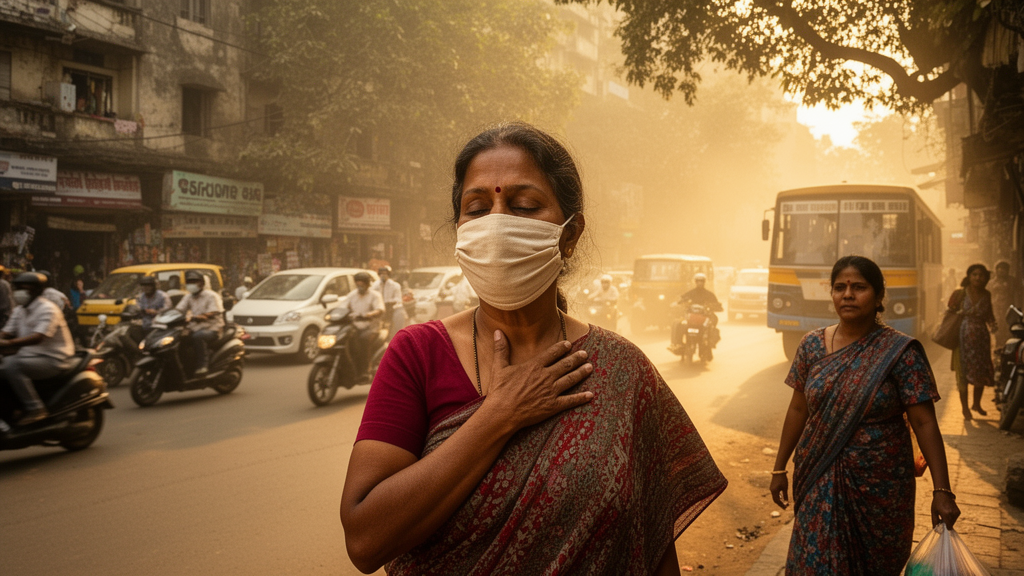
An observational analysis of 153,980 women across urban India found that morbidity was more prevalent in areas with higher temperatures, heavier rainfall and greater fine-particle pollution, while residence above 200 metres was associated with lower odds of illness. The study also identified associations between morbidity and household indoor air pollution, age, overweight status, tobacco use, alcohol consumption and wealth group. These are statistical relationships in survey and environmental data, not evidence that the measured factors caused illness.

Researchers combined urban cluster-level data from the fifth National Family Health Survey, or NFHS-5, with gridded climatic and environmental indicators from NASA. The analysis assessed the prevalence, geographic clustering and correlates of morbidity among urban women. Chi-square tests and logistic regression were used to examine associations, while Moran’s I, cluster-outlier analysis and bivariate local indicators of spatial association, including biLISA, evaluated geographic patterns. The resulting odds ratios describe the likelihood of morbidity after adjustment for variables included in the study’s model; the supplied abstract does not specify the full adjustment set or provide the clinical composition of the morbidity outcome.

Temperature showed a statistically significant association with morbidity in the multivariable model. Women living in areas where temperatures exceeded 25 °C had 11.9% higher adjusted odds of morbidity than women in comparison areas. The reported adjusted odds ratio was 1.119, with a confidence interval of 1.057–1.185. By contrast, residence at altitudes above 200 metres was associated with 20.6% lower adjusted odds, represented by an adjusted odds ratio of 0.794 and a reported confidence interval of 0.765–0.824. These estimates come from an observational analysis and should not be interpreted as demonstrating direct effects of altitude or temperature on individual health.

Rainfall was also significantly associated with morbidity. Urban areas receiving more than 150 millimetres of rainfall had 8.8% higher adjusted odds of morbidity than comparison areas, with an adjusted odds ratio of 1.088 and a reported confidence interval of 1.045–1.132. The strongest environmental association involved ambient PM2.5: women living where concentrations exceeded 40 µg/m³ had 24.3% higher adjusted odds of morbidity. That estimate had an adjusted odds ratio of 1.243 and a reported confidence interval of 1.185–1.305. Household indoor air pollution, designated HIAP in the study, was associated with 9.3% higher adjusted odds, with an adjusted odds ratio of 1.093 and a reported confidence interval of 1.026–1.164.

Spatial analysis placed morbidity hotspots in northern, eastern, central and southern India. The biLISA results showed positive local spatial association between morbidity and rainfall, temperature, PM2.5 and household indoor air pollution, indicating that locations with relatively high values of a given indicator tended to occur near other locations with relatively high morbidity. The demographic and behavioural analysis also found higher odds among women aged 40–49 years, women with overweight, tobacco users, alcohol consumers and women from higher wealth groups. Together, the findings present a broad national view of environmental and social correlates of morbidity, with cluster-level exposure measures and observational associations limiting direct interpretation for individual risk.

Subject of Research: Environmental and sociodemographic correlates of morbidity among urban women in India

Article Title: Linkages between climatic, environmental, sociodemographic and behavioural factors with morbidity among women in urban India

Article References: Sarkar, S., & Dolui, M. (2026). Linkages between climatic, environmental, sociodemographic and behavioural factors with morbidity among women in urban India. Discover Sustainability. https://doi.org/10.1007/s43621-026-04817-y

Image Credits: AI Generated

DOI: 10.1007/s43621-026-04817-y

Keywords: urban women’s health, morbidity, air pollution, PM2.5, household air pollution, temperature, rainfall, spatial analysis, NFHS-5, India, Linkages, between

Cite Scienmag News

Violet Maxwell. (October 20, 2026). Observational study links urban Indian women’s morbidity to heat and pollution. Scienmag. https://scienmag.com/observational-study-links-urban-indian-womens-morbidity-to-heat-and-pollution/


Violet Maxwell. "Observational study links urban Indian women’s morbidity to heat and pollution." Scienmag, 20 October 2026, https://scienmag.com/observational-study-links-urban-indian-womens-morbidity-to-heat-and-pollution/. Accessed 20 October 2026.

Violet Maxwell. "Observational study links urban Indian women’s morbidity to heat and pollution." Scienmag. October 20, 2026. https://scienmag.com/observational-study-links-urban-indian-womens-morbidity-to-heat-and-pollution/

Tags: Air pollutionassociation between rainfall and women's health risksbetweenclimate change effects on urban healthenvironmental factors and health outcomes in Indiageographic clustering of health issues in Indian citiesheat and pollution impact on women's healthhousehold air pollutionimpact of altitude on urban healthIndiaindoor air pollution and women's morbiditylinkagesmorbidityNFHS-5observational study on urban climate and women’s healthPM2.5rainfallsocioeconomic determinants of women's health in urban Indiaspatial analysisstatistical analysis of environmental health data in Indiatemperatureurban Indian women morbidityurban women’s health
Share26Tweet16
Previous Post

Oxidized homocysteine associated with methotrexate-linked kidney injury

Next Post

Lanthanum-tuned PtCo intermetallic catalyst improves oxygen-reduction activity in fuel-cell study

Related Posts

French groundwater model ensemble projects wetter north, drier south
Earth Science

French groundwater model ensemble projects wetter north, drier south

October 20, 2026
Landscape framework links farm intensity to soil functions
Earth Science

Landscape framework links farm intensity to soil functions

October 20, 2026
Mobile methanol bunkering cuts Yangtze network costs by 37.7%
Earth Science

Mobile methanol bunkering cuts Yangtze network costs by 37.7%

October 20, 2026
Wuhan ozone variability modeled with interpretable machine learning, 2019–2025
Earth Science

Wuhan ozone variability modeled with interpretable machine learning, 2019–2025

October 20, 2026
Seven challenges constrain urban informal businesses in Ethiopia’s Wallaga Zones
Earth Science

Seven challenges constrain urban informal businesses in Ethiopia’s Wallaga Zones

October 20, 2026
Terrain corrections reveal hidden geoid variations across Kalimantan
Earth Science

Terrain corrections reveal hidden geoid variations across Kalimantan

October 20, 2026
Next Post
Lanthanum-tuned PtCo intermetallic catalyst improves oxygen-reduction activity in fuel-cell study

Lanthanum-tuned PtCo intermetallic catalyst improves oxygen-reduction activity in fuel-cell study

  • Mothers who receive childcare support from maternal grandparents show more optimized

    Mothers who receive childcare support from maternal grandparents show more parental warmth, finds NTU Singapore study

    27656 shares
    Share 11059 Tweet 6912
  • University of Seville Breaks 120-Year-Old Mystery, Revises a Key Einstein Concept

    1061 shares
    Share 424 Tweet 265
  • Bee body mass, pathogens and local climate influence heat tolerance

    682 shares
    Share 273 Tweet 171
  • Researchers record first-ever images and data of a shark experiencing a boat strike

    546 shares
    Share 218 Tweet 137
  • Groundbreaking Clinical Trial Reveals Lubiprostone Enhances Kidney Function

    531 shares
    Share 212 Tweet 133
Science

Embark on a thrilling journey of discovery with Scienmag.com—your ultimate source for cutting-edge breakthroughs. Immerse yourself in a world where curiosity knows no limits and tomorrow’s possibilities become today’s reality!

RECENT NEWS

  • Autoencoder clustering boosts federated sentiment analysis under label skew
  • Ultrasound speeds synthesis of theophylline hybrids with antibacterial activity
  • Piper betle leaf oil shows cell cytotoxicity and antioxidant activity in vitro
  • Rare Alpine hoverflies use mountaintops for mating above 3,000 metres

Categories

  • Agriculture
  • Anthropology
  • Archaeology
  • Athmospheric
  • Biology
  • Biotechnology
  • Blog
  • Bussines
  • Cancer
  • Chemistry
  • Climate
  • Earth Science
  • Editorial Policy
  • Marine
  • Mathematics
  • Medicine
  • Pediatry
  • Policy
  • Psychology & Psychiatry
  • Science Education
  • Science News
  • Social Science
  • Space
  • Technology and Engineering

Subscribe to Blog via Email

Enter your email address to subscribe to this blog and receive notifications of new posts by email.

Join 5,150 other subscribers

© 2025 Scienmag - Science Magazine

Welcome Back!

Login to your account below

Forgotten Password?

Retrieve your password

Please enter your username or email address to reset your password.

Log In
No Result
View All Result
  • HOME
  • SCIENCE NEWS
  • CONTACT US

© 2025 Scienmag - Science Magazine

Discover more from Science

Subscribe now to keep reading and get access to the full archive.

Continue reading