


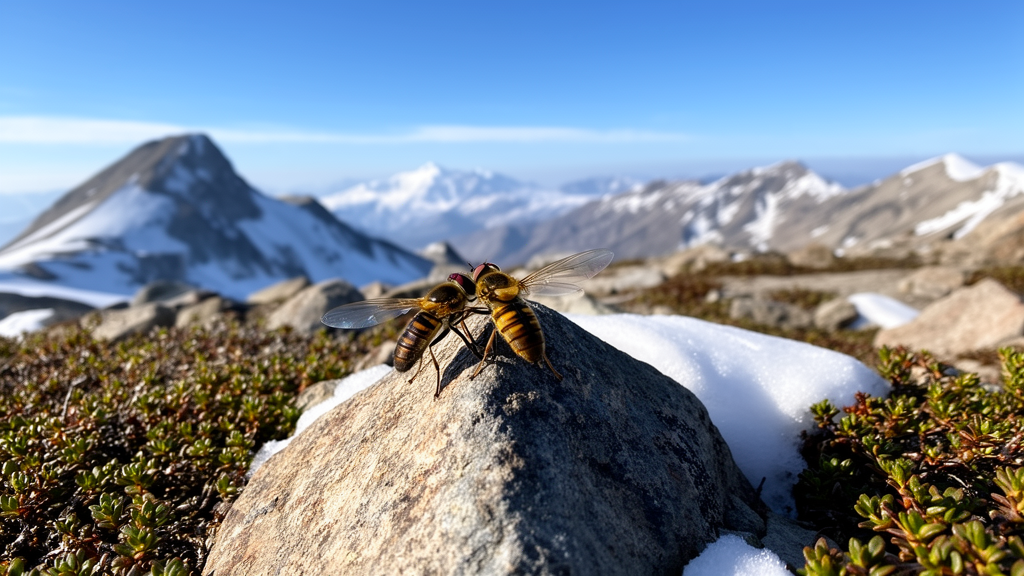
A focused survey of high-altitude sites in the French Alps found hoverfly species aggregating at mountaintops as high as 3,142 metres above sea level, including the rarely recorded Platycheirus altomontis and Rohdendorfia alpina, a species newly recorded for France. Fieldwork conducted between 2019 and 2021 also produced the first formal description of the female P. altomontis, based on three females collected in 2020. The observations indicate that the Alpine habitat above 2,800 metres remains poorly sampled and that searching high summits can reveal both undescribed morphology and new national records.
The field study was conducted by F. Van de Meutter during excursions to the French Alps, the French Pyrenees and Ardèche. Visits to Vars, Villar-d’Arêne, Freissinières and Molines-en-Queyras in the Alps covered elevations from 770 to 3,140 metres, with particular attention to the highest accessible points in July.
Additional Pyrenean localities ranged from 930 to 1,950 metres, while the Ardèche survey covered 550 to 1,250 metres. Hilltops were searched by sight and selected specimens were collected with a hand net. The collected hoverflies were preserved in the author’s personal collection in Tessenderlo, Belgium.
Because the French Alps had already been investigated extensively over many years, the study focused on a less explored component of the available habitat: the full elevational and seasonal range, especially high elevations during summer. The 2020 Alpine expeditions therefore targeted hilltops and prominent landmarks, with the highest accessible points sought particularly in July. Weather was favourable on all survey days, with long sunny spells and wind speed never exceeding 4 Bf.
Specimens were examined under a stereomicroscope and identified using a combination of identification works by Barkalov and Ståhls, Nielsen, van Veen, Šašić and colleagues, Ståhls and Barkalov, and Speight and Sarthou. Across all expeditions, the author observed 205 hoverfly species in French mountains. Two were new to the French fauna, while 26 occurred in five or fewer French departments according to the distribution information available to the study and could therefore be considered rare in the French context.
The lower montane and Alpine meadows between 1,200 and 2,400 metres contained numerous Cheilosia, Platycheirus, Pipizella and Sphaerophoria species, but no new species was found in that elevational band. By contrast, the narrow zone above 2,800 metres yielded a striking concentration of uncommon and newly recorded taxa, including many tens of R. alpina and multiple P. altomontis. Rohdendorfia alpina was recorded for the first time in France.
The species, associated with bare scree at high elevation, occurred in large numbers near Pain de Sucre at 2,780 metres and around La Mortrice, including the summit at 3,142 metres. The listed sample included 17 males and 11 females near Pain de Sucre, seven females near La Mortrice, and three males and one female at the summit. The numbers seen in the field were substantially higher than the numbers collected.
At La Mortrice, a male appeared to perform hilltopping behaviour. The species was found at both high mountain summits visited in July 2020, and the study noted that it may occur at other French Alpine summits as well, although that wider presence was not directly sampled. Platycheirus altomontis was also found at both mountain tops visited in July 2020.
One female was collected near Pain de Sucre at 2,780 metres, where it was feeding on small white flowers, while three males and two females were observed at La Mortrice at 3,142 metres. Females visited small flowers, whereas males fed or sat on stones and made short flights, behaviour described as suggestive of hilltopping. Until this study, the female of P. altomontis had not been formally described.
The description based on the three females established a body length of 6–7 millimetres. Females have bare eyes and a frons at antennal level that is distinctly broader than an eye. The third antennal segment is dark grey-brown, narrowly orange below at the base, while the scape and pedicel are black and the arista is relatively short and thick, slightly longer than the flagellum.
The face carries very long white pilosity, mainly at the sides, and is completely covered with thin grey pollinosity. The frons and vertex are undusted apart from narrow paired triangular dust spots. The scutum and scutellum are shining metallic blue-black with long white pilosity, and the pleurae and humerus have thin grey pollinosity with relatively long white hairs.
The wings have a light-yellow stigma and are covered with microtrichia apart from specified bare areas in cells bm, br and cua. The calypter is yellow-white and the haltere yellow-brown. All legs are dark and carry thin grey pollinosity, with narrow yellow tibial bases and yellow distal portions of the femora.
The relatively short, broad abdomen is dark grey-black and largely matt, apart from large shining areas at the sides of all tergites. Tergites 3 and 4 bear large, semi-rectangular white-grey pollinose spots with rounded inner corners. Abdominal pilosity is pale, sparse, short and appressed centrally, and long and erect laterally.
The female description nevertheless has a clear limitation. In Nielsen’s key to females, P. altomontis would run to P. lundbecki, but no female P. lundbecki was available for direct comparison, so the study did not provide a differential diagnosis between the two. Geographic context may help separate them: P. lundbecki is associated with Nordic countries, whereas P. altomontis is known from high Alpine summits.
From other known species in the P. ambiguus group, the newly described female was distinguished by its small, compact form, short and broad black abdomen with grey dust spots, and very dark legs. The female was also broadly similar to the male apart from the usual sexual dimorphism found within Platycheirus. Eight of the 23 species in the P. ambiguus group still lacked described females at the time of the study.
Thirteen species were observed hilltopping in the French Alps. At 3,142 metres, the highest site with confirmed observations, the group included P. altomontis, R. alpina, Epistrophe leiophthalma, Eupeodes flaviceps and Eristalis tenax. Lower Alpine sites produced concentrations of more than 25 males in loose swarms or around individual landmarks.
These assemblages included Platycheirus tatricus, Cheilosia melanura, Didea alneti, Pipizella calabra, P. nigriana and P. pennina, alongside hoverflies identified only provisionally as Parasyrphus kirgizorum or P. tarsatus. One Parasyrphus group was found at the last larch above the treeline at 2,320 metres, where more than 25 males sat on the tree or hovered nearby. The observations show that this strategy was not restricted to one taxonomic group or to species that are universally scarce.
The very common Cheilosia melanura hilltopped, and its summit-associated males were smaller than larger males of the same species observed hovering in lower forest clearings. The author suggested that hilltopping may be one mating strategy among several within a species and could be related to particular phenotypes, while emphasizing that further research is required to establish which species use the behaviour and how and why it evolved.
Subject of Research: High-altitude hoverfly records, female morphology and hilltopping behaviour in French mountains
Article Title: Description of the female of Platycheirus altomontis Merlin & Nielsen in Nielsen, 2004 ( Diptera , Syrphidae ) with notes on the occurrence and hilltopping behaviour of rare French montane and Alpine Syrphidae
Article References: Van de Meutter, F. (2022). Description of the female of Platycheirus altomontis Merlin & Nielsen in Nielsen, 2004 (Diptera, Syrphidae) with notes on the occurrence and hilltopping behaviour of rare French montane and Alpine Syrphidae. Alpine Entomology, 6, 65-76. https://doi.org/10.3897/alpento.6.81676
Image Credits: AI Generated
Keywords: hoverflies, Syrphidae, Platycheirus altomontis, Rohdendorfia alpina, hilltopping, French Alps, high-altitude insects, species description, Alpine ecology, Description, female, Platycheirus
Cite Scienmag News
Gavin Prescott. (October 20, 2026). Rare Alpine hoverflies use mountaintops for mating above 3,000 metres. Scienmag. https://scienmag.com/rare-alpine-hoverflies-use-mountaintops-for-mating-above-3000-metres/
Gavin Prescott. "Rare Alpine hoverflies use mountaintops for mating above 3,000 metres." Scienmag, 20 October 2026, https://scienmag.com/rare-alpine-hoverflies-use-mountaintops-for-mating-above-3000-metres/. Accessed 20 October 2026.
Gavin Prescott. "Rare Alpine hoverflies use mountaintops for mating above 3,000 metres." Scienmag. October 20, 2026. https://scienmag.com/rare-alpine-hoverflies-use-mountaintops-for-mating-above-3000-metres/


