


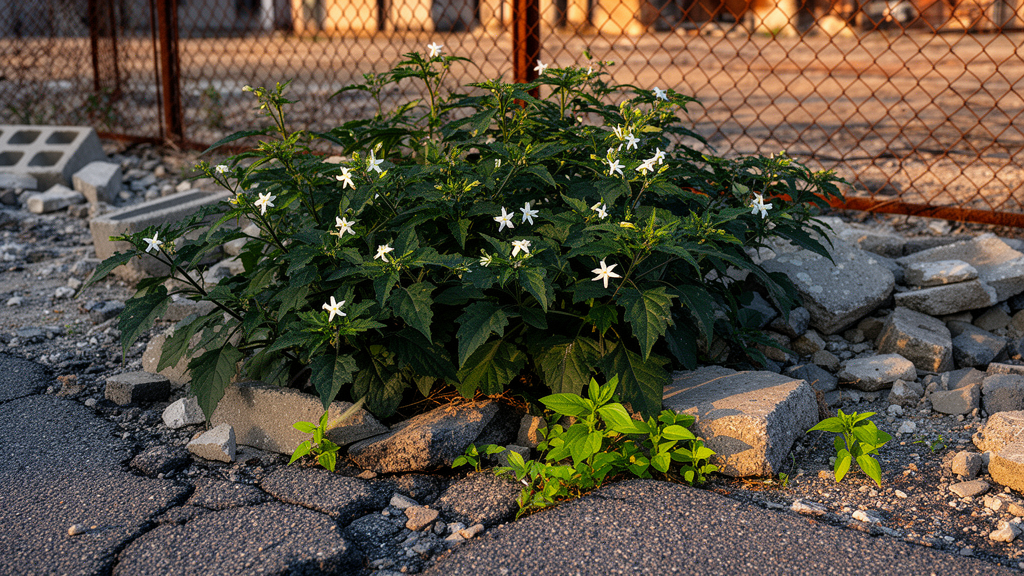
An observational field study in northern Poland found that the occurrence of the emerging non-native plant Solanum nitidibaccatum was associated with the environmental conditions, plant traits, diversity and functional structure of surrounding ruderal vegetation.
The researchers studied one rural, one suburban and one urban site around Toruń and the village of Górsk. The scope therefore covers local patterns at three disturbed sites rather than the species’ behavior throughout its introduced range.
In September 2023, the team surveyed 78 vegetation plots, each measuring 1 × 1 m. Thirty-nine contained S. nitidibaccatum and 39 were controls where the plant was absent. Control plots were matched as closely as possible to occupied plots by habitat type, level of transformation and disturbance. The habitats included roadsides, abandoned wasteland and construction-affected soils.
The analysis combined community-weighted ecological indicator values for light, temperature, moisture and soil fertility with traits such as canopy height, seed mass, specific leaf area and leaf dry matter content. It also measured species richness, mean pairwise phylogenetic distance and standardized functional richness, dispersion, divergence and evenness. Generalized linear mixed-effects models estimated occurrence probability along these gradients, with landscape type initially included as a random effect; its estimated variance was zero in the final models.
Model predictions associated occurrence with communities containing more light-demanding, thermophilous and moisture-demanding species. At selected prediction endpoints, estimated probability rose from 33% to 65% for the light indicator and from 28% to 78% for the temperature indicator. It increased from 6% to 95% for the moisture indicator but declined from 89% to 16% as the community-weighted soil-fertility indicator increased.
Occurrence was also associated with particular plant-trait combinations. At selected prediction endpoints, estimated probability was lower in communities with greater canopy height, seed mass and specific leaf area, declining from 76% to 20%, from 74% to 9% and from 74% to 9%, respectively. It was higher where leaf dry matter content was greater, increasing from 24% to 72%.
Diversity and assembly measures showed contrasting associations. Species richness was positively associated with occurrence, with estimated probability increasing from 23% in six-species plots to 87% in 23-species plots. Probability declined with greater phylogenetic diversity and with higher standardized functional richness, divergence and evenness, but increased with functional dispersion.
The authors interpret these relationships as consistent with habitat filtering and uneven occupation of trait space jointly shaping establishment opportunities for the late-germinating species. The study did not experimentally manipulate competition, resource availability or canopy gaps, so the models cannot establish which mechanisms directly caused the observed patterns. Its geographic scope, three landscape categories, single late-season survey and use of presence rather than abundance, growth, reproduction or population expansion also limit interpretation. Some missing trait data were imputed with a random-forest method.
Within these limits, the findings associate the local occurrence of S. nitidibaccatum with the assembly of disturbed plant communities. The authors conclude that its presence in ruderal vegetation indicates substantial potential to emerge as a problematic invasive weed, while emphasizing that its continuing expansion and ecological or economic consequences require further assessment.
Subject of Research: How ruderal community assembly is associated with the local occurrence of the emerging non-native Solanum nitidibaccatum in Poland
Article Title: Community assembly shapes the performance of Solanum nitidibaccatum , an emerging ruderal non-native
Article References: Puchałka, R., & Czortek, P. (2026). Community assembly shapes the performance of Solanum nitidibaccatum, an emerging ruderal non-native. NeoBiota, 107, 63-87. https://doi.org/10.3897/neobiota.107.179191
Image Credits: AI Generated
DOI: 10.3897/neobiota.107.179191
Keywords: Solanum nitidibaccatum, ruderal vegetation, plant invasion, community assembly, functional diversity, phylogenetic diversity, habitat filtering, Poland, Community, assembly, shapes, performance
Cite Scienmag News
Patricia Pace. (October 21, 2026). Observational study links emerging non-native Solanum nitidibaccatum to ruderal community structure in Poland. Scienmag. https://scienmag.com/observational-study-links-emerging-non-native-solanum-nitidibaccatum-to-ruderal-community-structure-in-poland/
Patricia Pace. "Observational study links emerging non-native Solanum nitidibaccatum to ruderal community structure in Poland." Scienmag, 21 October 2026, https://scienmag.com/observational-study-links-emerging-non-native-solanum-nitidibaccatum-to-ruderal-community-structure-in-poland/. Accessed 21 October 2026.
Patricia Pace. "Observational study links emerging non-native Solanum nitidibaccatum to ruderal community structure in Poland." Scienmag. October 21, 2026. https://scienmag.com/observational-study-links-emerging-non-native-solanum-nitidibaccatum-to-ruderal-community-structure-in-poland/


