


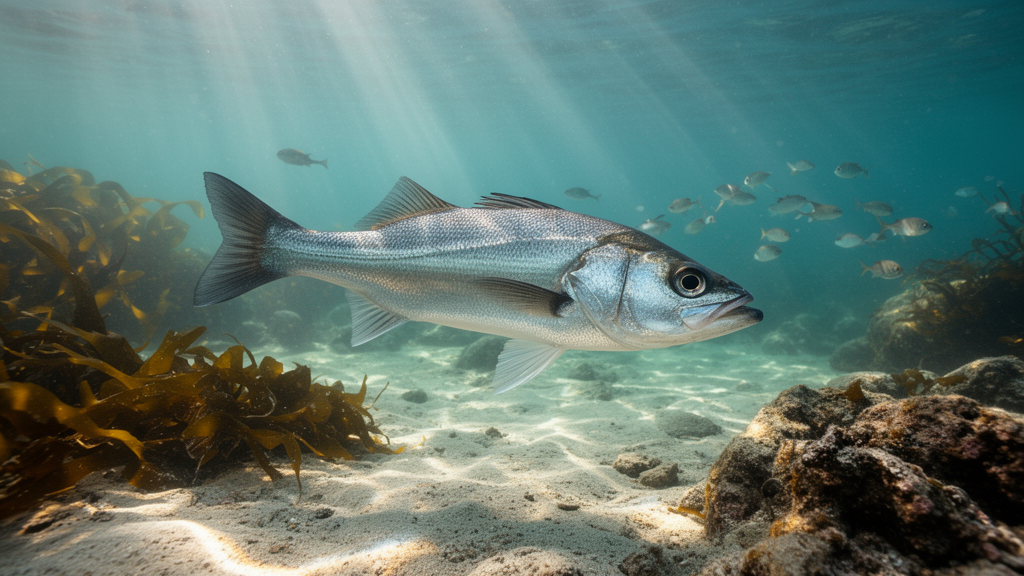
Japanese seabass collected in southwestern Korean waters consumed predominantly teleost fish, with their diets and estimated feeding intensity varying by body size and reproductive period. An observational stomach-content study reported that fish represented 70.5% frequency of occurrence, 74.3% of prey numbers, 91.9% of wet weight and 92.8% of the index of relative importance in Lateolabrax japonicus. The researchers described the population as mainly generalized in feeding strategy, while individual fish showed some specialization.
The researchers collected 340 Japanese seabass monthly from January through December 2020 in the southwestern waters of Korea, including the western Korea Strait. Most specimens were between 30 and 60 cm in total length, and the full sample ranged from 26.0 to 97.6 cm. Longline, gillnet and handline fishing conducted through routine commercial operations supplied the fish, so the study involved no additional experimental procedures or animal-handling protocol.
After capture, specimens were transported on ice to a laboratory, where total length was measured to the nearest 1.0 mm and body weight to the nearest 1.0 g. All 310 stomachs examined were removed, and their contents were preserved in 5% buffered formalin for at least 24 hours. Prey were identified under a dissecting microscope to the lowest feasible taxonomic level, with some poorly digested specimens assigned to family or order. Of the 310 stomachs, 134 were empty, an empty-stomach ratio of 43.2%, leaving 176 containing food for dietary analysis.
Among identified fish prey, Engraulis japonicus contributed the greatest wet-weight share at 42.6%. It was followed by Trachurus japonicus at 20.5% and Thryssa kammalensis at 7.3%. Caridean shrimps ranked second as a prey group, with an index of relative importance of 6.8%, and included Crangon affinis and Penaeus chinensis. Brachyuran crabs, euphausiids, stomatopods and cephalopods were also consumed, but each had an index of relative importance below 0.2%. The estimated trophic level based on the TROPH calculation was 4.42 ± 0.79.
Diet composition changed markedly across body-size classes. Teleosts accounted for 54.6% of prey biomass among fish shorter than 40 cm and 98.1% among those longer than 80 cm. In the opposite direction, Caridea contributed 44.6% of biomass in the smallest class and declined to 3.2% in the 60–80 cm class. Estimated trophic level also rose with size, from 4.10 ± 0.51 for fish below 40 cm to 4.48 ± 0.79 for those above 80 cm. These observations support an ontogenetic transition from greater reliance on shrimps among smaller fish to predominantly piscivorous diets among larger fish.
Reproductive period was associated with both prey composition and stomach fullness. Teleosts represented 85.2% of prey biomass during the non-spawning period from April through September and 96.2% during the spawning period from October through March, while Caridea represented 12.3% and 3.6%, respectively. The stomach content index, calculated as stomach-content weight relative to body weight, was lower during spawning, decreasing from 0.64 ± 0.12 in the non-spawning period to 0.35 ± 0.06 in the spawning period. This difference was significant in a one-way analysis of variance (F = 5.76, P < 0.05).
Stomach fullness also differed significantly among size classes (F = 7.14, P < 0.05). Mean values increased from 0.20 ± 0.06 in fish below 40 cm to 0.42 ± 0.08 at 40–60 cm, 0.92 ± 0.20 at 60–80 cm and 1.21 ± 0.63 in fish of at least 80 cm. Because the study was observational, the results associate larger body size and the spawning period with different feeding measures; they do not directly establish why those differences occurred.
Distance-based linear modelling found that diet composition was significantly associated with size class, total length, reproductive season and month, while sex had no significant independent contribution (P = 0.222). A conditional model containing all five predictors explained only 19.1% of the variation in diet, leaving most of the multivariate variation unexplained. A graphical analysis of prey-specific weight abundance and frequency of occurrence indicated a predominantly generalized population-level strategy. Teleosts had a prey-specific weight abundance of 98.3% and an occurrence frequency of 70.5%, while the clustering of other prey near the left axis indicated substantial among-individual variation in resource use.
The analysis provides a one-year baseline for Japanese seabass feeding in the surveyed part of southwestern Korea, but its scope and design limit broader conclusions. The fish came from commercial fishing rather than a controlled experiment, 43.2% of examined stomachs were empty, and dietary analysis was based on 176 non-empty stomachs. The study covered one annual cycle and a defined geographic area, and the explanatory model accounted for less than one-fifth of dietary variation. Within those limits, the findings show a predominantly fish-eating population with size- and season-associated changes in diet, feeding intensity and estimated trophic position, providing baseline information for assessing trophic relationships in Korean coastal waters.
Subject of Research: Feeding ecology, diet composition and trophic position of Japanese seabass in southwestern Korean waters
Article Title: Feeding ecology and strategy of Japanese seabass, Lateolabrax japonicus ( Actinopterygii , Acropomatiformes , Lateolabracidae ), in the southern waters off Korean peninsula
Article References: Kang, D. Y., Park, J. M., Moon, S. Y., & Baeck, G. W. (2026). Feeding ecology and strategy of Japanese seabass, Lateolabrax japonicus (Actinopterygii, Acropomatiformes, Lateolabracidae), in the southern waters off Korean peninsula. Acta Ichthyologica et Piscatoria, 56, 167-176. https://doi.org/10.3897/aiep.56.187895
Image Credits: AI Generated
Keywords: Japanese seabass, Lateolabrax japonicus, feeding ecology, diet composition, piscivory, ontogenetic shift, reproductive season, stomach contents, trophic level, Korean coastal waters, Feeding, ecology
Cite Scienmag News
Daisy Hatcher. (October 20, 2026). Observational stomach-content study links Japanese seabass diet to body size and reproductive season in Korean waters. Scienmag. https://scienmag.com/observational-stomach-content-study-links-japanese-seabass-diet-to-body-size-and-reproductive-season-in-korean-waters/
Daisy Hatcher. "Observational stomach-content study links Japanese seabass diet to body size and reproductive season in Korean waters." Scienmag, 20 October 2026, https://scienmag.com/observational-stomach-content-study-links-japanese-seabass-diet-to-body-size-and-reproductive-season-in-korean-waters/. Accessed 20 October 2026.
Daisy Hatcher. "Observational stomach-content study links Japanese seabass diet to body size and reproductive season in Korean waters." Scienmag. October 20, 2026. https://scienmag.com/observational-stomach-content-study-links-japanese-seabass-diet-to-body-size-and-reproductive-season-in-korean-waters/


