


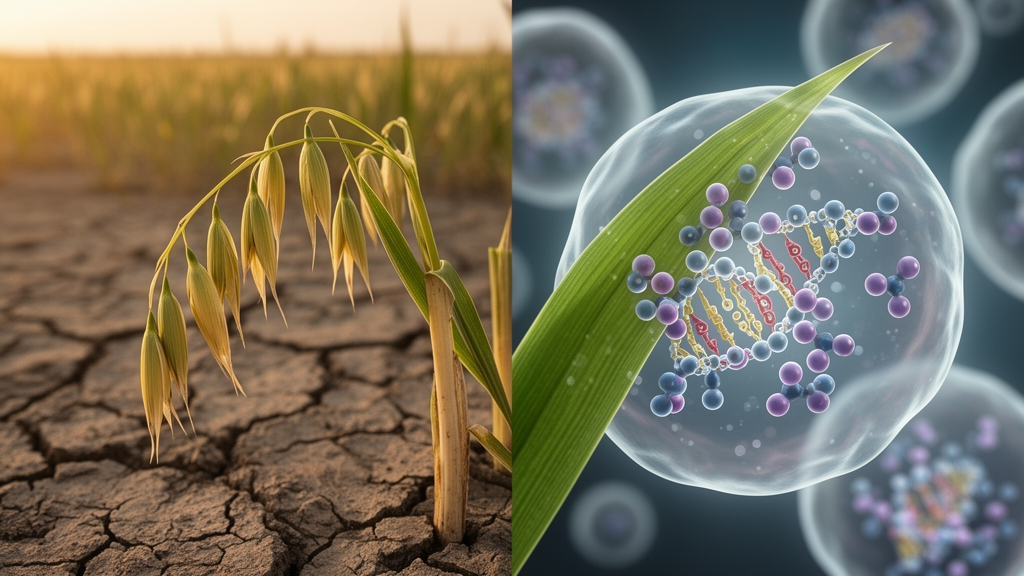
A controlled study of four oat cultivars found that drought-stressed seedlings underwent extensive changes in gene expression affecting carbon metabolism and identified a predicted non-coding RNA regulatory network centered on microRNA miR156. Researchers combined measurements of 21 morphological, physiological and photosynthetic traits with whole-transcriptome sequencing to characterize the response of oat, Avena sativa L., to drought at the seedling stage. The physiological evaluation produced an overall ranking of drought tolerance based on a comprehensive resistance index calculated through principal component analysis.
Zhongyan No.1 showed the highest drought tolerance, followed by Baiyan No.7, Denmark 440 and Longyan No.3. This assessment allowed the researchers to select Zhongyan No.1 for more detailed molecular analysis after comparing the cultivars under controlled drought conditions. Leaves from Zhongyan No.1 seedlings exposed to drought for six days were subjected to whole-transcriptome sequencing.
The analysis identified 10,446 differentially expressed messenger RNAs, 116 differentially expressed long non-coding RNAs, or lncRNAs, and 13 differentially expressed microRNAs, or miRNAs. These findings show broad transcriptional changes associated with drought exposure, but they do not establish which individual changes caused greater drought tolerance or resistance. Functional enrichment analysis connected the drought-responsive transcripts to pathways involved in photosynthetic carbon fixation, starch and sucrose metabolism, glycolysis and gluconeogenesis, and glyoxylate and dicarboxylate metabolism.
The pattern suggests that the molecular response included coordinated reorganization of several carbon-handling pathways rather than a response confined to one metabolic route. It also links the observed drought response to processes in which photosynthesis, carbohydrate metabolism and gene regulation intersect. The researchers additionally constructed a competing endogenous RNA, or ceRNA, network based on predicted lncRNA–miRNA–mRNA relationships.
One drought-responsive module was centered on miR156 and included two lncRNAs, miR156 itself and 11 target messenger RNAs. Although this network is a potentially useful guide for future experiments, its proposed interactions remain predictions. The study did not functionally validate the lncRNA–miRNA–mRNA relationships or show that changing miR156 activity would increase drought resistance.
Accordingly, the miR156-centered module is best viewed as a candidate regulatory structure for further testing rather than an established mechanism of drought adaptation. The research also differs in scope between its physiological screen and its molecular analysis. Physiological data were collected from four cultivars, whereas whole-transcriptome sequencing focused on leaves from the six-day drought treatment in Zhongyan No.1.
The results consequently describe the comparative performance of all four cultivars while providing a detailed transcriptomic view of one cultivar. The broader ranking should not be interpreted as a molecular explanation for every cultivar included in the screen. Overall, the study offers an integrated view of drought responses in oat seedlings by aligning quantitative physiological traits with genome-wide expression data and a predicted regulatory network.
Its findings highlight extensive changes in carbon metabolism and identify non-coding RNA candidates that may help coordinate those responses. The experiment was limited to seedlings under controlled drought conditions, and the inferred regulatory links require direct functional validation before they can be considered dependable targets for molecular breeding.
Subject of Research: Physiological and transcriptomic analysis of drought responses in oat seedlings
Article Title: Integrative physiological evaluation and whole-transcriptome analysis reveal non-coding RNA–associated drought responses in oat (Avena sativa L.)
Article References: Wu, F., Li, Y., Zhang, R., Zhang, J., Zhu, X., Yang, H., Duan, H., Cui, G., & Xu, L. (2026). Integrative physiological evaluation and whole-transcriptome analysis reveal non-coding RNA–associated drought responses in oat (Avena sativa L.). BMC Plant Biology. https://doi.org/10.1186/s12870-026-09808-9
Image Credits: AI Generated
DOI: 10.1186/s12870-026-09808-9
Keywords: oat, drought stress, non-coding RNA, miR156, ceRNA network, whole-transcriptome sequencing, carbon metabolism, photosynthesis, crop resilience, Integrative, physiological, evaluation
Cite Scienmag News
Alan Morgan. (October 26, 2026). Oat drought study identifies predicted miR156-centered RNA network. Scienmag. https://scienmag.com/oat-drought-study-identifies-predicted-mir156-centered-rna-network/
Alan Morgan. "Oat drought study identifies predicted miR156-centered RNA network." Scienmag, 26 October 2026, https://scienmag.com/oat-drought-study-identifies-predicted-mir156-centered-rna-network/. Accessed 26 October 2026.
Alan Morgan. "Oat drought study identifies predicted miR156-centered RNA network." Scienmag. October 26, 2026. https://scienmag.com/oat-drought-study-identifies-predicted-mir156-centered-rna-network/


