


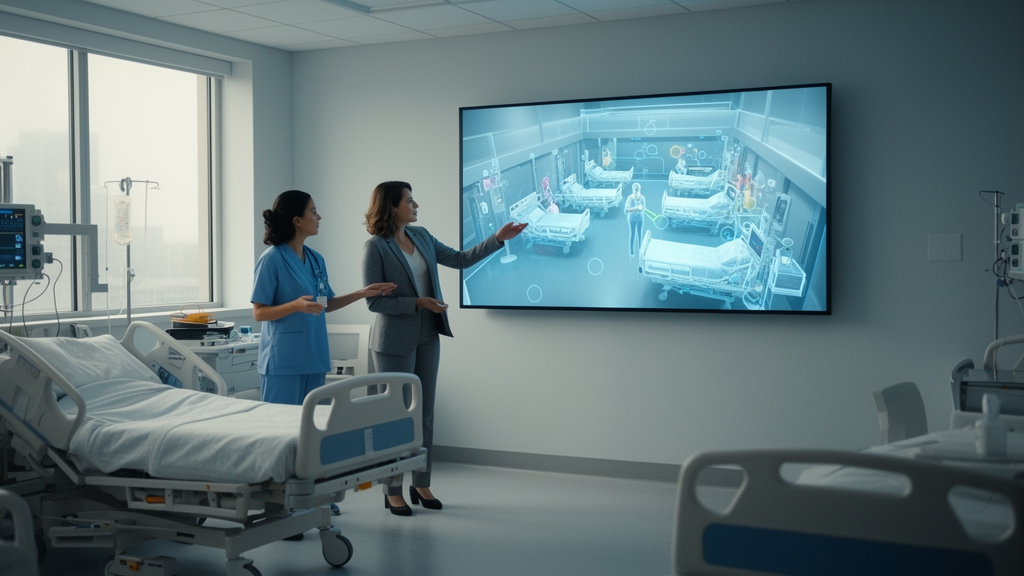
Clinical nurses and nurse leaders in China both report strong demand for digital twin–based ward management systems, but a new cross-sectional survey shows the two groups rank the technology’s potential functions very differently. The study, published in BMC Nursing, surveyed 1,329 nurses across multiple centers between April and August 2025 and used network analysis to map how perceived needs are structured within each role.
Digital twin technology, as described by the researchers, may support intelligent ward management by integrating real-time data, simulation, and decision support. The authors note that clinically useful systems must reflect the priorities of both frontline users and managers, yet evidence comparing these stakeholder perspectives has been limited. Their study set out to compare the two groups’ perceived needs and identify role-specific priority structures.
Participants completed the 15-item Digital Twin-Based Intelligent Ward Management Needs Scale (DT-IWMNS). Of 1,526 eligible nurses, 1,329 provided valid questionnaires: 1,024 clinical nurses and 305 nurse leaders. Clinical nurses recorded a higher mean overall score than nurse leaders, 4.42 (standard deviation 0.71) versus 4.18 (standard deviation 0.75), corresponding to a modest effect size (Hedges’ g = 0.33).
The team then estimated separate regularized Gaussian graphical models for each group to examine how the 15 need items related to one another. The network structures differed significantly between the groups (P < 0.001), while overall global strength — the total density of connections among needs — did not (P = 0.320). In other words, both groups reported similarly intense demand overall, but organized their priorities differently.
Among clinical nurses, the most central needs were patient-condition alerts (standardized strength = 1.13) and workforce optimization (standardized strength = 1.11). For nurse leaders, workforce optimization ranked first (standardized strength = 1.29), followed by ward air-quality monitoring (standardized strength = 1.26). Patient-condition alerts, the top-priority item for frontline nurses, did not appear among the leaders’ most central items.
Network stability was assessed with case-dropping bootstrap procedures. Strength centrality showed acceptable stability in both networks, with correlation stability coefficients of 0.44 for clinical nurses and 0.36 for nurse leaders. Closeness and betweenness centrality were unstable and were not interpreted, a limitation the authors state explicitly.
The pattern of results indicates that the frontline group’s most central items centered on patient-condition alerts and workforce optimization, while the leadership group’s centrality was led by workforce optimization and ward air-quality monitoring. Workforce optimization was highly central in both networks, marking it as the one function with a prominent role in both groups’ priority structures.
The authors conclude that participatory, role-sensitive development should integrate frontline priorities for real-time patient support with managerial priorities for workforce and environmental oversight. A system designed around only one group’s needs, the analysis implies, may leave the other group’s most valued functions underdeveloped.
Important caveats apply. The study measured perceived needs through a self-report survey, not actual system use, and its cross-sectional design captures a snapshot rather than change over time. The authors state that prospective usability and implementation studies are needed before these perceived needs can be translated into claims of clinical effectiveness, and the between-group network comparisons are presented as exploratory.
Even so, the work offers an early, quantified picture of what hospital nursing staff say they want from digital twin technology in ward management — and a reminder that the same ward can look quite different depending on whether it is viewed from the bedside or the manager’s office.
Subject of Research: Perceived needs for digital twin–based ward management systems among clinical nurses versus nurse leaders in China
Article Title: Differences in clinical nurses’ and nurse leaders’ perceived needs for digital twin–based ward management systems: cross-sectional network analysis
Article References: Han, Y., Li, Y., Chan, S. W. C., Qin, L., Jiang, X., & Li, C. (2026). Differences in clinical nurses’ and nurse leaders’ perceived needs for digital twin–based ward management systems: cross-sectional network analysis. BMC Nursing. https://doi.org/10.1186/s12912-026-05555-2
Image Credits: AI Generated
DOI: 10.1186/s12912-026-05555-2
Keywords: digital twin, ward management, nursing, network analysis, cross-sectional survey, clinical nurses, nurse leaders, patient-condition alerts, workforce optimization, air-quality monitoring, China, BMC Nursing
Cite Scienmag News
Ophelia Keating. (October 23, 2026). Nurses and Nurse Leaders Want Digital Twin Wards — But They Prioritize Different Features. Scienmag. https://scienmag.com/nurses-and-nurse-leaders-want-digital-twin-wards-but-they-prioritize-different-features/
Ophelia Keating. "Nurses and Nurse Leaders Want Digital Twin Wards — But They Prioritize Different Features." Scienmag, 23 October 2026, https://scienmag.com/nurses-and-nurse-leaders-want-digital-twin-wards-but-they-prioritize-different-features/. Accessed 23 October 2026.
Ophelia Keating. "Nurses and Nurse Leaders Want Digital Twin Wards — But They Prioritize Different Features." Scienmag. October 23, 2026. https://scienmag.com/nurses-and-nurse-leaders-want-digital-twin-wards-but-they-prioritize-different-features/


