


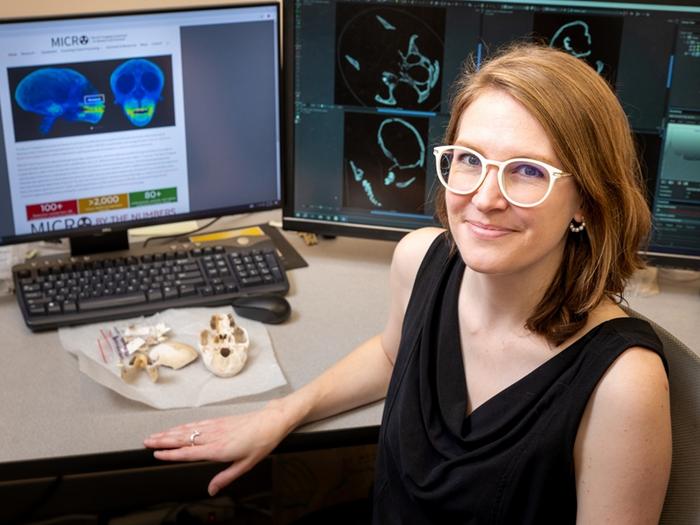
The National Science Foundation awarded $630,444 to Kathleen Paul, an assistant professor of anthropology at the U of A, to provide a comprehensive outline of dental genetic architecture for two primate species of tamarins and macaques.

Credit: University Relations
The National Science Foundation awarded $630,444 to Kathleen Paul, an assistant professor of anthropology at the U of A, to provide a comprehensive outline of dental genetic architecture for two primate species of tamarins and macaques.
Paul’s research team’s ultimate goal is to harness this information to advance bioanthropological practice, including the use of teeth for reconstructing evolutionary processes and experiences of stress and illness.
No live animals will be used in the research. Instead, skeletonized individuals from collections of known lineage will be scanned and studied. These collections contain the teeth and skulls of two long-term monkey colonies, one captive and one free-ranging, enabling the researchers to study changes over generations.
Due to their high mineral content, teeth are relatively abundant in the fossil record. This makes them useful to paleoanthropologists, who can study quantifiable differences in external crown and root surfaces to answer questions about past environments, diets, growth, development and evolution.
But can they be sure they are answering their questions correctly? Not always. In some cases, dental characters have failed to reliably reconstruct evolutionary relationships among humans, their fossil ancestors and their close living primate relatives.
Using images generated at the U of A’s MICRO facility, Paul and her colleagues will take a deeper look into tooth variation. The powerful scanner at MICRO will allow the team to examine crown shape at both the outer enamel and inner dentin surfaces. Pairing these data with relatedness and environmental information from the primate colonies, Paul and her colleagues hope to gain insight into the driving mechanisms of dental variation and how genes are recruited throughout development to influence distinct tooth structures.
“In our teeth, the boundary between the hard enamel that we chew on and the underlying dentin is formed very early in development. Using this unique combination of datasets, we can now explore if and how subsequent developmental events diffuse the genetic signal initially encoded in that enamel-dentin boundary,” Paul explained.
Joining Paul as co-principal investigators are Susan Antón and Alejandra Ortiz, biological anthropology faculty at New York University.
The researchers expect to produce more than 1,000 microCT scans and 3D surface models of skulls and teeth for public access. The researchers will also work with K-12 students in Puerto Rico to teach them about evolution and bones during scheduled visits to the Caribbean Primate Research Center in Puerto Rico.
Paul directs the U of A’s Predental Studies Program, which helps position students for dental school acceptance. As such, the researchers will also use the grant to recruit aspiring dentists and underrepresented/first generation scholars for project roles with the goal of building a more diverse STEM community and the next generation of oral health professionals serving our state.
Cite Scienmag News
Drew Townsend. (May 9, 2024). NSF awards $630,000 to study teeth of non-human primates. Scienmag. https://scienmag.com/nsf-awards-630000-to-study-teeth-of-non-human-primates/
Drew Townsend. "NSF awards $630,000 to study teeth of non-human primates." Scienmag, 9 May 2024, https://scienmag.com/nsf-awards-630000-to-study-teeth-of-non-human-primates/. Accessed 7 September 2026.
Drew Townsend. "NSF awards $630,000 to study teeth of non-human primates." Scienmag. May 9, 2024. https://scienmag.com/nsf-awards-630000-to-study-teeth-of-non-human-primates/

