


WASHINGTON – The U.S. Naval Research Laboratory’s (NRL) Compact Coronagraph (CCOR) was launched June 25, on the National Oceanic and Atmospheric Administration (NOAA) Geostationary Operational Environmental Satellite-U (GOES-U) from NASA – Kennedy Space Center to detect and characterize coronal mass ejections (CMEs).
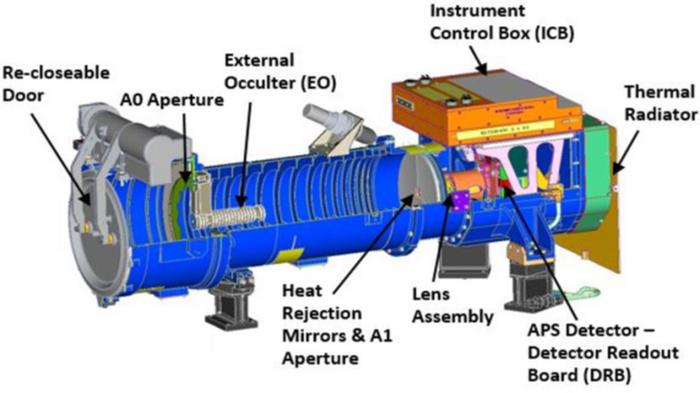
The NOAA sponsored NRL to design, integrate, and test CCOR, a small space telescope that will create an artificial eclipse of the sun and image the solar corona, which is the outer layer of the sun’s atmosphere.
“CMEs are the explosive release of mass and energy from the solar surface and are a primary driver of space weather and play a central role in understanding the conditions in the Earth’s magnetosphere, ionosphere, and thermosphere,” said Arnaud Thernisien, a research physicist from the Advanced Sensor Technology Section within the Space Science Division. “The instrument will be used by NOAA’s Space Weather Prediction Center and the Department of Defense to detect CMEs and will provide an early warning of possible magnetic storms surrounding Earth.”
NRL’s CCOR is the nation’s first operational coronagraph. Operational means that the instrument is tailored to provide low latency observations of the corona, and has some resilience to radiation induced space weather effects. The GOES-R series of Geostationary Operational Environmental Satellite has a Solar Pointing Platform that is dedicated to host solar pointed instruments for space weather monitoring.
“Watching NRL’s CCOR launch into space on the NOAA GOES-U is a testament to our collaborative space efforts and joint capabilities,” said NRL Commanding Officer, Capt. Jesse Black. “I am proud to be a part of an organization dedicated to innovation, and our commitment to scientific progress and national security. The science is important to orbital tracking, radio communications, and navigation that affect the operation of ships and aircraft, utilization of the near-space and space environment of the Earth, and the fundamental understanding of natural radiation and geophysical phenomena.”
The CCOR design has been adapted for the Space Weather Follow On Lagrange 1 (SWFO-L1) satellite, set to launch in 2025, and the Vigil space weather satellite, an international space weather mission led by the European Space Agency (ESA) to launch later in this decade.
About the U.S. Naval Research Laboratory
NRL is a scientific and engineering command dedicated to research that drives innovative advances for the U.S. Navy and Marine Corps from the seafloor to space and in the information domain. NRL is located in Washington, D.C. with major field sites in Stennis Space Center, Mississippi; Key West, Florida; Monterey, California, and employs approximately 3,000 civilian scientists, engineers and support personnel.
For more information, contact NRL Corporate Communications at (202) 480-3746 or nrlpao@us.navy.mil.

Credit: (NASA/NOAA/NRL)
WASHINGTON – The U.S. Naval Research Laboratory’s (NRL) Compact Coronagraph (CCOR) was launched June 25, on the National Oceanic and Atmospheric Administration (NOAA) Geostationary Operational Environmental Satellite-U (GOES-U) from NASA – Kennedy Space Center to detect and characterize coronal mass ejections (CMEs).
The NOAA sponsored NRL to design, integrate, and test CCOR, a small space telescope that will create an artificial eclipse of the sun and image the solar corona, which is the outer layer of the sun’s atmosphere.
“CMEs are the explosive release of mass and energy from the solar surface and are a primary driver of space weather and play a central role in understanding the conditions in the Earth’s magnetosphere, ionosphere, and thermosphere,” said Arnaud Thernisien, a research physicist from the Advanced Sensor Technology Section within the Space Science Division. “The instrument will be used by NOAA’s Space Weather Prediction Center and the Department of Defense to detect CMEs and will provide an early warning of possible magnetic storms surrounding Earth.”
NRL’s CCOR is the nation’s first operational coronagraph. Operational means that the instrument is tailored to provide low latency observations of the corona, and has some resilience to radiation induced space weather effects. The GOES-R series of Geostationary Operational Environmental Satellite has a Solar Pointing Platform that is dedicated to host solar pointed instruments for space weather monitoring.
“Watching NRL’s CCOR launch into space on the NOAA GOES-U is a testament to our collaborative space efforts and joint capabilities,” said NRL Commanding Officer, Capt. Jesse Black. “I am proud to be a part of an organization dedicated to innovation, and our commitment to scientific progress and national security. The science is important to orbital tracking, radio communications, and navigation that affect the operation of ships and aircraft, utilization of the near-space and space environment of the Earth, and the fundamental understanding of natural radiation and geophysical phenomena.”
The CCOR design has been adapted for the Space Weather Follow On Lagrange 1 (SWFO-L1) satellite, set to launch in 2025, and the Vigil space weather satellite, an international space weather mission led by the European Space Agency (ESA) to launch later in this decade.
About the U.S. Naval Research Laboratory
NRL is a scientific and engineering command dedicated to research that drives innovative advances for the U.S. Navy and Marine Corps from the seafloor to space and in the information domain. NRL is located in Washington, D.C. with major field sites in Stennis Space Center, Mississippi; Key West, Florida; Monterey, California, and employs approximately 3,000 civilian scientists, engineers and support personnel.
For more information, contact NRL Corporate Communications at (202) 480-3746 or nrlpao@us.navy.mil.
Cite Scienmag News
Cameron Wolfe. (June 26, 2024). NRL CCOR launches on the GOES-U NOAA satellite to monitor space weather. Scienmag. https://scienmag.com/nrl-ccor-launches-on-the-goes-u-noaa-satellite-to-monitor-space-weather/
Cameron Wolfe. "NRL CCOR launches on the GOES-U NOAA satellite to monitor space weather." Scienmag, 26 June 2024, https://scienmag.com/nrl-ccor-launches-on-the-goes-u-noaa-satellite-to-monitor-space-weather/. Accessed 3 September 2026.
Cameron Wolfe. "NRL CCOR launches on the GOES-U NOAA satellite to monitor space weather." Scienmag. June 26, 2024. https://scienmag.com/nrl-ccor-launches-on-the-goes-u-noaa-satellite-to-monitor-space-weather/

