


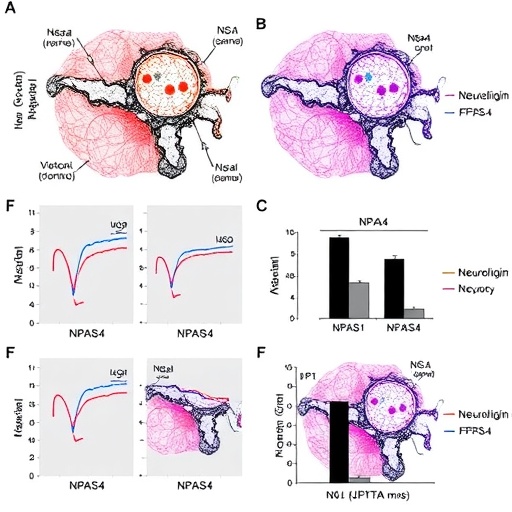
In the rapidly evolving landscape of neuroscience, the transcription factor Npas4 has emerged as a pivotal molecule in understanding the molecular mechanisms underpinning synapse formation and cognitive functions. A groundbreaking study published recently in Translational Psychiatry has unveiled compelling evidence that Npas4 exerts its influence by regulating the transcription of two crucial synaptic adhesion molecules: Neuroligin-1 and N-cadherin. This discovery not only deepens our comprehension of the molecular architecture of synaptic connectivity but also offers promising new avenues for addressing cognitive dysfunction seen in various neurological disorders.
Npas4, a neuronal PAS domain protein, is already known as a key immediate early gene highly responsive to neuronal activity. Its role as a transcription factor means it can regulate the expression of other genes, adjusting neuronal circuits in response to activity changes. However, what remained elusive until this recent investigation was the precise set of target genes and pathways through which Npas4 impacts synaptic assembly and cognitive outcomes. Through meticulous molecular and behavioral analyses, Gui et al. have now illuminated this relationship, highlighting Neuroligin-1 and N-cadherin as critical downstream effectors.
Neuroligin-1 is a postsynaptic cell adhesion protein instrumental in synapse specification and maturation, governing excitatory synaptic transmission and plasticity. Similarly, N-cadherin functions as a classical cadherin well-recognized for its role in synaptic stabilization and the modulation of synaptic strength. Both molecules contribute critically to synaptic architecture and neuronal connectivity, elements essential for cognitive processes such as learning and memory. By demonstrating that Npas4 directly modulates the transcription levels of these vital molecules, the study provides a mechanistic link between neuronal activity, gene expression, and synaptic integrity.
Using a combination of advanced in vivo and in vitro techniques, including chromatin immunoprecipitation and gene expression profiling, the researchers showed that Npas4 binds to regulatory regions within the Neuroligin-1 and N-cadherin gene promoters. This binding enhances their transcription following neuronal activation, indicating a direct regulatory pathway. Moreover, functional assays revealed that perturbations in Npas4 expression lead to corresponding alterations in Neuroligin-1 and N-cadherin levels, and consequently, synaptic density and function.
What makes this finding particularly impactful is the demonstration that modulating Npas4 expression in animal models significantly influences cognitive performance. Behavioral tests assessing memory and learning showed that animals with reduced Npas4 activity displayed marked impairments, correlating with diminished Neuroligin-1 and N-cadherin expression and disrupted synaptic connectivity. Conversely, restoring or enhancing Npas4 activity ameliorated these deficits, underscoring the therapeutic potential of targeting this pathway.
This research elegantly ties the molecular regulation of synaptic adhesion complexes to cognitive function, affirming the concept that transcription factors like Npas4 serve as master regulators orchestrating complex gene networks essential for brain plasticity. The direct control of Neuroligin-1 and N-cadherin expression situates Npas4 at a critical nexus linking neuronal activity-induced gene expression to the physical and functional remodeling of synapses.
The implications of these findings extend beyond basic neuroscience into the realm of neurological and psychiatric disorders. Many cognitive pathologies, including autism spectrum disorders, schizophrenia, and Alzheimer’s disease, are characterized by synaptic dysfunction and altered expression of synaptic proteins. The ability of Npas4 to tune the expression of Neuroligin-1 and N-cadherin suggests that dysregulation of this transcriptional axis may contribute to the synaptic anomalies observed in these conditions.
Furthermore, the study opens new investigative pathways exploring how environmental stimuli and neuronal activity patterns influence Npas4 activity and downstream synaptic gene expression. Since Npas4 is known to be an activity-dependent gene, understanding the dynamics of its regulation could pave the way for behavioral or pharmacological interventions aimed at enhancing cognitive resilience or recovery after injury.
Methodologically, this investigation sets a new standard by combining state-of-the-art molecular biology techniques with comprehensive behavioral analyses, reflecting an integrative approach crucial for unraveling the complex gene-brain-behavior relationships. The use of both loss-of-function and gain-of-function models allowed for a nuanced understanding of the directionality and causality in the role of Npas4.
One particularly fascinating aspect of the research lies in the context-dependent modulation of synaptic properties by Npas4. The researchers observed that Npas4 did not uniformly affect all synapses but appeared to selectively regulate specific subsets, thereby fine-tuning neural circuits for optimal cognitive output. This level of specificity underscores the sophisticated regulatory capacities of transcription factors in the nervous system.
In a broader neuroscientific context, this work adds to the growing recognition that transcription factors can act as molecular convergences where activity-dependent signals translate into long-term structural and functional changes. It supports models of synaptic plasticity not just at the synaptic protein level but also through intricate transcriptional reprogramming.
The translational potential of these findings cannot be overstated. Developing pharmacological agents or gene therapy approaches targeting the Npas4-Neuroligin-1/N-cadherin axis offers an exciting prospect for treating cognitive impairments and synaptopathies. Moreover, as synaptic adhesion molecules are extracellular or membrane-bound proteins, they provide accessible targets for therapeutic modulation.
The study also raises intriguing questions about how other activity-dependent transcription factors might interact with Npas4 or co-regulate synaptic genes, suggesting a complex transcriptional network that finely balances synaptic formation, maintenance, and elimination. Future research aimed at decoding this network could lead to holistic approaches in restoring synaptic health.
In conclusion, the work conducted by Gui and colleagues propels our understanding of how neuronal activity-dependent transcriptional regulation orchestrates synaptic architecture and cognitive function. By establishing Npas4 as a crucial molecular switch regulating Neuroligin-1 and N-cadherin transcription, this study illuminates fundamental mechanisms of brain plasticity with profound implications for neurobiological research and clinical intervention.
As neuroscience strides forward, unraveling such molecular intricacies will be pivotal for developing novel therapeutic strategies that address the root causes of cognitive dysfunction. The Npas4-mediated transcriptional regulation pathway stands as a promising target, inspiring hope for future breakthroughs in treating neuropsychiatric diseases and enhancing human cognitive health.
Cite Scienmag News
Juliet Wilcox. (June 10, 2026). Npas4 Regulates Synaptic Function via Neuroligin-1, N-cadherin. Scienmag. https://scienmag.com/npas4-regulates-synaptic-function-via-neuroligin-1-n-cadherin/
Juliet Wilcox. "Npas4 Regulates Synaptic Function via Neuroligin-1, N-cadherin." Scienmag, 10 June 2026, https://scienmag.com/npas4-regulates-synaptic-function-via-neuroligin-1-n-cadherin/. Accessed 3 September 2026.
Juliet Wilcox. "Npas4 Regulates Synaptic Function via Neuroligin-1, N-cadherin." Scienmag. June 10, 2026. https://scienmag.com/npas4-regulates-synaptic-function-via-neuroligin-1-n-cadherin/


