


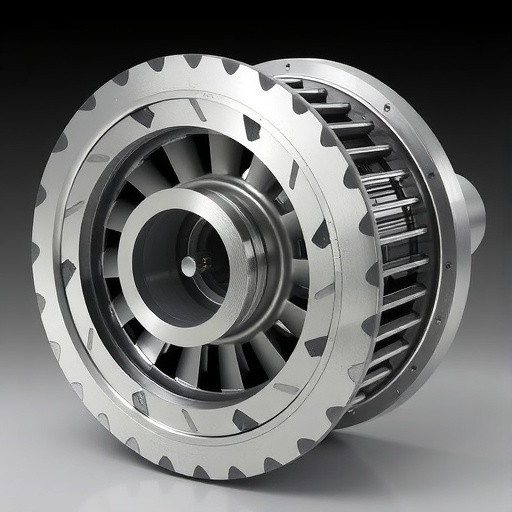
A new study has identified a potentially powerful way to make transonic compressor rotors more stable by reshaping one of the most turbulent regions inside an aircraft engine. Researchers A.H. Ahadifard and H. Khaleghi report that a novel slotted circumferential groove, designed to create its own internal flow-recirculation pathway, can improve the operating stability of a transonic compressor rotor. The work, published in Scientific Reports, focuses on a problem that engineers have been wrestling with for decades: how to extract more performance from compact, high-speed compressors without pushing them into dangerous flow breakdown.
Compressors are the aerodynamic heart of gas-turbine engines. Before fuel can be burned, the engine must squeeze incoming air to a much higher pressure. In modern aircraft engines, the first stages of compression can operate at transonic speeds, meaning that portions of the airflow move near or beyond the speed of sound. This allows engineers to generate large pressure increases with relatively small components, but it also creates an environment filled with shock waves, separated flow and intense interactions between the rotating blades and the stationary casing. A compressor working close to its limits may suddenly lose its ability to maintain smooth airflow, triggering rotating stall or surge.
Those instabilities are more than an efficiency problem. Rotating stall occurs when large regions of disrupted flow circulate around the annulus of the compressor, while surge can involve violent, system-wide oscillations in pressure and mass flow. Both conditions reduce the compressor’s ability to deliver air to the combustor and can impose severe mechanical and thermal loads on the engine. Designers therefore seek a wide “stable operating margin,” allowing the compressor to function reliably across takeoff, climb, cruise and rapid changes in throttle setting. Any method that expands this margin without significantly increasing weight, complexity or manufacturing cost could have broad implications for aviation and power generation.
The approach examined by Ahadifard and Khaleghi builds on a familiar idea in compressor engineering: modifying the casing above the rotor blade tips. The narrow gap between a rotating blade tip and the surrounding casing is a critical source of aerodynamic loss. High-pressure air tends to leak over the tip from the pressure side of the blade toward the suction side, forming a swirling tip-leakage vortex. In a transonic rotor, that vortex interacts with shock structures near the blade tip and can generate local regions of reversed or highly distorted flow. These disturbances may grow until the entire compressor becomes unstable.
Casing treatments are intended to control that difficult flow region. Conventional circumferential grooves cut into the casing can provide a temporary storage volume for disturbed air and can alter the pressure field near the blade tips. However, a groove that merely captures flow may also introduce additional losses if the air remains trapped or mixes inefficiently with the main stream. The researchers’ concept adds slots to the circumferential groove, creating a more deliberate route for air to move between the groove and the passage above the rotor. This geometry is designed to produce self-recirculation, allowing the casing treatment to redirect air without relying on an external pumping system or a separate active-control device.
The central aerodynamic idea is straightforward but technically important. When the compressor approaches its stability limit, pressure rises downstream and the blade-tip region becomes increasingly vulnerable to flow reversal. A carefully positioned groove and slot arrangement can respond passively to these pressure differences. Some of the disturbed air can enter the cavity, travel through the slotted structure and return to the rotor-tip region in a way that modifies the local momentum and pressure distribution. By influencing the tip-leakage vortex and weakening the conditions that support flow separation, the treatment may delay the onset of rotating stall while preserving the rotor’s ability to produce pressure.
The study is especially relevant because transonic compressors combine several destabilizing mechanisms at once. Shock waves can move as the compressor operating point changes, and their interaction with the boundary layer may cause sudden separation on or near the blade surface. At the same time, the tip-leakage vortex can become stronger, while the narrow clearance between blade and casing leaves little room for disturbances to dissipate. A passive self-recirculating groove could act as a form of aerodynamic shock absorber, smoothing the exchange of energy in this region. Rather than waiting for instability to develop throughout the blade passage, the casing treatment attempts to manage the earliest warning signs close to the tip.
Although the concept is passive, its behavior depends strongly on geometry. The circumferential groove’s depth, width and axial position, together with the size and arrangement of the slots, determine how much air enters the cavity and where it returns. If the passage is too restrictive, the treatment may have little influence on the flow. If it is too open, the groove could increase leakage and reduce pressure ratio or efficiency. The challenge is therefore to create enough recirculation to stabilize the rotor without paying an excessive aerodynamic penalty. This balance is one of the reasons casing treatments must be evaluated through detailed flow analysis rather than judged solely by their appearance or simplicity.
For engine manufacturers, the attraction of such a system lies in its potential combination of effectiveness and mechanical simplicity. Active stability-control systems can use sensors, actuators and fast control algorithms to respond to changing operating conditions, but they add cost, weight and failure modes. A properly designed passive casing treatment has no moving parts and can operate continuously as part of the compressor’s fixed structure. The new study’s self-recirculating design could therefore offer an alternative route to stability enhancement, particularly in applications where reliability, compactness and low maintenance are priorities.
The findings also point toward a broader shift in compressor design: instability may be controlled not only by changing blade shape or reducing tip clearance, but by treating the casing and rotor as a coupled aerodynamic system. The casing is often viewed as a boundary surrounding the rotating machinery, yet its geometry can profoundly influence the pressure waves and vortices that govern compressor performance. By giving that boundary an active aerodynamic role, engineers can create local feedback mechanisms that respond naturally to the flow. The slotted circumferential groove examined in this research represents that philosophy in a practical form, using pressure differences already present inside the compressor to drive the stabilizing circulation.
The implications extend beyond a single rotor configuration. More stable transonic compressors could operate closer to their peak pressure capability, potentially helping engines become smaller, lighter or more efficient for a given thrust requirement. Increased stability may also improve tolerance to disturbances such as changes in inlet flow, atmospheric conditions or rapid power commands. However, transferring the concept from numerical or laboratory studies to an operational engine will require further investigation. Researchers will need to examine performance across a broad range of speeds, pressure ratios and inlet conditions, while also assessing manufacturing tolerances, structural durability, acoustic effects and the treatment’s behavior under foreign-object damage or long-term wear.
What makes the research newsworthy is the possibility that a relatively small change in the casing could influence one of the most consequential limits in high-speed propulsion. Compressor instability is often associated with dramatic, system-wide behavior, but its origins can lie in a tiny region near the blade tip, where shocks, vortices and reversed flow interact within millimeters. The proposed slotted groove targets that hidden zone directly. If future experiments and engine-scale demonstrations confirm the predicted benefits while keeping efficiency losses low, self-recirculating casing treatments could become an important tool for designing safer, more flexible and more capable transonic compressors.
Cite Scienmag News
Ophelia Keating. (August 12, 2026). Novel slotted circumferential groove with self-recirculation boosts transonic compressor rotor stability. Scienmag. https://scienmag.com/novel-slotted-circumferential-groove-with-self-recirculation-boosts-transonic-compressor-rotor-stability/
Ophelia Keating. "Novel slotted circumferential groove with self-recirculation boosts transonic compressor rotor stability." Scienmag, 12 August 2026, https://scienmag.com/novel-slotted-circumferential-groove-with-self-recirculation-boosts-transonic-compressor-rotor-stability/. Accessed 3 September 2026.
Ophelia Keating. "Novel slotted circumferential groove with self-recirculation boosts transonic compressor rotor stability." Scienmag. August 12, 2026. https://scienmag.com/novel-slotted-circumferential-groove-with-self-recirculation-boosts-transonic-compressor-rotor-stability/


