


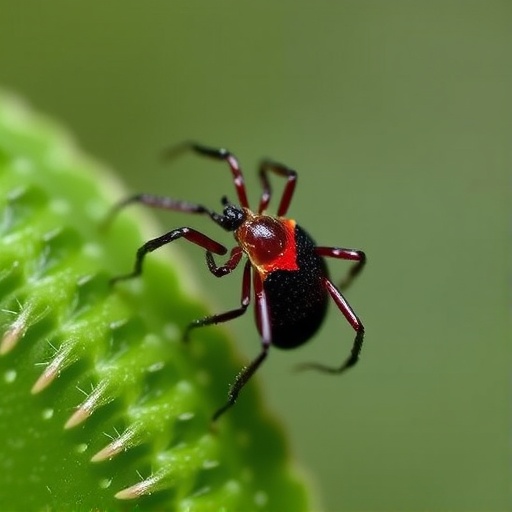
A groundbreaking advance in the battle against Lyme disease is poised to transform public health measures by shifting the frontline defense away from direct human intervention toward environmental management. Scientists at The University of Texas at San Antonio have developed an innovative, non-toxic biologic product designed to be accessible via everyday retail outlets such as big-box and home improvement stores. This pioneering technology promises to redefine how Lyme disease prevention is approached, focusing on interrupting the pathogen’s transmission cycle at its ecological roots.
Unlike traditional strategies that concentrate on vaccinating humans or domestic animals, the UT San Antonio research team, spearheaded by Professor Janakiram Seshu, targets the small mammal populations that serve as reservoir hosts for Borrelia burgdorferi, the bacterial agent responsible for Lyme disease. These hosts, which include wildlife like squirrels, chipmunks, and white-footed mice, perpetuate the bacterial cycle by infecting tick populations. The team’s philosophy revolves around cleansing this reservoir of pathogens to prevent ticks from acquiring the bacteria in the first place, effectively curtailing the spread to humans and pets.
Central to this breakthrough is a nuanced understanding of how Borrelia burgdorferi interacts with the immune systems of its mammalian hosts. The researchers have zeroed in on specific surface lipoproteins expressed by the bacterium that facilitate its survival in the host environment. These lipoproteins also trigger immune responses that can block the transmission of the pathogen to feeding ticks. Capitalizing on this mechanism, the team developed pathogen-derived biologics—essentially oral vaccines—administered through bait that stimulates a protective immune response in these wildlife hosts. This intervention equips the small mammals’ immune systems to suppress bacterial loads, disrupting the pathogen’s natural life cycle.
Assistant Professor of Research Venkatesh Kumaresan highlights the technology’s efficacy, noting that their lipoprotein-based vaccine candidates significantly reduce the bacterial burden not only in the wildlife hosts but also within tick populations. Such dual-action immunization illustrates a vital point: diminishing the reservoir host’s bacterial load translates directly into fewer infected ticks, thereby lowering the incidence of Lyme disease in human populations. This represents a paradigm shift, as efforts now pivot to environmental “herd immunity” rather than direct clinical prophylaxis.
Lyme disease currently affects an estimated 476,000 individuals annually in the United States alone, according to the Centers for Disease Control and Prevention (CDC). Its symptoms range from flu-like manifestations to chronic conditions such as arthritis, which can persist long after standard antibiotic treatments. The societal burden of Lyme disease underscores the urgency for innovative preventive solutions that can be deployed at scale and with minimal risk to non-target organisms or the environment.
The first commercial iteration of the technology is envisioned as non-toxic bait pellets, formulated for residential and garden use. These pellets are designed for voluntary consumption by local small mammals, which upon ingestion, acquire an immune bolstering dose of the biologic. By reducing the bacterial colonization within these animals, the pellets effectively lower the probability that feeding tick larvae—which are born free of Borrelia—become infected. This strategic immunization approach was validated through preclinical trials that demonstrated a drastic reduction in bacterial loads, from as high as 100,000 units down to nearly 100, effectively severing pathogen transmission to humans and other non-infected animals.
Researchers are already setting their sights beyond Lyme disease to develop formulations capable of neutralizing a broader spectrum of tick-borne pathogens. Given that ticks can harbor and transmit up to seven different infectious agents simultaneously, future versions of these biologic pellets could provide holistic protection against multiple co-infections. This multi-pathogen targeting approach is vital to addressing the increasingly complex epidemiology of tick-borne illnesses and enhancing the protective efficacy of the intervention.
The project also serves as an invaluable training ground for doctoral students engaged in cutting-edge molecular microbiology and immunology research. PhD candidate Jolie Starling, for instance, is at the forefront of efforts to expand the vaccine’s scope to include protection against multiple simultaneously transmitted tick-borne diseases. Her work—focused on understanding and countering triple-infection scenarios—represents a crucial step toward developing comprehensive bio-intervention strategies that reflect the multifaceted nature of tick-borne disease ecology.
This hands-on research experience offers aspiring scientists a unique opportunity to participate fully in the entire continuum of scientific innovation, from discovery and lab-based experimentation to the invention and commercialization necessary for real-world application. Professor Seshu emphasizes the importance of involving students in every phase of this process, thereby preparing the next generation of leaders in biotechnology, public health, and related sectors to deliver impactful solutions to complex infectious disease challenges.
To protect their intellectual property and facilitate commercialization, the UT San Antonio team has filed a provisional patent application covering the developed biologics. They anticipate that, following rigorous safety and efficacy evaluations, the initial non-toxic pellet products will be available to consumers within a few years. This timeline marks an encouraging step toward enabling widespread adoption of environmentally based Lyme disease prevention tools at the community level.
The implications of this advancement are profound. By shifting the paradigm from treating symptoms post-infection to preventive intervention at the ecological source, researchers are harnessing immunological insights to break the chain of transmission more effectively. This approach not only promises to reduce the incidence of Lyme disease but also offers an ecological model for managing other vector-borne diseases through environmentally targeted biologic strategies.
As Lyme disease continues to confer significant public health burdens, including long-lasting chronic symptoms and substantial medical costs, innovations such as those emerging from UT San Antonio provide a hopeful glimpse into the future of disease control. With ongoing research aimed at expanding the technology’s protective breadth and improving its user accessibility, communities could soon have a new, powerful ally in the struggle against tick-borne illnesses — one that acts decisively within the natural reservoirs long before pathogens reach humans.
News Publication Date: Not provided.
Web References: https://www.cdc.gov/lyme/data-research/facts-stats/index.html; https://sciences.utsa.edu/stceid/labs/janakiram-seshu/
References: Not provided.
Cite Scienmag News
Kristina Jarvis. (July 1, 2026). Non-Toxic Lyme Disease Protection May Soon Be a Common Purchase. Scienmag. https://scienmag.com/non-toxic-lyme-disease-protection-may-soon-be-a-common-purchase/
Kristina Jarvis. "Non-Toxic Lyme Disease Protection May Soon Be a Common Purchase." Scienmag, 1 July 2026, https://scienmag.com/non-toxic-lyme-disease-protection-may-soon-be-a-common-purchase/. Accessed 3 September 2026.
Kristina Jarvis. "Non-Toxic Lyme Disease Protection May Soon Be a Common Purchase." Scienmag. July 1, 2026. https://scienmag.com/non-toxic-lyme-disease-protection-may-soon-be-a-common-purchase/


