


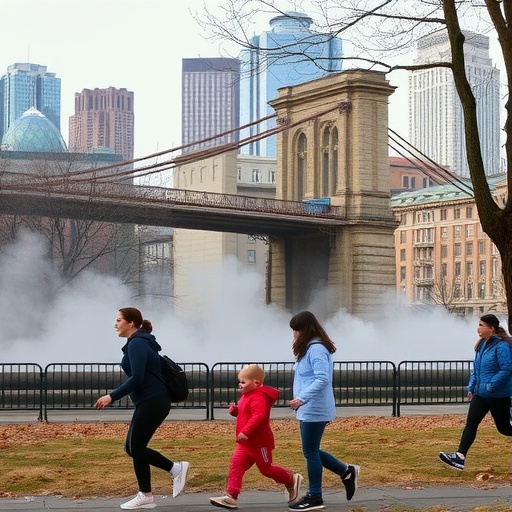
In a groundbreaking study that shines a light on urban pollution, researchers have delved into the troubling exposure levels of nitrogen dioxide (NO₂) in children’s parks during high pollution events. The study, led by prominent scientists including Simón-Moral, Herranz-Pascual, and Padró, highlights the importance of addressing air quality, especially in areas designed for children’s recreation. Parks serve as essential spaces for children’s physical activity and social interaction, yet their proximity to pollution sources often raises concerns about the quality of the air that young ones breathe. The findings reveal alarming insights that are critical for parents, city planners, and policymakers alike.
According to the research, urban parks, often situated near busy streets and industrial areas, are not immune to the influx of harmful pollutants. NO₂ is a toxic gas resulting primarily from vehicular emissions and industrial activities. It persists in urban environments, becoming concentrated in areas where children play. Given the vulnerability of children, who are still developing both physically and cognitively, understanding their exposure during high pollution events is of utmost importance. Through advanced mesoscale simulations, the researchers created rigorous models that showcased NO₂ concentrations in children’s parks during peak pollution periods.
The ramifications of this study extend beyond mere statistics. The implications are wide-ranging, affecting public health policies, environmental standards, and urban planning strategies. The researchers observed that during high pollution days, NO₂ levels in some parks exceeded safe thresholds, underscoring the need for immediate attention. This not only raises questions about the safety of these recreational spaces, but it also challenges city officials to consider alternative site locations for parks and recreational areas. It emphasizes the urgency of integrating environmental health into urban design.
In terms of methodology, the research employed state-of-the-art environmental simulation tools to monitor NO₂ levels effectively. By refining the mesoscale simulations, researchers were able to capture variations in pollution caused by geographical and meteorological factors. This approach provided a nuanced understanding of how air quality can fluctuate dramatically within short time spans, posing greater risks to children.
The alarming findings draw attention to the need for improved air quality monitoring systems in urban environments. Current protocols often fail to accurately assess pollution within local parks and recreational zones, leaving a troubling gap in safeguarding public health. Moreover, this lack of data hampers the ability of policymakers to enact regulations that protect vulnerable populations, particularly children. The authors argue for the establishment of robust monitoring networks that can provide real-time data on air quality, ensuring that parents are informed about potential hazards in their environments.
The study also delivers a critical message about community awareness and education. Parents and guardians must be made aware of the potential air quality risks that their children face while playing in parks. By fostering a community dialogue around air quality, parents can advocate for better environmental policies while also taking proactive measures to limit their children’s exposure to pollution. Simple actions, such as choosing to visit parks during times of lower traffic or when pollution is less prominent, can have meaningful impacts on children’s health.
Furthermore, the implications for urban planning are profound. City planners and architects must prioritize environmental health when designing urban spaces. Integrating greenery, improving public transportation, reducing vehicle emissions, and strategically locating parks away from major pollution sources are some critical strategies that can mitigate these dangers. By creating a multi-faceted approach involving policymakers, environmental scientists, and community members, cities can forge a path towards cleaner air and healthier environments.
Interestingly, the study also indicates that local governance plays a significant role in implementing effective air quality interventions. Cities that adopt stringent air quality regulations tend to exhibit lower incidences of pollution-related health problems among children. This correlation suggests that political will is essential for enacting changes that prioritize public health, reinforcing the notion that cleaner air is a fundamental right for all citizens, especially the vulnerable youth.
As public awareness of environmental issues grows, the need for advocacy around children’s health and safety becomes increasingly paramount. Educating the public about the risks associated with pollution, and particularly NO₂, is crucial. Public health campaigns should focus on not only raising awareness but also providing actionable steps for families to minimize their children’s exposure during high pollution days.
The authors of this study ultimately call for a united front—a coalition of scientists, municipal leaders, and community organizers—to take decisive action toward improving air quality in urban settings. The complexities of air pollution require collaborative solutions that span multiple disciplines and sectors. The integration of technology, data analysis, and community engagement can lead to innovative solutions that create cleaner, safer environments for children.
In conclusion, the study on NO₂ exposure in children’s parks during high pollution episodes is a clarion call for action. It brings to light the urgent need for improved air quality monitoring, community empowerment, and strategic urban planning to protect the health of future generations. As the world continues to confront the multifaceted challenges of climate change and urbanization, understanding and addressing the pollution crisis must remain at the forefront of public health discussions. Only by uniting efforts across sectors can society hope to realize a vision of clean air and safe recreation for all.
Simón-Moral, A., Herranz-Pascual, K., Padró, A. et al. Exposure to NO2 in children’s parks during a high pollution episode based on mesoscale simulations.
Environ Monit Assess 197, 1171 (2025). https://doi.org/10.1007/s10661-025-14576-4
Cite Scienmag News
Russell Cooper. (October 3, 2025). NO2 Levels Skyrocket in Children’s Parks During Pollution Event. Scienmag. https://scienmag.com/no2-levels-skyrocket-in-childrens-parks-during-pollution-event/
Russell Cooper. "NO2 Levels Skyrocket in Children’s Parks During Pollution Event." Scienmag, 3 October 2025, https://scienmag.com/no2-levels-skyrocket-in-childrens-parks-during-pollution-event/. Accessed 4 September 2026.
Russell Cooper. "NO2 Levels Skyrocket in Children’s Parks During Pollution Event." Scienmag. October 3, 2025. https://scienmag.com/no2-levels-skyrocket-in-childrens-parks-during-pollution-event/


