


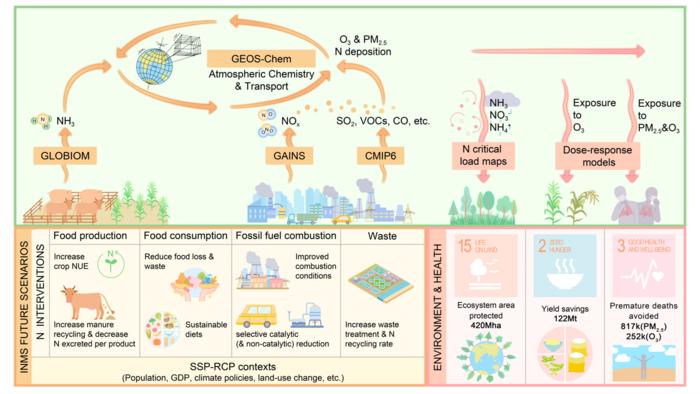
The Earth’s nitrogen cycle is among the most heavily exceeded planetary boundaries. Agricultural production and fossil fuel burning release nitrogen pollutants like ammonia (NH3), nitrogen oxides (NOx), and nitrous oxide (N2O), which contribute to air pollution and damage ecosystems. These pollutants harm human health, crops, and ecosystems. Given the growing global energy and food demand, this damage is expected to increase even further.

Credit: Guo Y., Zhao H., Winiwarter W., Chang J., Wang X., Zhou M., Havlik P., Leclere D., Pan D., Kanter D., Zhang L. (2024) Aspirational Nitrogen Interventions Accelerate Air Pollution Abatement and Ecosystem Protection, Science Advances, doi.org/10.1126/sciadv.ado0112.
The Earth’s nitrogen cycle is among the most heavily exceeded planetary boundaries. Agricultural production and fossil fuel burning release nitrogen pollutants like ammonia (NH3), nitrogen oxides (NOx), and nitrous oxide (N2O), which contribute to air pollution and damage ecosystems. These pollutants harm human health, crops, and ecosystems. Given the growing global energy and food demand, this damage is expected to increase even further.
The potential of nitrogen pollution mitigation technologies and policies – so-called “nitrogen interventions” – for improving air quality and reducing impacts on ecosystems, has been underexplored. A gap exists between traditional nitrogen budget research, which tracks nitrogen flows across air, water, and soil, but lacks detail on biogeochemical transformations, and Earth science research, which models these transformations but usually focuses on a single environmental medium.
To address this knowledge gap, an international research team combined multidisciplinary methods to evaluate how nitrogen interventions could improve air quality and reduce nitrogen deposition. Their study, published in Science Advances, found that interventions, such as improving fuel combustion conditions, increasing agricultural nitrogen use efficiency, and reducing food loss and waste, could significantly lower premature deaths attributed to air pollution, crop losses, and ecosystems risks. While typically considered for individual goals like air or water quality, recognizing the broad co-benefits of nitrogen management is critical for future policy design and effective pollution control.
“We established an integrated assessment framework combining future nitrogen policy scenarios with integrated assessment models, air quality models and dose-response relationships to assess how ambitious measures can reduce air pollution and ecosystems damage at detailed geographic levels,” explains lead author Yixin Guo, a postdoctoral researcher jointly appointed by Peking University and IIASA.
The study shows that by 2050, high-ambition nitrogen interventions could cut global ammonia and nitrogen oxides emissions by 40% and 52%, respectively, compared to 2015 levels. This would reduce air pollution, preventing 817,000 premature deaths, lower ground-level ozone concentrations, and cut crop yield losses. Without these interventions, environmental damage will worsen by 2050, with Africa and Asia being affected the most. On the other hand, should those measures be implemented, Africa and Asia would benefit from them the most.
“We found that nitrogen interventions offer increasing benefits over time, with greater effects by 2050 than by 2030. The biggest reductions in ammonia and nitrogen oxides are expected in East and South Asia, mainly through improved crop practices and technology adoption in industrial sectors. These reductions will help lower air pollutions levels, making it easier for many regions to achieve the World Health Organization interim targets. Additionally, as populations grow, the health benefits of these interventions will increase, especially in developing areas,” adds Yixin.
“Our results highlight that nitrogen interventions can significantly help achieve multiple SDGs, including Good Health and Well-being (SDG3), Zero Hunger (SDG2), Responsible Consumption and Production (SDG12), and Life on Land (SDG15),” says Lin Zhang, a study coauthor and tenured associated professor at Department of Atmospheric and Oceanic Sciences at Peking University.
“This collaborative research shows how IIASA research can be rolled out globally. Solutions for environmental impacts will vary by region, enabling customized policy recommendations, even for complex issues like nitrogen pollution,” concludes Wilfried Winiwarter, a study coauthor and senior researcher in the Pollution Management Research Group of the IIASA Energy, Climate, and Environment Program.
Reference:
Guo Y., Zhao H., Winiwarter W., Chang J., Wang X., Zhou M., Havlik P., Leclere D., Pan D., Kanter D., Zhang L. (2024) Aspirational Nitrogen Interventions Accelerate Air Pollution Abatement and Ecosystem Protection, Science Advances, https://doi.org/10.1126/sciadv.ado0112.
Researcher contacts:
Yixin Guo
Postdoctoral researcher jointed between Peking University and IIASA
Now tenure-track assistant professor at Earth, Ocean and Atmospheric Sciences Thrust of Hong Kong University of Science and Technology (Guangzhou)
yixinguo@hkust-gz.edu.cn
Jinfeng Chang
Guest Research Scholar
Integrated Biosphere Futures Research Group
Biodiversity and Natural Resources Program
changj@iiasa.ac.at
Wilfried Winiwarter
Senior Research Scholar
Pollution Management Research Group
Energy, Climate, and Environment Program
winiwart@iiasa.ac.at
Press Officer
Bettina Greenwell
IIASA Press Office
Tel: +43 2236 807 282
greenwell@iiasa.ac.at
About IIASA:
The International Institute for Applied Systems Analysis (IIASA) is an international scientific institute that conducts research into the critical issues of global environmental, economic, technological, and social change that we face in the twenty-first century. Our findings provide valuable options to policymakers to shape the future of our changing world. IIASA is independent and funded by prestigious research funding agencies in Africa, the Americas, Asia, and Europe.
Journal
Science Advances
Article Title
Aspirational Nitrogen Interventions Accelerate Air Pollution Abatement and Ecosystem Protection
Article Publication Date
16-Aug-2024
Cite Scienmag News
Ophelia Keating. (August 16, 2024). Nitrogen interventions as a key to better health and robust ecosystems. Scienmag. https://scienmag.com/nitrogen-interventions-as-a-key-to-better-health-and-robust-ecosystems/
Ophelia Keating. "Nitrogen interventions as a key to better health and robust ecosystems." Scienmag, 16 August 2024, https://scienmag.com/nitrogen-interventions-as-a-key-to-better-health-and-robust-ecosystems/. Accessed 5 September 2026.
Ophelia Keating. "Nitrogen interventions as a key to better health and robust ecosystems." Scienmag. August 16, 2024. https://scienmag.com/nitrogen-interventions-as-a-key-to-better-health-and-robust-ecosystems/

