


Microscope images could be obtained much more quickly – rather than one pixel at a time – thanks to a new imaging method for neutral atomic beam microscopes developed by Swansea University researchers. It could ultimately lead to engineers and scientists getting faster results when they are scanning samples.

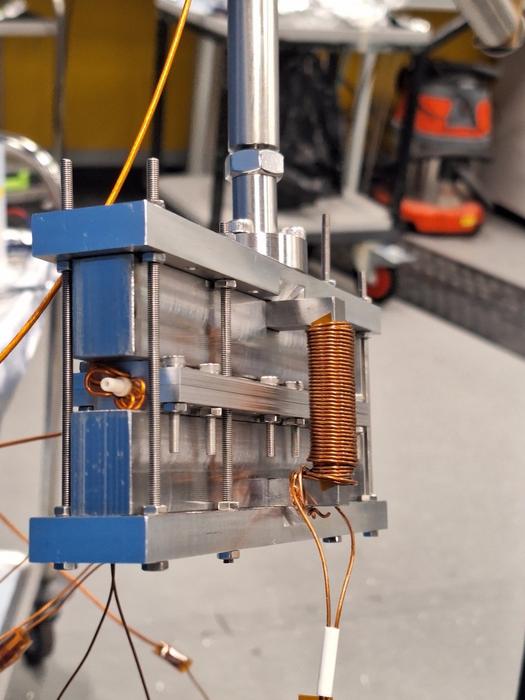
Credit: Morgan Lowe, a PhD student in the Swansea team.
Microscope images could be obtained much more quickly – rather than one pixel at a time – thanks to a new imaging method for neutral atomic beam microscopes developed by Swansea University researchers. It could ultimately lead to engineers and scientists getting faster results when they are scanning samples.
Neutral atomic beam microscopes are a major focus of research interest at present. They are capable of imaging various surfaces which cannot be studied using commercially available microscopes. These could include delicate samples – such as bacterial biofilms, ice films or organic photovoltaic devices – which are difficult to image or which are damaged and altered by electrons, ions and photons.
They work by scattering a beam of low energy neutral particles, usually helium atoms, from a surface to image its structure and composition.
Existing neutral atomic beam microscopes obtain the image by illuminating the sample through a microscopic pinhole. They then scan the position of the sample while recording the scattered beam to build an image.
However, one major limitation of this approach is the imaging time required, as the image is measured one pixel at a time. Improving the resolution by reducing the pin-hole dimension reduces the beam flux dramatically and requires significantly longer measurement time.
This is where the new Swansea University research makes a difference. The research group of Professor Gil Alexandrowicz from the chemistry department have developed a new – and faster – alternative method to pinhole scanning.
They demonstrated the new method using a beam of helium-3 atoms, a rare light isotope of regular helium.
The method works by passing a beam of atoms through a non-uniform magnetic field and using nuclear spin precession to encode the position of the beam particles which interact with the sample.
Morgan Lowe, a PhD student in the Swansea team, built the magnetic encoding device and performed the first set of experiments which demonstrate that the new method works.
The beam profile Mr. Lowe measured compares very well with numerical simulation calculations. The team has also used numerical simulations to show that the new magnetic encoding method should be capable of improving image resolution with a significantly smaller increase in time, in comparison to the currently used pin-hole microscopy approach.
Professor Gil Alexandrowicz of Swansea University chemistry department, lead researcher, explained:
“The method we have developed opens up various new opportunities in the field of neutral beam microscopy. It should make it possible to improve image resolution without requiring forbiddingly long measurement times, and also has the potential for enabling new contrast mechanisms based on the magnetic properties of the sample studied.
In the immediate future the new method will be further developed to create a fully working prototype magnetic encoding neutral beam microscope. This will allow testing of the resolution limits, contrast mechanisms and operation modes of the new technique.
In the more distant future, this new type of microscope should become available to scientists and engineers to characterise the topography and composition of sensitive and delicate samples they produce and/or study.”
The research has been published in the latest issue of the scientific journal Nature Communications.
Journal
Nature Communications
Method of Research
Imaging analysis
Subject of Research
Not applicable
Article Title
Neutral beam microscopy with a reciprocalspace approach using magnetic beam spinencoding
Article Publication Date
15-Aug-2024
COI Statement
Professor Gil Alexandrowicz is the inventor of a patent application submitted by Swansea University that covers the use of magnetic encoding for neutral beam microscopy. The remaining authors declare no competing interests
Cite Scienmag News
Bethany Barker. (August 16, 2024). Faster than one pixel at a time – new imaging method for neutral atomic beam microscopes developed by Swansea researchers. Scienmag. https://scienmag.com/faster-than-one-pixel-at-a-time-new-imaging-method-for-neutral-atomic-beam-microscopes-developed-by-swansea-researchers/
Bethany Barker. "Faster than one pixel at a time – new imaging method for neutral atomic beam microscopes developed by Swansea researchers." Scienmag, 16 August 2024, https://scienmag.com/faster-than-one-pixel-at-a-time-new-imaging-method-for-neutral-atomic-beam-microscopes-developed-by-swansea-researchers/. Accessed 6 September 2026.
Bethany Barker. "Faster than one pixel at a time – new imaging method for neutral atomic beam microscopes developed by Swansea researchers." Scienmag. August 16, 2024. https://scienmag.com/faster-than-one-pixel-at-a-time-new-imaging-method-for-neutral-atomic-beam-microscopes-developed-by-swansea-researchers/

