


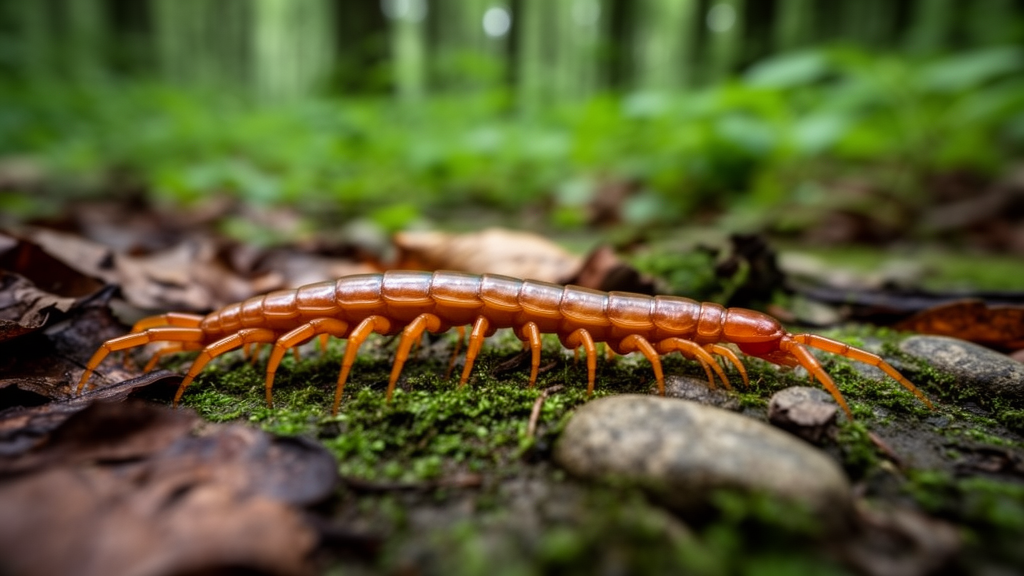
Deep in the leaf litter of the Caucasus, a quiet revolution in biodiversity science is underway. A team of zoologists working across Georgia has added nine centipede species to the country’s known fauna, and three of them had never before been recorded anywhere in the entire Caucasus region. The discovery, published in the journal Caucasiana, lifts the number of centipede species documented in Georgia from 56 to 65, a striking jump for a group of animals that most people never notice, even as it scurries beneath their feet.
Georgia sits at the heart of the Caucasus biodiversity hotspot, one of the most biologically rich and least explored temperate regions on Earth. For two centuries, zoologists have been drawn to its mountains, forests, and river valleys, yet a large share of the country’s animal diversity remains unmapped. Centipedes, predatory arthropods of the class Chilopoda, are a prime example. These many-legged hunters play a crucial role in soil ecosystems, preying on insects and other invertebrates, but their diversity in the South Caucasus has long been underestimated.
The new study is the product of more than a decade of patient fieldwork. Between 2010 and 2023, researchers collected specimens in regions spanning eastern and western Georgia, from the limestone quarries near Mtskheta to the subalpine meadows of Lagodekhi National Park at elevations exceeding 2,300 meters. The team extracted centipedes from sieved leaf litter and topsoil using Winkler extractors, devices that allow small arthropods to migrate out of litter samples as they dry, or gathered them by hand under stones and among forest debris.
Identification demanded careful microscopic work. Specimens were preserved in 96 percent ethanol and examined under compound and stereo microscopes at the Institute of Zoology of Ilia State University in Tbilisi, where the collections are now deposited. The researchers used classical taxonomic keys alongside ChiloKey, an interactive digital identification tool, and validated every species name against Chilobase, the authoritative online database for centipede taxonomy. High-resolution photographs of heads, sternal pores, and posterior segments accompany the study, providing the visual evidence that future taxonomists will need.
Among the nine species newly recorded in Georgia are Henia brevis, Henia hirsuta, and Henia taurica, all soil-dwelling members of the order Geophilomorpha, the long, slender earth centipedes. Henia brevis, originally described from Italy in 1896 and previously known from scattered European localities including Britain, France, Germany, and the Czech Republic, turned up in the Saskhori limestone quarry east of Tbilisi. Henia hirsuta is a far more remarkable case: until now, the species was known only from its original description near Mesolongi in central Greece in 1928, with no confirmed records anywhere else for nearly a century. Its discovery in Lagodekhi National Park and near the village of Bochorma represents a dramatic expansion of its known range.
Henia taurica, first described from the Crimean Peninsula in 1884 and long considered a regional endemic, was later found in Krasnodar, Russia, under stones of deciduous forests. Its presence in western Georgia near the village of Dizi confirms that the species ranges across the Black Sea side of the Caucasus. Two further geophilomorph species, Strigamia caucasia and Strigamia pusilla, also join the Georgian list. Strigamia caucasia was known for decades from a single locality in the western Caucasus of Russia, while Strigamia pusilla stretches from central Europe to Mongolia, and the Georgian record from Lagodekhi’s mixed broadleaf forest at 1,428 meters fills a significant gap in that distribution.
The order Lithobiomorpha, the faster-moving stone centipedes, contributed four new records of its own. Harpolithobius spinipes, a Caucasus endemic previously known from only a handful of Russian localities, proved surprisingly widespread in Georgia, with specimens collected at nine sites ranging from the Colchic humid forests of Mtirala mountain at 450 meters to subalpine meadows near Stepantsminda at 2,280 meters. Lithobius antipai, described from Iran’s Demavend mountain and previously recorded from Russia, Iran, and Azerbaijan, appeared in the broadleaf forests of Lagodekhi. Lithobius foviceps is perhaps the most striking biogeographical lesson: until now it was known solely from its type locality at Kemervan in Azerbaijan, roughly 150 kilometers from the Georgian collection site, making it one of the least documented centipedes in the region.
The ninth species, Lithobius micropodus, is a widespread European lithobiid recorded from Greece, Italy, France, the Balkans, Turkey, and elsewhere, yet it had never been documented in the Caucasus. Two male specimens were found in a subalpine meadow in Lagodekhi National Park at 2,347 meters, marking its first appearance in the region. Together, the three Caucasus-level first records, Henia brevis, Henia hirsuta, and Lithobius micropodus, illustrate how even well-studied European species can remain undetected just beyond the boundaries of decades of faunistic surveys.
The study also sharpened the taxonomic foundation of Georgian centipede science. A recently published checklist had listed 59 subspecies and species, but the new analysis identified inaccuracies, including the incorrect inclusion of Pleurogeophilus caucasicus, which is a junior synonym of Clinopodes caucasicus, a species already known from several Georgian localities. After correcting the record, the baseline count stood at 56 valid species and two subspecies before the nine additions. The researchers also flagged lingering uncertainties, such as the doubtful listing of the greenhouse species Lamyctes coeculus, whose Georgian record cannot be verified and may even refer to the American state of Georgia rather than the country.
Even at 65 species, the authors caution that the true centipede diversity of Georgia is almost certainly higher. The country’s varied landscapes, from humid Colchic lowland forests to arid subalpine meadows, harbor microhabitats that remain unsampled, and many of the new records came from sites visited only once. As molecular tools and intensified field surveys spread through the Caucasus hotspot, taxonomists expect the list to keep growing. For now, the humble centipedes of Georgia have delivered a reminder that some of the planet’s most familiar-seeming animals still hold surprises, hidden in the soil beneath some of its most celebrated mountains.
Subject of Research: New records of centipedes (Myriapoda: Chilopoda) in the fauna of Georgia, South Caucasus
Article Title: New records of centipedes ( Myriapoda : Chilopoda ) in the fauna of Georgia, South Caucasus
Article References: Kiria, E., Mumladze, L., Barjadze, S., & Tuf, I. H. (2024). New records of centipedes (Myriapoda: Chilopoda) in the fauna of Georgia, South Caucasus. Caucasiana, 3, 151-162. https://doi.org/10.3897/caucasiana.3.e130238
Image Credits: AI Generated
DOI: 10.3897/caucasiana.3.e130238
Keywords: records, centipedes, Myriapoda, Chilopoda, fauna, Georgia, South, Caucasus, scientific research
Cite Scienmag News
Margaret Porter. (October 19, 2026). Nine New Centipede Species Recorded in Georgia, Three New to the Caucasus. Scienmag. https://scienmag.com/nine-new-centipede-species-recorded-in-georgia-three-new-to-the-caucasus/
Margaret Porter. "Nine New Centipede Species Recorded in Georgia, Three New to the Caucasus." Scienmag, 19 October 2026, https://scienmag.com/nine-new-centipede-species-recorded-in-georgia-three-new-to-the-caucasus/. Accessed 19 October 2026.
Margaret Porter. "Nine New Centipede Species Recorded in Georgia, Three New to the Caucasus." Scienmag. October 19, 2026. https://scienmag.com/nine-new-centipede-species-recorded-in-georgia-three-new-to-the-caucasus/


