

Sunday, October 25, 2026
Science
No Result
View All Result
  • Login
  • HOME
  • SCIENCE NEWS
  • CONTACT US
  • HOME
  • SCIENCE NEWS
  • CONTACT US
No Result
View All Result
Scienmag
No Result
View All Result
Home Science News Technology and Engineering

NIH-funded project develops unified AI platform for brain imaging analysis

October 25, 2026
in Technology and Engineering
Cassandra Pierce
By Cassandra Pierce Scienmag Editorial Profile - Systems Neuroscience
Reading Time: 3 mins read
0
NIH-funded project develops unified AI platform for brain imaging analysis

NIH-funded project develops unified AI platform for brain imaging analysis

65
SHARES
587
VIEWS
Share on FacebookShare on Twitter
ADVERTISEMENT

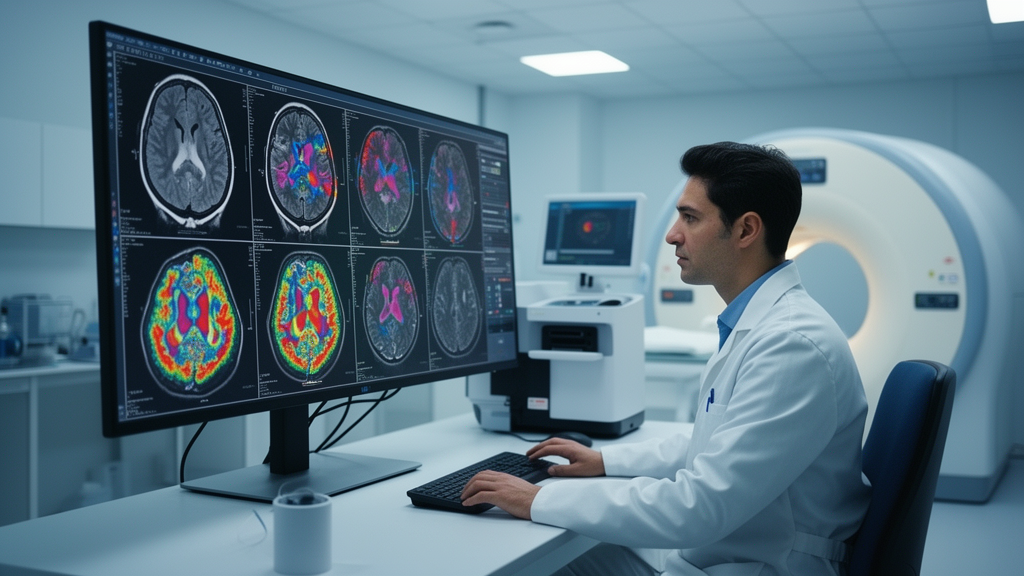
A Lehigh University-led research team has received a four-year, $2.8 million grant from the National Institute of Biomedical Imaging and Bioengineering to develop UniBrain, an artificial-intelligence platform designed to streamline the computational steps used to analyze brain scans. The project aims to unify image preprocessing and downstream brain-network analysis in one system while incorporating complementary information from multiple imaging modalities. Its long-term vision is to let researchers move from raw brain scans to interpretable outputs within a single platform, potentially supporting studies of neurological diseases including Alzheimer’s and Parkinson’s. The grant supports a development program, and the announcement does not report patient outcomes or establish clinical efficacy.

Conventional brain-imaging workflows commonly divide tasks such as image registration, segmentation, feature extraction and disease prediction into separate stages that may require data to be transferred among specialized software packages. The researchers say this process can take weeks or months for large datasets and can be difficult for clinicians and scientists without advanced computational training. UniBrain is intended to address that complexity by combining preprocessing and analysis within a unified framework. According to the team’s preliminary results, a unified deep-learning model made the process more efficient while matching or improving performance relative to conventional workflows. The news release does not provide detailed quantitative comparisons, identify the datasets used or specify the clinical conditions represented in those tests, so the scope of the reported performance remains limited.

The multi-institution project is led by Lifang He, an associate professor of computer science and engineering at Lehigh University. Its principal collaborators are Xiang Li of Massachusetts General Hospital and Harvard Medical School, Carl Yang of Emory University and Liang Zhan of the University of Pittsburgh. The team also includes Lehigh assistant professor Lichao Sun, along with Quanzheng Li, Randy Hirschtick, Daniel Barron, Boadie Dunlop and Ying Ding. According to the university, the collaborators represent fields including artificial intelligence, radiology, neuroscience and bioengineering. Their combined expertise is intended to address brain imaging, data harmonization and clinical validation as UniBrain is designed and developed. He described the project as an effort to create and deploy new AI tools while rethinking the entire neuroimaging analysis process from start to finish, requiring cooperation across several disciplines.

Researchers are also developing an agentic version of UniBrain with a ChatGPT-like interface. In the proposed design, researchers and physicians could upload raw magnetic resonance imaging data, ask questions in plain language and have the system automatically preprocess and analyze the data. The platform would generate interpretable results and reports highlighting imaging biomarkers potentially associated with disease. The investigators say this interaction model could make sophisticated analysis tools more accessible to people without advanced programming expertise and could help researchers identify subtle imaging biomarkers associated with neurological disorders that might otherwise be overlooked. These are proposed capabilities of a system still under development; the announcement describes the intended workflow rather than a completed clinical deployment or independently validated medical decision system. Over the four-year grant period, the team aims to advance toward a unified AI platform that combines raw-scan processing with interpretable research insights, with potential relevance to brain-imaging studies of Alzheimer’s and Parkinson’s disease and other neurological disorders.

Subject of Research: Development of an AI platform for integrated brain-imaging analysis

Article Title: Lehigh-led team developing end-to-end AI platform to streamline brain imaging analysis

Article References: Lehigh-led team developing end-to-end AI platform to streamline brain imaging analysis. Original publication (Bibliographic details unavailable.)

Image Credits: AI Generated

DOI: Not provided

Keywords: brain imaging, neuroimaging, artificial intelligence, MRI analysis, deep learning, NIH grant, Lehigh University, biomedical informatics, Alzheimer’s disease, Parkinson’s disease, Lehigh-led, team

Cite Scienmag News

Cassandra Pierce. (October 25, 2026). NIH-funded project develops unified AI platform for brain imaging analysis. Scienmag. https://scienmag.com/nih-funded-project-develops-unified-ai-platform-for-brain-imaging-analysis/

Cassandra Pierce. "NIH-funded project develops unified AI platform for brain imaging analysis." Scienmag, 25 October 2026, https://scienmag.com/nih-funded-project-develops-unified-ai-platform-for-brain-imaging-analysis/. Accessed 25 October 2026.

Cassandra Pierce. "NIH-funded project develops unified AI platform for brain imaging analysis." Scienmag. October 25, 2026. https://scienmag.com/nih-funded-project-develops-unified-ai-platform-for-brain-imaging-analysis/


Tags: AI platform for Alzheimer’s and Parkinson’s studiesAI-powered brain imaging analysis platformAlzheimer's diseaseArtificial Intelligencebiomedical imaging software developmentbiomedical informaticsbrain imagingcomputational brain network analysisdeep learningdeep learning for neurological disease detectionintegrated brain image preprocessinginterdisciplinary neuroinformatics platformLehigh UniversityLehigh-ledMRI analysismulti-modal brain scan analysisneuroimagingneurological disease research toolsNIH grantNIH-funded brain imaging projectParkinson's diseasestreamlining neuroimaging data processingteamunified neuroimaging workflow
Share26Tweet16
Previous Post

SP1-induced PDRG1 drives hepatocellular carcinoma growth via Wnt/β-catenin signaling

Next Post

Early sowing and smart nitrogen use could soften climate blows to Ethiopian highland wheat

Related Posts

Zebrafish Tectum Integrates Visual and Auditory Threat Cues to Sharpen Escape Decisions
Technology and Engineering

Zebrafish Tectum Integrates Visual and Auditory Threat Cues to Sharpen Escape Decisions

October 25, 2026
Concrete Autoencoder Framework Sharpens Intrusion Detection for SDN-IoT Networks
Technology and Engineering

Concrete Autoencoder Framework Sharpens Intrusion Detection for SDN-IoT Networks

October 25, 2026
Printed liquid-metal electrodes track motion and heart signals
Technology and Engineering

Printed liquid-metal electrodes track motion and heart signals

October 25, 2026
Interpretable machine learning predicts strength of heat-storing microcapsule concrete in external lab tests
Technology and Engineering

Interpretable machine learning predicts strength of heat-storing microcapsule concrete in external lab tests

October 25, 2026
Explainable AI system predicts IT outsourcing success before contracts are signed in Iraq
Technology and Engineering

Explainable AI system predicts IT outsourcing success before contracts are signed in Iraq

October 25, 2026
Body tissue links miniature implants to wearable health devices
Technology and Engineering

Body tissue links miniature implants to wearable health devices

October 25, 2026
Next Post
Early sowing and smart nitrogen use could soften climate blows to Ethiopian highland wheat

Early sowing and smart nitrogen use could soften climate blows to Ethiopian highland wheat

  • Mothers who receive childcare support from maternal grandparents show more optimized

    Mothers who receive childcare support from maternal grandparents show more parental warmth, finds NTU Singapore study

    27656 shares
    Share 11059 Tweet 6912
  • University of Seville Breaks 120-Year-Old Mystery, Revises a Key Einstein Concept

    1061 shares
    Share 424 Tweet 265
  • Bee body mass, pathogens and local climate influence heat tolerance

    682 shares
    Share 273 Tweet 171
  • Researchers record first-ever images and data of a shark experiencing a boat strike

    546 shares
    Share 218 Tweet 137
  • Groundbreaking Clinical Trial Reveals Lubiprostone Enhances Kidney Function

    531 shares
    Share 212 Tweet 133
Science

Embark on a thrilling journey of discovery with Scienmag.com—your ultimate source for cutting-edge breakthroughs. Immerse yourself in a world where curiosity knows no limits and tomorrow’s possibilities become today’s reality!

RECENT NEWS

  • Electromagnetic tracking brings sub-millimeter augmented reality to robotic surgery
  • Early sowing and smart nitrogen use could soften climate blows to Ethiopian highland wheat
  • NIH-funded project develops unified AI platform for brain imaging analysis
  • SP1-induced PDRG1 drives hepatocellular carcinoma growth via Wnt/β-catenin signaling

Categories

  • Agriculture
  • Anthropology
  • Archaeology
  • Athmospheric
  • Biology
  • Biotechnology
  • Blog
  • Bussines
  • Cancer
  • Chemistry
  • Climate
  • Earth Science
  • Editorial Policy
  • Marine
  • Mathematics
  • Medicine
  • Pediatry
  • Policy
  • Psychology & Psychiatry
  • Science Education
  • Science News
  • Social Science
  • Space
  • Technology and Engineering

Subscribe to Blog via Email

Enter your email address to subscribe to this blog and receive notifications of new posts by email.

Join 5,151 other subscribers

© 2025 Scienmag - Science Magazine

Welcome Back!

Login to your account below

Forgotten Password?

Retrieve your password

Please enter your username or email address to reset your password.

Log In
No Result
View All Result
  • HOME
  • SCIENCE NEWS
  • CONTACT US

© 2025 Scienmag - Science Magazine

Discover more from Science

Subscribe now to keep reading and get access to the full archive.

Continue reading