


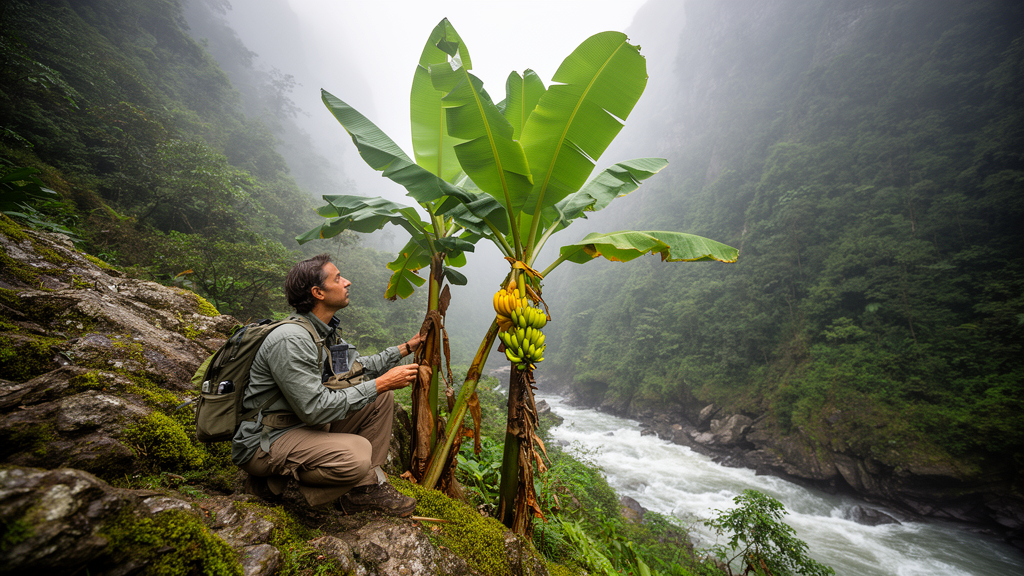
Deep in the forested slopes of the Dulong River valley in northwestern Yunnan Province, China, botanists have identified a wild banana that no one had formally recorded before. The plant, now described as Musa dulongjiangensis in the journal PhytoKeys, stands up to six and a half meters tall and produces dark purple flower bracts and lax bunches of upward-curving fruits. The discovery adds a new branch to the family tree of the genus that gave the world the cultivated banana, and it strengthens a growing picture of the eastern Himalaya as an unexpectedly rich hotspot for wild Musa diversity.
The genus Musa carries extraordinary weight in the history of botany. When Carolus Linnaeus described Musa paradisiaca in his Species Plantarum of 1753, he not only gave scientific names to bananas for the first time but also helped establish the system of botanical nomenclature that governs plant naming to this day. Over the two centuries that followed, the classification of the genus was repeatedly overhauled. In 1893 it was split into three subgenera, and in the late 1940s the botanist Cheesman reorganized it into four sections based on chromosome numbers and morphology: Australimusa and Callimusa with 20 chromosomes, and Musa and Rhodochlamys with 22.
That four-section framework, however, did not survive the molecular era. Studies using AFLP genetic markers uncovered similarities that cut across the traditional groupings, researchers discovered species with unusual chromosome numbers, and molecular phylogenies failed to support the four sections as evolutionarily coherent lineages. In a landmark 2013 revision, Häkkinen consolidated the genus into just two sections: sect. Musa, absorbing the former Eumusa and Rhodochlamys species with a base chromosome number of eleven, and sect. Callimusa, gathering the former Australimusa, Callimusa, and Ingentimusa species with base numbers of ten, nine, or seven. Today, according to the Plants of the World Online database, 86 accepted Musa species grow across the tropics and subtropics of Asia, the Pacific, and Australia.
Southern and southwestern China are among the important centers of that distribution, and Yunnan Province stands out as the most species-rich region in the country. Based on literature records and recent field surveys, at least 30 wild Musa taxa, counting species and varieties, occur naturally in China. These range from widespread ancestors of cultivated bananas such as Musa acuminata and Musa balbisiana to narrow endemics like Musa rubinea, Musa zaifui, and Musa markkuana. The rugged gorges of the Dulong River and the Yarlung Tsangpo River basins, on the southern slopes of the Himalaya, have proven especially productive ground for new discoveries, offering the low-altitude, humid habitats that wild bananas favor.
It was in this landscape, during surveys of Musaceae resources conducted between 2023 and 2025 in Dulongjiang Township of Gongshan County, that researchers encountered a distinctive population of wild banana that could not be matched to any known species. The plants grow on forested slopes at roughly 1,100 meters above sea level along both banks of the Dulong River. After detailed morphological observation of fresh material in its native habitat, together with examination of herbarium specimens held at the Tropical Crops Genetic Resources Institute of the Chinese Academy of Tropical Agricultural Sciences, the team concluded that the population represented an independent new species, which they named Musa dulongjiangensis after its type locality.
The new species is morphologically most similar to Musa puspanjaliae, a relative known from Mêdog County in Xizang, and the two share several broad traits. Both are robust plants with strong pseudostems, both bear pendent inflorescences, and both shed their leaves entirely before the fruits mature. Both also produce relatively large, flattened, irregular seeds with a top width of one centimeter or more. Yet the differences between them are numerous and consistent, spanning virtually every part of the reproductive apparatus, from the bracts and flowers to the structure and orientation of the fruit bunch itself.
The diagnostic details are striking. In Musa dulongjiangensis, the bracts of the female bud are dark purple on the outside and purple within, whereas those of M. puspanjaliae are greenish-yellow or purple. The new species carries six to seven basal female flowers arranged in two rows, compared with thirteen to sixteen in its relative. Its ovaries are pale green and glabrous rather than cream and slightly pubescent, and its compound tepals are three centimeters long with distinct, dense red stripes at the base, against five-centimeter tepals lacking red striping in M. puspanjaliae. The male buds of the new species are not revolute, or rolled back, before the bracts fall, and they are not covered by persistent dry old bracts, unlike those of M. puspanjaliae. The anther lobes are pinkish purple rather than creamy to pale pink.
The fruiting structures differ just as clearly. The bunch of Musa dulongjiangensis is lax, with upward-curving fingers, typically eight hands of six to seven fruits each arranged in two rows, while M. puspanjaliae forms very compact bunches with about fifteen fruits per hand. Individual fruits of the new species are curved, three-ridged, ten to thirteen centimeters long, and borne on clearly developed pedicels of about two centimeters, whereas the fruits of its relative are straight and sessile. The mature peel turns pale yellowish-green with irregular light brown spots and a rough texture. The species flowers mainly from April to August, with fruits ripening from October through the following March, and its seeds are irregularly flattened, wrinkled, and angular, measuring eight to ten millimeters long and twelve to fifteen millimeters wide at the top.
The ecology of the new species reflects the extreme climate of its home. The Dulong River valley lies in a subtropical warm and humid zone where annual precipitation reaches between 2,932 and 4,000 millimeters and relative humidity hovers around ninety percent year-round. Musa dulongjiangensis prefers semi-shaded, highly humid conditions on forested slopes, and it grows alongside two other wild banana species of the same family, Musa chunii and Musa markkuana. Field surveys of M. puspanjaliae in Mêdog County, where that species is abundant in river valleys at elevations of 1,000 meters and below, confirmed that it does not occur in the Dulongjiang area, and no literature record places it there either, reinforcing the distinctness and separation of the two species.
Conservation assessments for the new species are cautiously encouraging but incomplete. The known populations along the Dulong River below 1,300 meters are relatively large in number, and the fruits contain abundant seeds, a favorable trait for population expansion. Moreover, the distribution area falls within the Gaoligong Mountain National Nature Reserve, providing a measure of formal protection. However, because the species’ range likely extends downstream into Myanmar, where extensive surveys have not been possible, the authors recommend assessing it as Data Deficient under the IUCN Red List Categories and Criteria. Beyond its immediate conservation value, the discovery carries broader significance: wild Musa species are the genetic reservoir of the cultivated banana, offering traits such as disease resistance and stress tolerance that breeders increasingly need. The finding adds to mounting evidence that the northern margin of the genus’ natural range harbors far greater diversity than previously thought, and it underscores the case for continued taxonomic research, molecular phylogenetic study, and integrated in situ and ex situ conservation programs across the eastern Himalaya.
Subject of Research: Taxonomic description of a new wild banana species, Musa dulongjiangensis, from Yunnan, southwest China
Article Title: Musa dulongjiangensis ( Musaceae ), a new species from Yunnan, southwest China
Article References: Yang, H.-B., Wang, Q.-L., Wu, Y.-Y., Chen, J.-H., Han, P., Huang, M.-Z., Yuan, L.-X., & Wang, J.-B. (2026). Musa dulongjiangensis (Musaceae), a new species from Yunnan, southwest China. PhytoKeys, 280, 83-91. https://doi.org/10.3897/phytokeys.280.196585
Image Credits: AI Generated
DOI: 10.3897/phytokeys.280.196585
Keywords: Musa dulongjiangensis, wild banana, Musaceae, Yunnan, new species, taxonomy, Dulong River, eastern Himalaya, plant conservation, biodiversity, banana genetics, PhytoKeys
Cite Scienmag News
Margaret Porter. (October 17, 2026). New Wild Banana Species Discovered in China’s Dulong River Gorge. Scienmag. https://scienmag.com/new-wild-banana-species-discovered-in-chinas-dulong-river-gorge/
Margaret Porter. "New Wild Banana Species Discovered in China’s Dulong River Gorge." Scienmag, 17 October 2026, https://scienmag.com/new-wild-banana-species-discovered-in-chinas-dulong-river-gorge/. Accessed 17 October 2026.
Margaret Porter. "New Wild Banana Species Discovered in China’s Dulong River Gorge." Scienmag. October 17, 2026. https://scienmag.com/new-wild-banana-species-discovered-in-chinas-dulong-river-gorge/


